
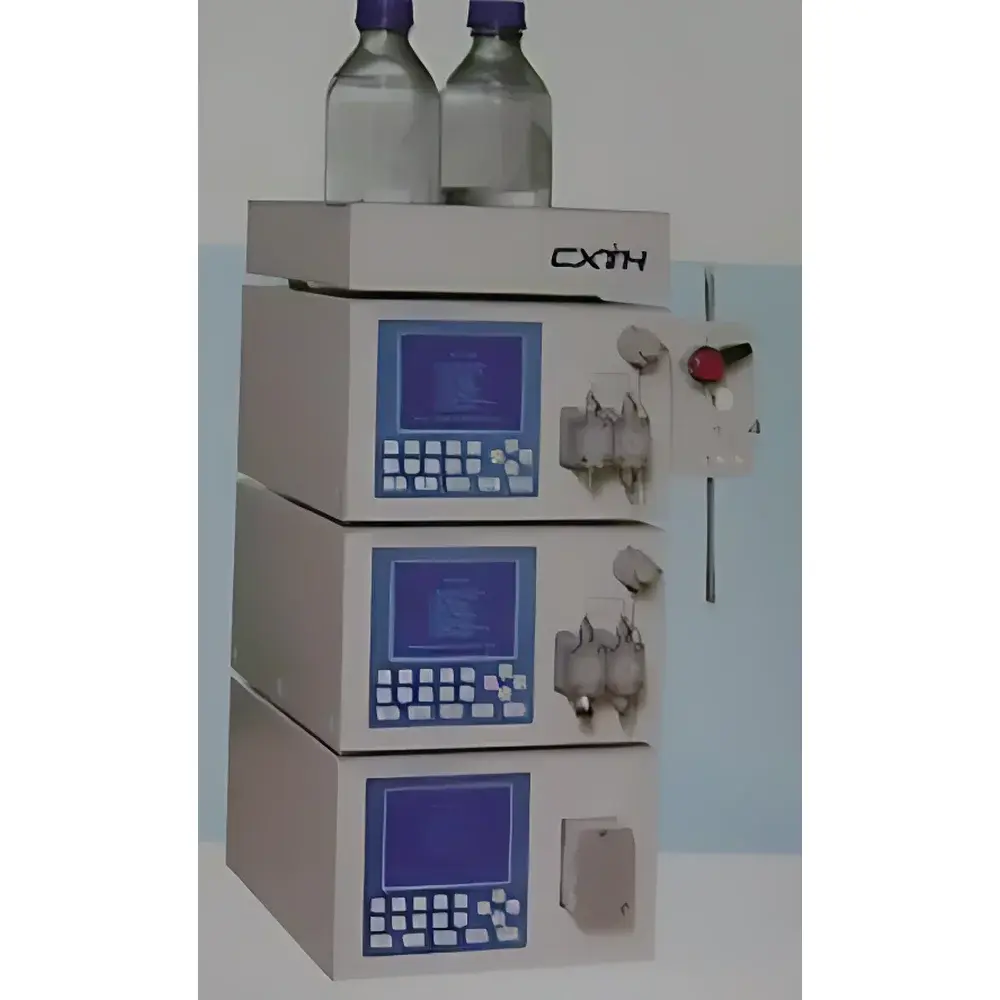
Chu Ding Technology LC3000 Dual-Pump High-Pressure Gradient Liquid Chromatograph
| Brand | Chu Ding Technology |
|---|---|
| Origin | Shanghai, China |
| Model | LC3000 |
| Pump Flow Range | 0.001–9.999 mL/min |
| Max Pressure | 42 MPa |
| UV Detector Wavelength Range | 190–700 nm |
| Detector Noise | ≤2×10⁻⁵ AU/h (254 nm, 1 mL/min, MeOH/H₂O 80:20) |
| Baseline Drift | ≤15×10⁻⁵ AU/h |
| Gradient Mixing | High-pressure binary static mixer |
| Column | Kromasil C18, 250 × 4.6 mm, 5 µm |
| Software | GLP-compliant chromatography workstation with system back-control and audit trail capability |
Overview
The Chu Ding Technology LC3000 is a dual-pump, high-pressure gradient liquid chromatograph engineered for precision, reproducibility, and regulatory compliance in routine analytical laboratories. Built upon classical reversed-phase HPLC architecture, the system employs high-pressure binary gradient elution—where two independently controlled P3000 high-performance solvent delivery units generate precise mobile phase composition profiles via post-column static mixing at pressures up to 42 MPa. This configuration ensures minimal dwell volume, superior gradient accuracy, and robust retention time stability—critical for method transfer between labs and long-term validation under GxP frameworks. The LC3000 is purpose-built for pharmaceutical quality control (QC), clinical research, food safety testing, and environmental analysis where adherence to pharmacopoeial methods (e.g., USP , EP 2.2.46) and internal SOPs is mandatory.
Key Features
- Dual P3000 high-pressure reciprocating piston pumps with independent flow and pressure control, supporting gradient programming with real-time on-screen gradient profile verification.
- UV3000 UV/Vis detector featuring a deuterium lamp (standard) and optional tungsten lamp, delivering wavelength scanning from 190–700 nm with ±2 nm accuracy and programmable scan parameters (start/end points, step size).
- 7725i manual injection valve with integrated 20 µL fixed-loop configuration, compatible with standard 1/8″ stainless steel or PEEK tubing and offering low carryover performance.
- High-pressure binary static mixer enabling homogeneous solvent blending prior to column entry—eliminating low-pressure mixing artifacts and ensuring gradient fidelity across wide flow and viscosity ranges.
- Full-featured chromatography workstation with native Chinese GUI, full system back-control (pump, detector, autosampler interface-ready), electronic signature support, and built-in GLP audit trail logging—including lamp usage hours, lamp replacement history, and instrument serial traceability.
- Pre-installed Kromasil C18 column (250 × 4.6 mm, 5 µm) — a silica-based, endcapped reversed-phase column validated for USP L1 classification and widely used in small-molecule assay development and stability-indicating methods.
Sample Compatibility & Compliance
The LC3000 accommodates a broad range of analytes including small organic molecules, peptides, vitamins, preservatives, residual solvents, and degradation products. Its flow and pressure specifications align with ISO 17025 method validation requirements for precision, linearity, and robustness assessment. The system meets essential elements of FDA 21 CFR Part 11 through its workstation’s user access controls, electronic signatures, and immutable audit trails. All hardware modules comply with IEC 61010-1 for laboratory electrical safety and electromagnetic compatibility (EMC). The UV3000 detector satisfies optical performance criteria outlined in ASTM E260 and EP 2.2.25 for absorbance measurement reliability. Routine operation supports compliance with pharmacopeial monographs requiring gradient HPLC separation under controlled temperature (column oven optional) and documented instrument qualification (IQ/OQ/PQ).
Software & Data Management
The embedded chromatography workstation provides comprehensive data acquisition, processing, and reporting capabilities. It supports peak integration using multiple algorithms (tangent skim, valley-to-valley, perpendicular drop), calibration curve generation (linear, quadratic, weighted), and system suitability calculations per USP guidelines (e.g., resolution, tailing factor, theoretical plates). Raw data files are stored in vendor-neutral formats (e.g., .cdf-compatible structure) and include metadata such as method parameters, detector settings, and hardware status logs. Audit trail records capture all user-initiated actions—including method edits, result deletions, and report approvals—with timestamps, operator IDs, and reason-for-change fields. Data export options include CSV, PDF, and XML for LIMS integration or regulatory submission packages.
Applications
- Pharmaceutical QC: Assay quantification of active pharmaceutical ingredients (APIs), related substances testing, and dissolution profile analysis per USP chapters and .
- Clinical toxicology: Quantitative determination of therapeutic drugs (e.g., digoxin, phenytoin) and metabolites in serum or plasma using protein precipitation or solid-phase extraction sample prep.
- Food & beverage: Detection of synthetic dyes (e.g., Allura Red AC), mycotoxins (aflatoxin B1), and preservatives (sorbic acid, benzoic acid) under EU Regulation (EC) No 1881/2006.
- Environmental monitoring: Analysis of polycyclic aromatic hydrocarbons (PAHs), phthalate esters, and pesticides in water extracts following EPA Method 8330B and ISO 17993.
- Academic research: Method development for natural product isolation, chiral separations (with compatible chiral columns), and stability-indicating forced degradation studies.
FAQ
Does the LC3000 support automated sample injection?
Yes—the system is designed with RS232 and future-ready digital I/O interfaces to integrate seamlessly with third-party autosamplers (e.g., CTI-100 series or equivalent), enabling unattended batch analysis and full sequence control from the workstation.
Is the UV3000 detector compliant with pharmacopeial wavelength accuracy requirements?
Yes—the detector achieves ±2 nm wavelength accuracy and 0.4 nm repeatability, satisfying the minimum performance thresholds specified in USP and EP 2.2.25 for UV/VIS spectrophotometric detectors used in HPLC.
Can the P3000 pumps be operated in isocratic mode?
Yes—each pump can function independently in isocratic mode, or synchronously in high-pressure gradient mode; the front-panel interface and workstation software provide dedicated isocratic and gradient method templates.
What documentation is provided for IQ/OQ validation?
A complete validation package—including equipment specification sheets, factory test reports, installation checklist, operational qualification protocols, and blank PQ templates aligned with ASTM E2500 and Annex 11—is supplied with each system.
Is remote diagnostic support available?
Yes—Chu Ding Technology offers secure remote access (via encrypted VNC session with user consent) for firmware updates, parameter diagnostics, and troubleshooting by certified field application engineers.
Related Products




