
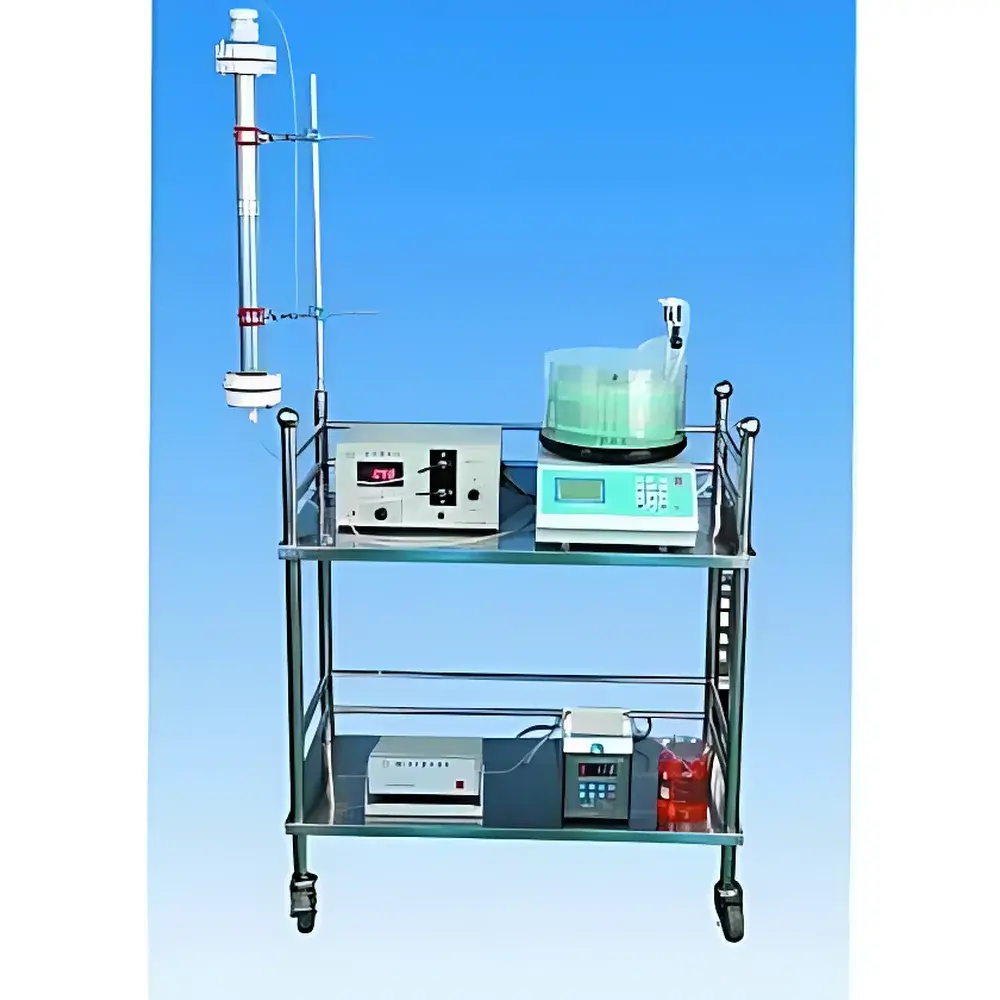
MD99-2 Automatic Liquid Chromatography Fraction Collector System with UV Detection and PC-Based Data Acquisition (Standard 5-Component Kit)
| Origin | Shanghai, China |
|---|---|
| Manufacturer Type | Authorized Distributor |
| Regional Origin | Domestic (PRC) |
| Model | MD99-2 |
| Price | USD 3,450 (FOB Shanghai) |
| UV Wavelengths | 220, 254, 280, 340 nm |
| Timer Range | 1 s – 9999 min |
| Flow Rate | 0.1–10 mL/min |
| Drop Counting Range | 1–9999 drops |
| Fraction Capacity | 12 mL × 100 tubes |
| Data Interface | USB 2.0 |
| Software Compatibility | Windows 10/11 (64-bit), .CSV/.TXT export |
Overview
The MD99-2 Automatic Liquid Chromatography Fraction Collector System is an integrated benchtop platform engineered for reproducible, real-time separation and fractionation of biomolecules—including proteins, nucleic acids, peptides, and small-molecule metabolites—using classical column-based liquid chromatography principles. Unlike high-pressure systems, this instrument operates under low-to-medium pressure conditions (≤1.5 bar), relying on gravity-assisted or peristaltic-driven flow through packed or gel-filtration columns. Its core measurement principle centers on UV absorbance detection at four fixed wavelengths (220 nm, 254 nm, 280 nm, and 340 nm), enabling selective monitoring of aromatic amino acids (280 nm), nucleic acid backbone (260 nm approximated by 254/280), peptide bonds (220 nm), and co-eluting contaminants (340 nm). The system couples analog signal acquisition from the HD-3 UV detector with digital synchronization to the SBS-100 drop-counting fraction collector and HL-2S constant-flow pump—ensuring precise temporal alignment between elution profiles and tube-based collection events.
Key Features
- Four-wavelength UV photometric detection (220/254/280/340 nm) with ±1 nm wavelength accuracy and <±0.002 AU baseline stability over 2 hours
- SBS-100 numerical drop-counting fraction collector with programmable drop threshold (1–9999 drops per tube), eliminating timer-only dependency and improving resolution for narrow peaks
- HL-2S precision peristaltic pump delivering stable flow rates from 0.1 to 10 mL/min with ≤±2% flow variability across operating range
- HD-A universal analog-to-digital acquisition module (12-bit resolution, 100 Hz sampling rate) interfacing directly with standard Windows PCs via USB 2.0
- Included column set: three pre-packed glass columns (Φ1.0×40 cm, Φ1.6×50 cm, Φ2.5×60 cm) optimized for gel filtration, ion exchange, and affinity applications
- Open-format software architecture supporting manual peak integration, retention time calibration, AUC calculation, and export to third-party analysis tools (e.g., OriginLab, GraphPad Prism)
Sample Compatibility & Compliance
The MD99-2 accommodates aqueous and mild organic solvent mobile phases (e.g., Tris-HCl, PBS, NaCl gradients, 20% methanol/water), compatible with common stationary phases including Sephadex G-25/G-75, DEAE-cellulose, and CNBr-activated sepharose. All wetted components—including flow cells, tubing, and fraction tubes—are chemically resistant to pH 2–12 and standard cleaning agents (e.g., 0.1 M NaOH, 70% ethanol). The system meets general laboratory safety requirements per IEC 61010-1:2010 and supports GLP-compliant workflows when used with validated SOPs: audit trails are maintained via timestamped data files (.CSV), and raw acquisition logs include detector voltage, pump status, and collection trigger events. While not FDA 21 CFR Part 11–certified out-of-the-box, the software architecture permits integration with validated electronic lab notebook (ELN) systems for regulated environments.
Software & Data Management
The included Windows-native acquisition software provides real-time dual-channel plotting (Absorbance A and Transmittance T%) with adjustable scaling, baseline correction, and overlay functionality. Each session generates a structured project folder containing: (1) raw binary acquisition data (.dat), (2) processed ASCII-exported chromatograms (.csv), (3) collection event log (.txt), and (4) user-defined metadata (sample ID, column type, buffer composition). Data export supports comma-, tab-, or semicolon-delimited formats for direct import into MATLAB, Python (pandas), or Excel. No cloud storage or telemetry is embedded; all processing occurs locally. Software updates are distributed as signed installers with SHA-256 checksum verification. Version history and change logs are publicly accessible in the documentation package.
Applications
- Purification of recombinant proteins following ammonium sulfate precipitation or crude lysate loading
- Desalting and buffer exchange of oligonucleotides prior to HPLC or mass spectrometry analysis
- Separation of plant secondary metabolites (e.g., flavonoids, alkaloids) using gradient elution with TH-500-compatible setups
- Quality control of antibody fragments (Fabs, scFvs) via size-exclusion chromatography under non-denaturing conditions
- Teaching laboratory implementation of chromatographic theory—retention time, resolution (Rs), theoretical plates (N), and asymmetry factor (As)
- Preparative isolation of active fractions from enzymatic digests for downstream MALDI-TOF MS identification
FAQ
Is the MD99-2 compatible with third-party chromatography software such as Chromeleon or Empower?
No—the HD-A acquisition module uses a proprietary USB protocol and only supports the included Windows application. However, exported .CSV files retain full time-absorbance-collector position metadata for reprocessing.
Can the system be upgraded to support gradient elution?
Yes—TH-500 gradient mixers (sold separately) integrate mechanically and hydraulically with the HL-2S pump and are fully supported in MD99-2A configurations.
What is the minimum detectable absorbance change at 280 nm?
With a 10 mm pathlength flow cell and standard lamp intensity, the system resolves ΔA ≥ 0.005 AU (RMS noise <0.002 AU) under optimal flow and temperature-stabilized conditions.
Are replacement columns and UV lamps available as consumables?
Yes—standardized Φ1.0/1.6/2.5 cm glass columns and HD-3-compatible mercury-vapor UV lamps (254 nm dominant) are stocked and shipped globally with traceable lot numbers.
Does the software support automated peak detection and integration?
Basic threshold-based peak finding is included; advanced algorithms (e.g., second-derivative, valley-seeking) require post-export analysis in external tools.





