
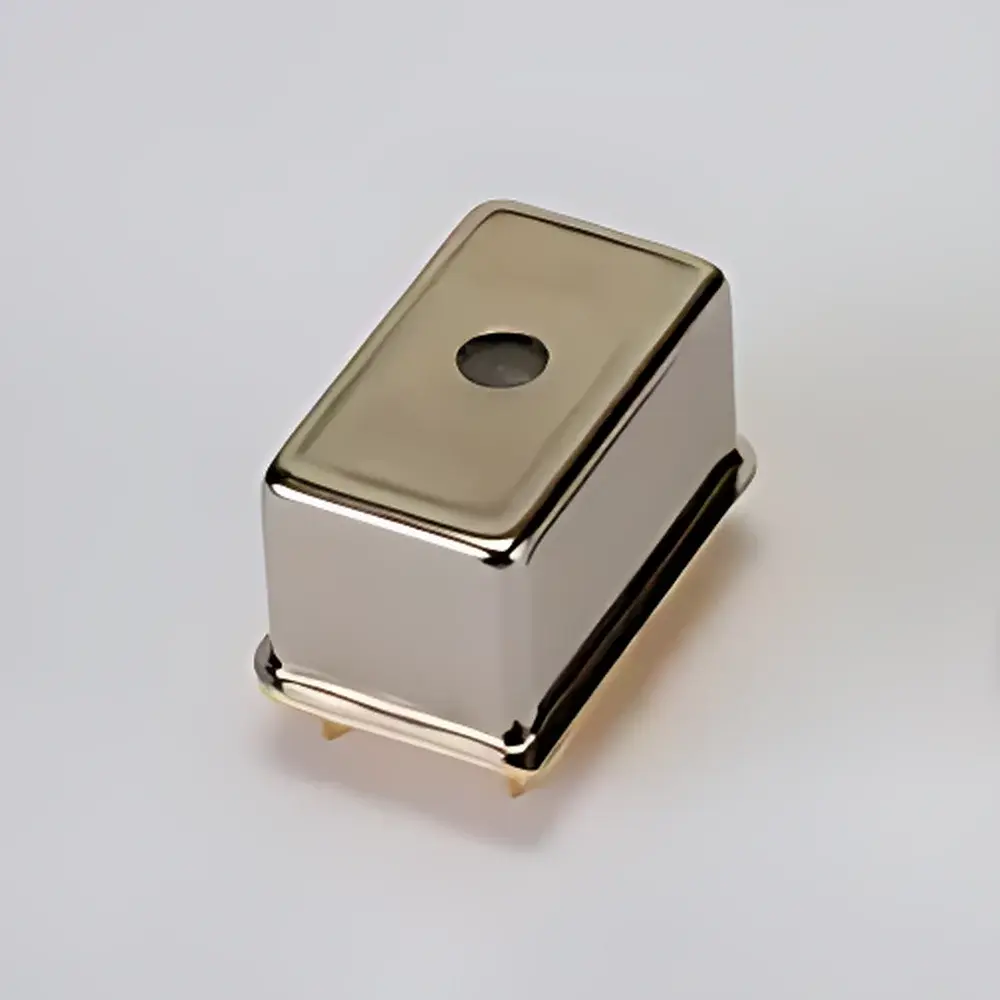
Hamamatsu C12666MA Miniature Spectrometer Module
| Brand | Hamamatsu |
|---|---|
| Origin | Japan |
| Manufacturer Type | Original Equipment Manufacturer (OEM) |
| Product Category | Imported Optical Component |
| Model | C12666MA |
| Component Type | Optical Sensor Module |
| Dimensions | 20.1 × 12.5 × 10.1 mm |
| Weight | 5 g |
| Spectral Response Range | 340–780 nm |
| Spectral Resolution (FWHM, max) | 15 nm |
| Pixel Count | 256 pixels |
| Operating Temperature | Ta = 25 °C |
| Enclosure | Hermetically Sealed for Humidity Resistance |
Overview
The Hamamatsu C12666MA is a miniature spectrometer module engineered for seamless integration into space-constrained optical systems. Based on Hamamatsu Photonics’ proprietary micro-electromechanical systems (MEMS) scanning grating technology and monolithic CMOS image sensor architecture, the C12666MA implements a compact concave diffraction grating optical path with no moving macroscopic parts—enabling high optical throughput and mechanical robustness in an ultra-small form factor. Its core measurement principle relies on wavelength-dispersive detection via MEMS-driven angular scanning of incident light across a linear 256-pixel photodiode array, with real-time pixel-to-wavelength mapping calibrated using traceable NIST-traceable reference sources. Designed explicitly for OEM deployment, the module operates without external cooling or active stabilization, delivering stable spectral response under ambient conditions (Ta = 25 °C), and is optimized for visible-light applications requiring portability, low power consumption (<150 mW typical), and rapid acquisition (integration times from 1 ms to 1 s). Unlike benchtop spectrometers employing slit-based collimation and CCD/CMOS area sensors, the C12666MA achieves its footprint reduction through elimination of free-space optics and replacement of traditional diffraction gratings with a monolithically integrated MEMS grating mirror—making it suitable for embedded colorimetry, spectral reflectance monitoring, and real-time process feedback loops.
Key Features
- Ultra-compact dimensions: 20.1 × 12.5 × 10.1 mm — among the smallest commercially available OEM spectrometer modules
- Hermetically sealed ceramic LCC package providing IP54-equivalent protection against humidity and particulate ingress
- Visible-range spectral coverage: 340–780 nm with linear dispersion and factory-calibrated wavelength conversion coefficients (supplied in test report)
- Fixed spectral resolution of ≤15 nm FWHM across full range, validated per ISO 17025-accredited calibration procedures
- 256-pixel linear CMOS sensor with 16-bit ADC output and low read noise (<15 e⁻ RMS)
- OEM-friendly interface: SPI-compatible digital output, 3.3 V logic level, minimal external component requirement
- No thermal stabilization required; performance specified at Ta = 25 °C, with ±0.5 nm wavelength drift over 0–40 °C operational range
Sample Compatibility & Compliance
The C12666MA is intended for non-contact, integrative spectral measurement of reflective, transmissive, or emissive samples in ambient lighting or controlled illumination environments. It supports fiber-coupled input (SMA 905 compatible via optional adapter) or direct free-space coupling using collimated beams with NA ≤ 0.22. The module complies with RoHS Directive 2011/65/EU and REACH Regulation (EC) No. 1907/2006. While not certified as a medical device or safety-critical instrument, its design adheres to IEC 61326-1:2013 for electromagnetic compatibility in industrial environments. Calibration data—including pixel-to-wavelength mapping, relative responsivity, and dark signal profiles—is provided in accordance with ISO/IEC 17025 requirements and traceable to NIST SRM 2035 and 2036. Device-level validation reports include uncertainty budgets for wavelength assignment (k = 2, U = ±0.8 nm) and radiometric linearity (R² > 0.9998 over 3–95% saturation).
Software & Data Management
Hamamatsu provides the C12666MA Evaluation Software (Windows/Linux) for rapid prototyping, including real-time spectrum visualization, baseline correction, peak detection, and CIE XYZ chromaticity calculation. Raw 16-bit pixel data is accessible via open SPI register map documentation, enabling full custom firmware integration (e.g., ARM Cortex-M4/M7, ESP32, or Raspberry Pi Pico platforms). All calibration coefficients are stored in non-volatile memory on-chip and applied automatically during data acquisition. For regulated environments, the module supports audit-ready data logging when paired with host systems compliant with FDA 21 CFR Part 11 (electronic records/signatures) and GLP/GMP-aligned metadata tagging (timestamp, temperature, integration time, gain setting). Export formats include CSV, HDF5, and industry-standard JCAMP-DX v6.00.
Applications
- Embedded color sensing in industrial printers and proofing systems for real-time ink density and hue verification
- Portable colorimeters and handheld paint/metal finish analyzers requiring sub-15 nm resolution in visible band
- Spectral feedback control in LED manufacturing lines and horticultural lighting systems
- Smartphone-attached spectral sensors for material identification (e.g., plastics sorting, textile batch verification)
- Miniaturized environmental monitors for UV index estimation and sky radiance profiling
- Lab-on-chip platforms integrating spectral detection with microfluidic sample handling
FAQ
Is the C12666MA suitable for quantitative absorbance measurements?
Yes—when used with matched reference and sample cuvettes and calibrated light source, it supports Beer-Lambert law-based concentration analysis in the 340–780 nm range, provided optical path length and stray light are controlled.
Can multiple C12666MA modules be synchronized for multi-angle spectral acquisition?
Yes—SPI clock and frame synchronization signals are exposed on dedicated pins, enabling hardware-triggered simultaneous acquisition across up to 8 modules with <1 µs timing skew.
Does Hamamatsu provide calibration certificates with NIST traceability?
Yes—each unit ships with a certificate of calibration listing wavelength accuracy, linearity, and responsivity, traceable to NIST Standard Reference Materials under ISO/IEC 17025-accredited processes.
What is the recommended optical interface for coupling with a 400 µm core fiber?
A custom-designed 1:1 imaging relay lens (f = 4.5 mm, NA 0.22) is recommended; Hamamatsu provides mechanical drawings and MTF data for third-party lens selection.
Is firmware update capability supported in-field?
No—the internal MEMS driver and ADC firmware are mask-programmed at wafer level and not field-upgradable; functional updates require hardware revision (e.g., C12666MA-02).





