
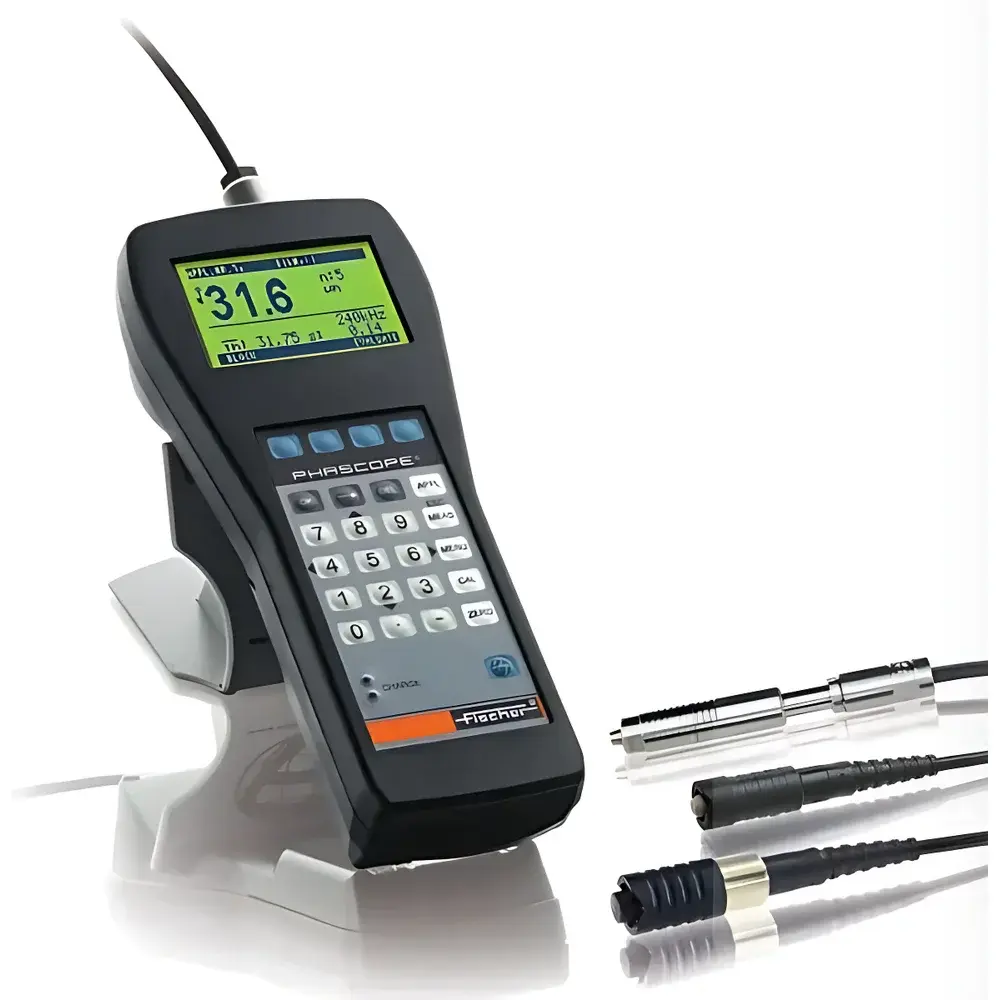
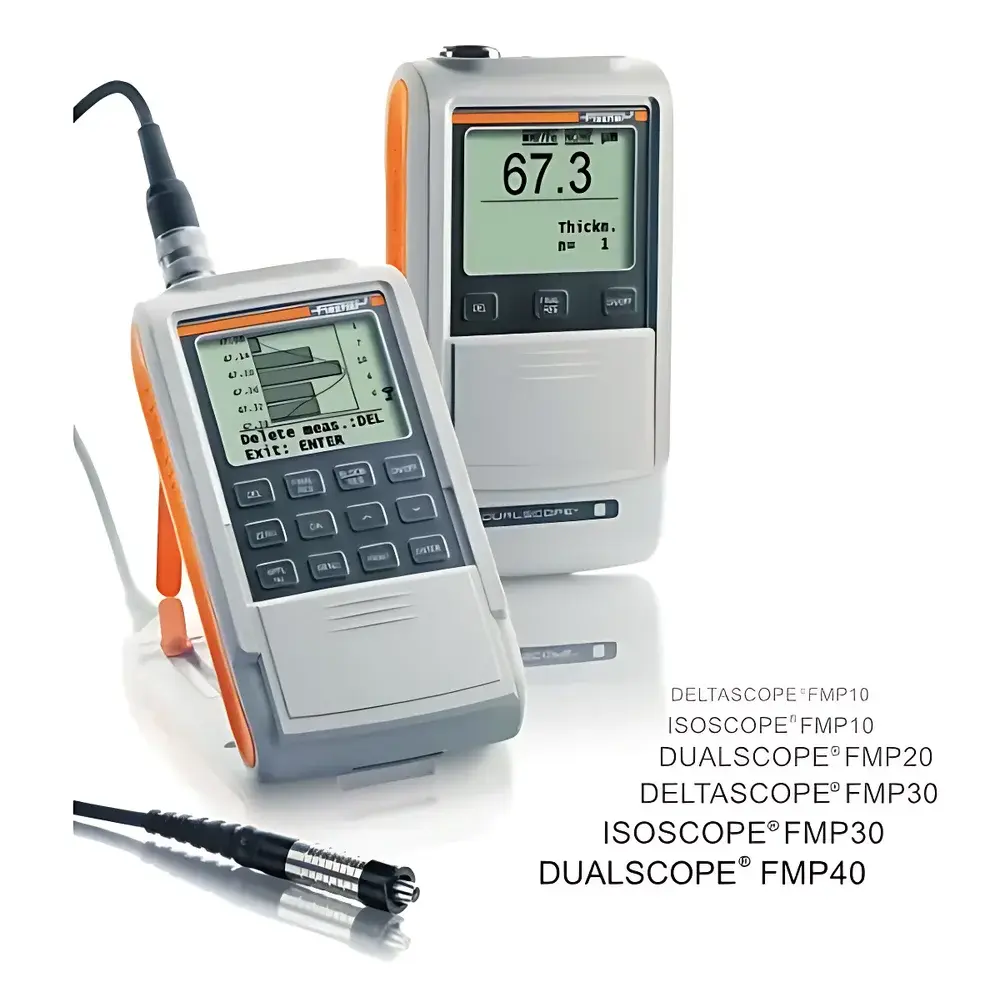
Fischer Fischerscope PMP10 Portable Phase-Sensitive Eddy Current Coating Thickness Gauge for PCB Copper Thickness Measurement
| Origin | Germany |
|---|---|
| Manufacturer Type | Authorized Distributor |
| Origin Category | Imported |
| Model | Fischerscope PMP10 |
| Pricing | Available Upon Request |
| Measurement Principle | Phase-Sensitive Eddy Current Method |
| Compliance | DIN EN ISO 21968 |
| Standard Probe Frequencies | 60 kHz, 240 kHz, 1.25 MHz |
| Software | FISCHER DataCenter (PC-based, supports data transfer, statistical analysis, graphical evaluation, and report generation) |
| Probe Options | ESD20Cu (for planar PCB copper), ESL080 (for through-hole copper plating), ESD20ZN/ESD2.4/ESD20NI (for Zn/Ni on steel) |
Overview
The Fischer Fischerscope PMP10 is a handheld, phase-sensitive eddy current coating thickness gauge engineered for precise, non-destructive measurement of conductive layer thicknesses on conductive and non-conductive substrates. Designed specifically for quality assurance in printed circuit board (PCB) manufacturing and metal finishing industries, it operates on the physical principle of electromagnetic induction: an alternating current in the probe coil generates a high-frequency magnetic field that induces eddy currents in the conductive coating; the phase shift between the excitation signal and the induced response correlates directly with coating thickness. This method delivers high reproducibility and excellent resolution for thin copper layers—critical for controlling electroplating uniformity across rigid and flexible PCBs, including surface copper, inner-layer copper, and through-hole wall copper (via barrel plating). Its portability and rapid single-point measurement capability make it suitable for both laboratory benchtop use and in-line process verification at production stations.
Key Features
- Phase-sensitive eddy current technology optimized for copper thickness measurement on FR-4, polyimide, and other common PCB dielectric substrates
- Multi-frequency operation (60 kHz, 240 kHz, 1.25 MHz) enabling selective depth penetration and improved signal-to-noise ratio for varying substrate conductivity and coating thickness ranges
- Dedicated probe configurations: ESD20Cu for planar copper on outer/inner layers; ESL080 micro-probe for accurate measurement of copper thickness inside drilled vias (minimum via diameter ≥ 0.3 mm)
- Compliance with DIN EN ISO 21968 for non-destructive coating thickness measurement using eddy current methods—fully traceable to national metrological standards
- Integrated temperature compensation and automatic zero calibration to minimize drift during extended operation or ambient fluctuations
- Rugged industrial housing rated IP54 for resistance to dust and incidental water exposure in manufacturing environments
Sample Compatibility & Compliance
The PMP10 supports measurement on diverse sample geometries including flat laminates, curved surfaces, and high-aspect-ratio plated through-holes. It accommodates substrates such as copper-clad laminates (CCL), bare copper foils, steel parts with Zn/Ni/Cu/Al coatings, and non-conductive materials (e.g., plastics, ceramics) with metallic coatings. All measurements adhere to internationally recognized standards: DIN EN ISO 21968 defines performance requirements for eddy current gauges, while ASTM B499 and ISO 2360 provide supplementary guidance for non-magnetic coating thickness on ferrous and non-ferrous substrates. The instrument’s design facilitates compliance with IPC-6012 and IPC-4552A (Electroless Nickel/Immersion Gold specification) for PCB process validation under GLP/GMP-aligned quality systems.
Software & Data Management
The included FISCHER DataCenter software enables full traceability and regulatory readiness. It supports bidirectional communication with the PMP10 via USB or Bluetooth, allowing real-time data streaming, batch export, and structured database storage. Statistical functions include mean, standard deviation, Cp/Cpk calculation, histogram plotting, and trend analysis per lot or shift. All measurement records retain metadata (operator ID, timestamp, probe ID, calibration status, environmental conditions) and support audit trails compliant with FDA 21 CFR Part 11 requirements when configured with user authentication and electronic signature modules. Customizable report templates meet internal QA documentation needs and external customer audit expectations.
Applications
- Verification of copper thickness on outer and inner layers of multilayer PCBs pre- and post-etching
- Quantification of via wall copper thickness to ensure minimum plating integrity per IPC-6012 Class 2/3 requirements
- In-process monitoring of electroplating baths in PCB fabrication lines
- Quality control of copper cladding on flexible circuits and HDI substrates
- Thickness mapping of patterned copper features using manual XY stage integration or automated scanning accessories
- Validation of copper thickness uniformity across panel edges versus center—critical for impedance-controlled designs
FAQ
Can the PMP10 measure copper thickness on flex PCBs with polyimide substrates?
Yes—the phase-sensitive eddy current method is insensitive to dielectric properties of non-conductive substrates; polyimide, FR-4, and ceramic substrates are fully supported.
Is calibration required before each measurement session?
A two-point calibration (zero and span) is recommended before daily use or after probe replacement; the instrument stores up to 100 calibration sets for different probe/substrate combinations.
Does the ESL080 probe require physical contact with the via wall?
It operates in near-contact mode: the probe tip must be positioned within 0.1 mm of the via surface but does not require mechanical pressure or surface coupling agents.
How does the PMP10 handle surface roughness or oxide layers on copper?
Surface oxides (e.g., CuO, Cu₂O) have negligible effect due to their low conductivity; however, excessive topography (>1 µm Ra) may reduce repeatability—smoothing or averaging over multiple points is advised.
Is firmware update support available for long-term deployment?
Yes—Fischer provides periodic firmware releases via DataCenter software, including enhanced statistical algorithms, new probe profiles, and compatibility with updated operating systems.



