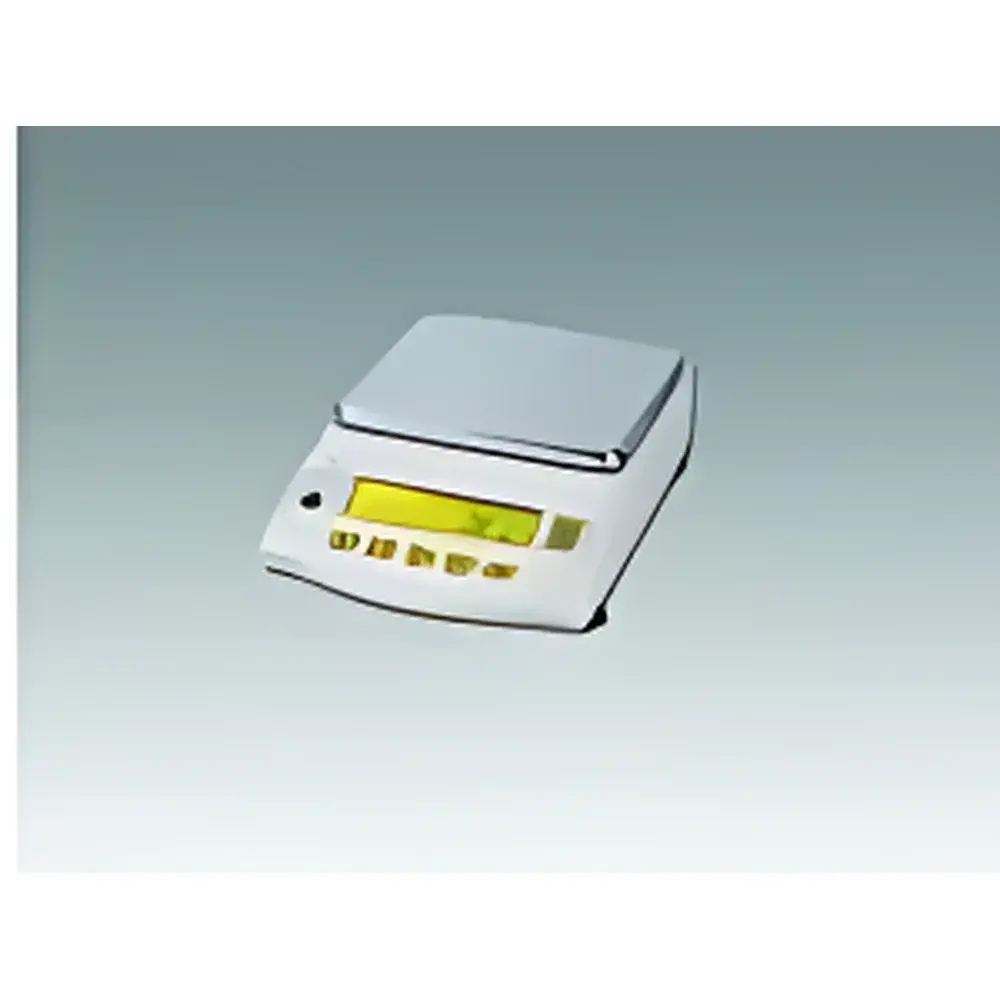
YP2001N Precision Electronic Balance
| Capacity | 2000 g |
|---|---|
| Readability | 0.1 g |
| Repeatability | ±0.1 g |
| Linearity | ±0.2 g |
| Pan Dimensions | 188 × 160 mm |
| Overall Dimensions | 270 × 190 × 75 mm |
| Power | AC adapter or 9 V DC battery |
| Interface | RS232 |
| Features | Auto-calibration, tare, counting mode, unit conversion, backlit LCD, level indicator, all-range tare, single-key operation |
Overview
The YP2001N Precision Electronic Balance is an entry-level yet robust analytical-grade balance engineered for consistent mass measurement in routine laboratory, educational, quality control, and light industrial environments. It employs a high-stability electromagnetic force compensation sensor architecture—distinct from traditional strain-gauge designs—to eliminate common drift sources such as creep, thermal hysteresis, and long-term linearity degradation. This design ensures rapid stabilization (typically <3 seconds to final reading), minimal zero drift under ambient temperature fluctuations (15–30 °C), and reliable performance across daily operational cycles without frequent recalibration. The balance operates on dual power modes—AC mains via included adapter or 9 V alkaline battery—enabling flexible deployment in classrooms, field labs, production floors, or mobile testing stations where outlet access is limited.
Key Features
- High-resolution 0.1 g readability with 2000 g maximum capacity, optimized for general-purpose weighing tasks requiring moderate precision
- Backlit LCD display with large, high-contrast digits for clear visibility under varied lighting conditions—including low-light classrooms or factory floor settings
- Integrated bubble level and adjustable leveling feet ensure mechanical stability and measurement integrity on non-ideal surfaces
- One-touch operation interface: dedicated keys for tare, unit conversion (g, oz, ct, etc.), counting mode, and auto-calibration minimize user training requirements
- Full-range tare functionality supports containerized weighing of powders, granules, or liquid samples without range limitation
- RS232 serial interface enables direct data export to PCs, LIMS, or statistical process control (SPC) software—compatible with standard terminal emulators and spreadsheet applications
- Compliant with basic metrological principles per OIML R76-1 (non-automatic weighing instruments), supporting traceable mass determination when used with certified calibration weights
Sample Compatibility & Compliance
The YP2001N accommodates a broad range of sample types—including solid reagents, packaged goods, biological specimens, and small hardware components—thanks to its spacious 188 × 160 mm stainless-steel weighing pan. The pan’s corrosion-resistant finish withstands incidental exposure to mild solvents, aqueous solutions, and particulate matter. While not rated for hazardous or explosive atmospheres (ATEX/IECEx), the balance meets CE marking requirements for electromagnetic compatibility (EMC Directive 2014/30/EU) and low-voltage safety (LVD Directive 2014/35/EU). Its design supports GLP-aligned workflows: automatic calibration log retention (via external software), operator-identifiable data output (when paired with compliant host systems), and repeatable measurement conditions under ISO/IEC 17025 clause 7.6 (traceability of measurements).
Software & Data Management
Data acquisition is performed via the built-in RS232 port using standard ASCII protocol (9600 baud, 8N1, no handshake). No proprietary drivers are required; raw weight values can be captured in real time using HyperTerminal, PuTTY, or Excel’s “Get External Data” function. When integrated into regulated environments, the balance supports audit-ready documentation when paired with validated third-party data capture tools that enforce 21 CFR Part 11-compliant electronic signatures, audit trails, and user access controls. Internal memory does not store historical readings—ensuring data sovereignty remains with the host system and facilitating compliance with internal data governance policies.
Applications
- Educational laboratories: Student experiments involving stoichiometric calculations, density determinations, and formulation exercises
- QC/QA departments: In-process checks of raw material batches, packaging fill weight verification, and component sorting by mass
- Agricultural extension services: Seed count calibration, fertilizer blend verification, and feed ration preparation
- Small-scale manufacturing: Assembly line component verification, solder paste dispensing validation, and PCB component inventory management
- Pharmaceutical support labs: Non-GMP auxiliary weighing for excipient handling, cleaning solution preparation, and equipment calibration checks
FAQ
What calibration standards are recommended for routine verification?
Certified Class M2 or better weights (per ISO 9001 Annex A.4), with nominal values covering 5%, 50%, and 100% of full scale (e.g., 100 g, 1000 g, 2000 g), should be used at least daily before critical measurements.
Is the YP2001N suitable for dynamic (moving) load applications?
No—it is designed exclusively for static mass measurement. Vibration, air currents, or mechanical shock will degrade repeatability and must be mitigated using draft shields or isolation tables.
Does the balance support internal calibration with motorized mechanism?
No—calibration is manual via external standard weights; the “auto-calibration” function refers to automatic initiation of internal calibration sequence upon activation, not motor-driven adjustment.
Can multiple units be networked via RS232 to a central PC?
Yes—with appropriate multiplexer hardware or multi-port serial cards, up to 8 units may be addressed individually using addressable command protocols (requires custom scripting or middleware configuration).
What environmental conditions affect measurement accuracy?
Ambient temperature gradients exceeding 2 °C/hour, relative humidity above 85% RH, or static charge buildup on insulating samples may introduce deviations beyond stated repeatability specifications.