
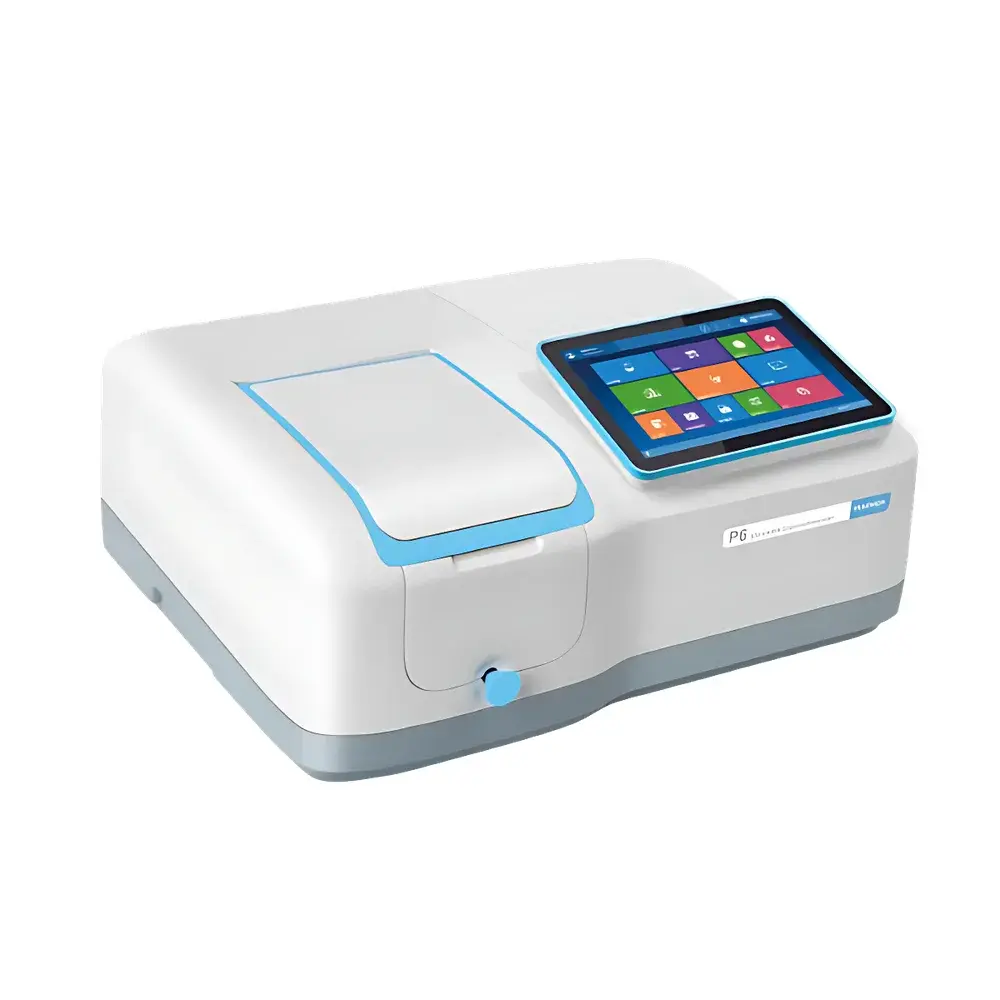
MAPADA P6 Proportional Double-Beam UV-Vis Spectrophotometer
| Brand | MAPADA |
|---|---|
| Origin | Shanghai, China |
| Manufacturer Type | Direct Manufacturer |
| Instrument Architecture | Double-Beam |
| Detector Type | Silicon Photocell |
| Wavelength Range | 190–1100 nm |
| Wavelength Scanning Mode | Automatic |
| Spectral Bandwidth | 1.5 nm |
| Wavelength Accuracy | ±0.5 nm |
Overview
The MAPADA P6 Proportional Double-Beam UV-Vis Spectrophotometer is a precision optical instrument engineered for quantitative and qualitative analysis of absorbance, transmittance, and reflectance across the ultraviolet, visible, and near-infrared spectral regions. Based on the proportional double-beam optical architecture, the P6 continuously splits the light path into sample and reference channels using a rotating mirror or beam splitter—enabling real-time compensation for source intensity drift, lamp aging, and electronic baseline fluctuations. This design significantly enhances measurement stability and photometric reproducibility over extended operation periods. Operating across a broad spectral range of 190–1100 nm, the P6 supports routine laboratory applications including concentration determination, kinetic studies, spectral scanning, and multi-wavelength quantitation in pharmaceutical, environmental, biochemical, and quality control laboratories.
Key Features
- Proportional double-beam optical system with real-time reference correction, minimizing baseline drift and improving long-term photometric accuracy
- High-stability deuterium and tungsten-halogen dual-lamp source, automatically switched at ~350 nm to ensure optimal signal-to-noise ratio across full UV-Vis-NIR range
- Fixed 1.5 nm spectral bandwidth, optimized for resolution and sensitivity balance in compliance with common pharmacopeial methods (e.g., USP & EP)
- Automatic wavelength scanning and positioning driven by stepper motor-controlled monochromator with grating optics
- Wavelength accuracy certified to ±0.5 nm (as verified per ISO 8579-1:2021 calibration protocol), traceable to NIST-traceable standards
- Silicon photocell detector offering linear response over four orders of magnitude (0–3.0 A), with low dark current and high thermal stability
- Integrated cuvette holder accommodating standard 10 mm pathlength cells; optional accessories support 5 mm, 20 mm, and micro-volume configurations
Sample Compatibility & Compliance
The P6 accommodates liquid, solution-based, and transparent solid samples in quartz, glass, or plastic cuvettes. It supports both transmission and reflectance measurements (with optional integrating sphere accessory). The instrument complies with fundamental performance criteria outlined in ISO 14785:2022 (UV-Vis spectrophotometers — Performance verification) and meets essential requirements for GLP-compliant environments. While not inherently 21 CFR Part 11 compliant out-of-the-box, its firmware architecture supports audit trail logging and user access control when paired with validated third-party LIMS or ELN integration modules. Routine operation aligns with ASTM E275, ISO 6206, and Chinese Pharmacopoeia (ChP) General Chapter 0401 methodologies.
Software & Data Management
The P6 operates via MAPADA’s proprietary PC-based software suite (Windows 10/11 compatible), supporting spectral acquisition, kinetic time-scan, multi-point quantitative analysis, and derivative spectroscopy. Data export formats include CSV, TXT, and XML for interoperability with statistical packages (e.g., OriginLab, JMP) and enterprise QA/QC systems. The software implements configurable method templates, automatic calibration curve generation (linear, quadratic, cubic), and built-in validation tools for wavelength and photometric accuracy checks. All data files contain embedded metadata—including date/time stamp, operator ID, instrument serial number, and measurement parameters—ensuring traceability in regulated workflows.
Applications
- Determination of active pharmaceutical ingredient (API) concentration in dissolution testing and formulation development
- Enzyme kinetics monitoring (e.g., NADH/NADPH assays at 340 nm) and protein quantification (Bradford, Lowry, BCA)
- Water quality analysis: nitrate, phosphate, COD, and heavy metal complexation (e.g., Cr(VI) at 540 nm)
- Colorimetric assay validation in food safety labs (e.g., sulfite, formaldehyde, melamine detection)
- Educational use in undergraduate chemistry and analytical science curricula for Beer–Lambert law verification and spectral interpretation
- Raw material identification and purity assessment in fine chemical manufacturing
FAQ
What is the difference between proportional double-beam and true double-beam architectures?
The P6 uses a proportional double-beam design, where a single detector alternately measures sample and reference beams via synchronized mechanical modulation. Unlike true double-beam systems (which employ two independent detectors), this approach achieves comparable baseline stability at lower cost and complexity while maintaining sufficient accuracy for routine QC applications.
Is the P6 suitable for GMP-regulated environments?
Yes—when operated with documented SOPs, calibrated against traceable standards, and integrated with controlled software environments, the P6 meets core instrumentation requirements for GMP Annex 11 and ICH Q2(R2) analytical method validation frameworks.
Can the P6 perform spectral scanning below 190 nm?
No—the 190 nm lower limit is constrained by atmospheric oxygen absorption and quartz cuvette cutoff; vacuum or purged-path configurations are not supported on this model.
Does the instrument support USB or Ethernet connectivity?
The P6 connects exclusively via USB 2.0 interface; Ethernet or Wi-Fi capability is not available in the base configuration.
How often should wavelength calibration be performed?
We recommend wavelength verification before each analytical session using holmium oxide or didymium filters, with full recalibration every six months or after any mechanical impact or lamp replacement.



