
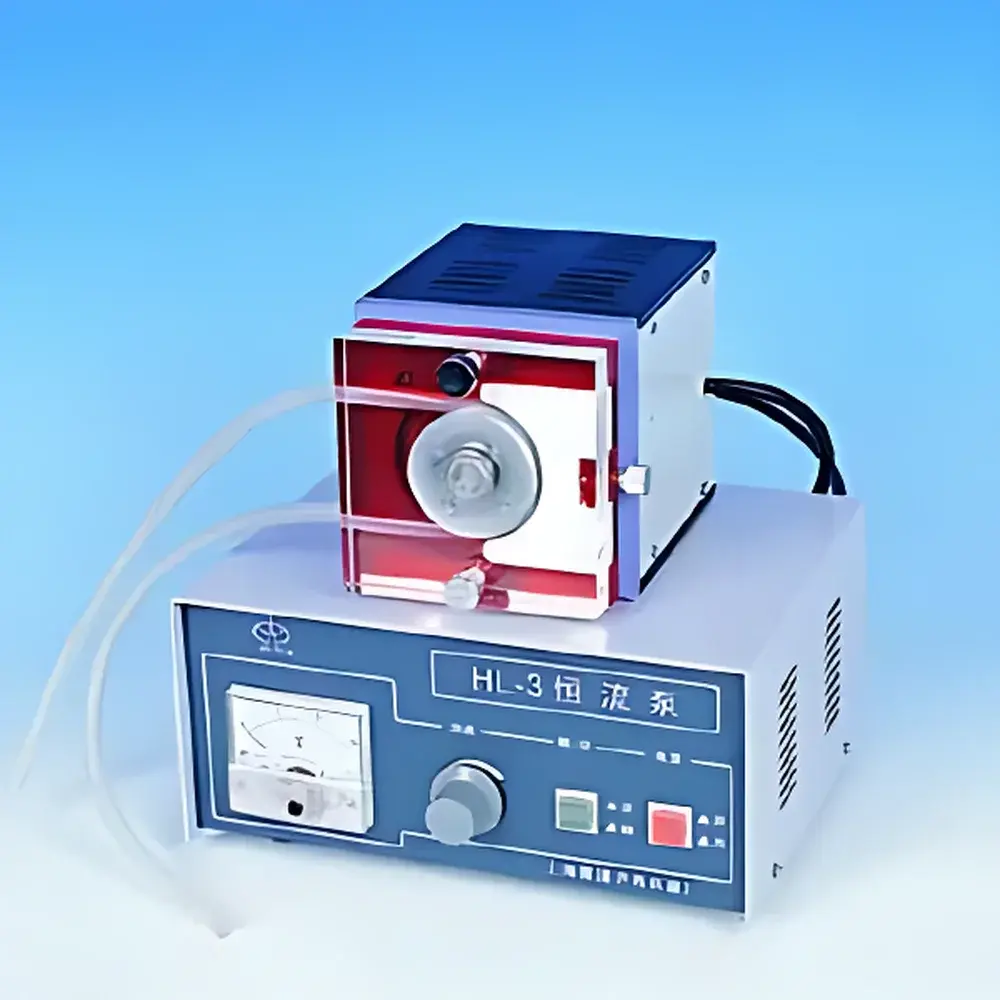
HL-3 Single-Channel Constant-Flow Peristaltic Pump (Separate Pump Head & Controller Design)
| Origin | Shanghai, China |
|---|---|
| Manufacturer Type | Authorized Distributor |
| Origin Category | Domestic (China) |
| Model | HL-3 |
| Flow Rate Range | 60–10,000 mL/h |
| Maximum Back Pressure | ≥2 kg/cm² |
| Pump Head Dimensions | 120 × 120 × 180 mm |
| Controller Dimensions | 260 × 200 × 120 mm |
| Drive Type | Stepless Mechanical Speed Control (Non-Variable Frequency Drive) |
| Channel Configuration | Single-Channel, Modular (Pump Head and Controller Separately Mounted) |
Overview
The HL-3 Single-Channel Constant-Flow Peristaltic Pump is an engineered solution for precise, pulse-free fluid delivery in laboratory and light industrial applications. Based on the principle of peristalsis—where rollers compress a flexible tubing segment against a curved housing to generate positive displacement—the HL-3 delivers consistent volumetric flow without direct contact between the pump mechanism and the fluid. This design ensures complete fluid isolation, eliminating contamination risk and enabling safe handling of aggressive, viscous, or shear-sensitive media including cell suspensions, reagents, buffers, and wastewater samples. Its modular architecture separates the compact pump head from the dedicated controller unit, allowing flexible installation in fume hoods, bioreactor manifolds, chromatography systems, or custom fluidic assemblies where spatial constraints or electromagnetic interference require physical decoupling of drive electronics and fluid path.
Key Features
- Stepless mechanical speed control enables continuous adjustment across the full operational range—no discrete speed steps or digital resolution limitations.
- Robust roller-and-housing geometry maintains high torque transmission and long-term flow stability under sustained operation at elevated back pressures (≥2 kg/cm²).
- Modular pump head and controller configuration supports remote mounting up to 2 meters via standardized low-voltage signal cable (included), facilitating integration into enclosed or temperature-controlled environments.
- Front-panel analog dial with calibrated scale provides intuitive speed setting; mechanical feedback ensures repeatable positioning and minimal drift over extended duty cycles.
- Tube compatibility with standard silicone or Tygon® L/S series tubing (ID 1.6–4.8 mm) allows rapid interchangeability and validation traceability per ISO 8536-4 and USP tubing specifications.
- No internal valves, seals, or lubricants—reducing maintenance intervals and eliminating sources of particulate generation or chemical incompatibility.
Sample Compatibility & Compliance
The HL-3 is compatible with a broad spectrum of aqueous, organic, and mildly corrosive solutions commonly encountered in environmental monitoring, clinical diagnostics, academic research, and pilot-scale process development. Its tubing-based fluid path avoids metal wetted surfaces, making it suitable for pH-sensitive or metal-catalyzed reactions. While not certified for IEC 61000-6-2/6-3 EMC compliance or ATEX hazardous area use, the device meets general electrical safety requirements per GB 4793.1–2007 (equivalent to IEC 61010-1:2010) for laboratory equipment. It supports GLP-aligned workflows through manual logbook documentation of speed settings and tubing batch numbers; optional analog output (0–5 V DC) permits external data logging for audit trail reconstruction.
Software & Data Management
The HL-3 operates as a standalone analog-controlled instrument and does not include embedded firmware, USB connectivity, or proprietary software. Flow rate calibration is performed manually using gravimetric or volumetric methods per ASTM D3418 or ISO 4787 standards. For laboratories requiring electronic recordkeeping, the analog speed control signal can be interfaced with third-party DAQ systems (e.g., National Instruments CompactDAQ or LabVIEW-based controllers) to capture time-stamped operational parameters. No FDA 21 CFR Part 11-compliant audit trail functionality is built-in; such compliance must be implemented externally via validated system integration protocols.
Applications
- Continuous feed of nutrient media or harvest streams in benchtop bioreactors and perfusion culture systems.
- Controlled eluent delivery in column chromatography (e.g., ion exchange, size exclusion) where pulse-free flow minimizes band broadening.
- Automated sampling in water quality monitoring stations—paired with conductivity or turbidity sensors for real-time parameter correlation.
- Reagent dosing in automated titration or enzymatic assay platforms where flow reproducibility directly impacts endpoint accuracy.
- Perfusion of tissue explants or organ-on-chip devices requiring stable shear stress profiles over multi-hour experiments.
- Waste stream transfer in lab-scale effluent treatment simulations under regulated back-pressure conditions.
FAQ
What tubing sizes are recommended for optimal performance with the HL-3 pump head?
Standard tubing inner diameters of 1.6 mm, 2.4 mm, 3.2 mm, and 4.8 mm (L/S series) are validated for full-range flow accuracy and roller lifespan. Tubing wall thickness must comply with ISO 3308 tolerances to ensure consistent occlusion and pressure containment.
Can the HL-3 maintain constant flow under variable downstream resistance?
Yes—within its rated back pressure limit (≥2 kg/cm²), the peristaltic mechanism inherently compensates for moderate resistance changes by maintaining rotational speed and occlusion geometry, delivering high flow reproducibility (±3% typical, per gravimetric verification).
Is the controller compatible with 220 V AC / 50 Hz mains supply only?
The unit is configured for 220 V AC ±10%, 50 Hz input. A wide-input (100–240 V AC, 50/60 Hz) version is available upon request for international deployment, subject to CE or UKCA marking validation.
Does the HL-3 support programmable ramping or multi-stage flow profiles?
No—this model features fixed-speed analog control only. For time-dependent flow programming, consider integrating the pump head with an external programmable motion controller supporting 0–5 V analog input.
How often should tubing be replaced during continuous operation?
Under nominal load (flow rates ≤5,000 mL/h, ambient temperature), silicone tubing requires replacement every 100–200 hours of cumulative operation. Actual service life depends on chemical compatibility, pressure, and roller compression settings—documented in the user’s tubing qualification report.



