
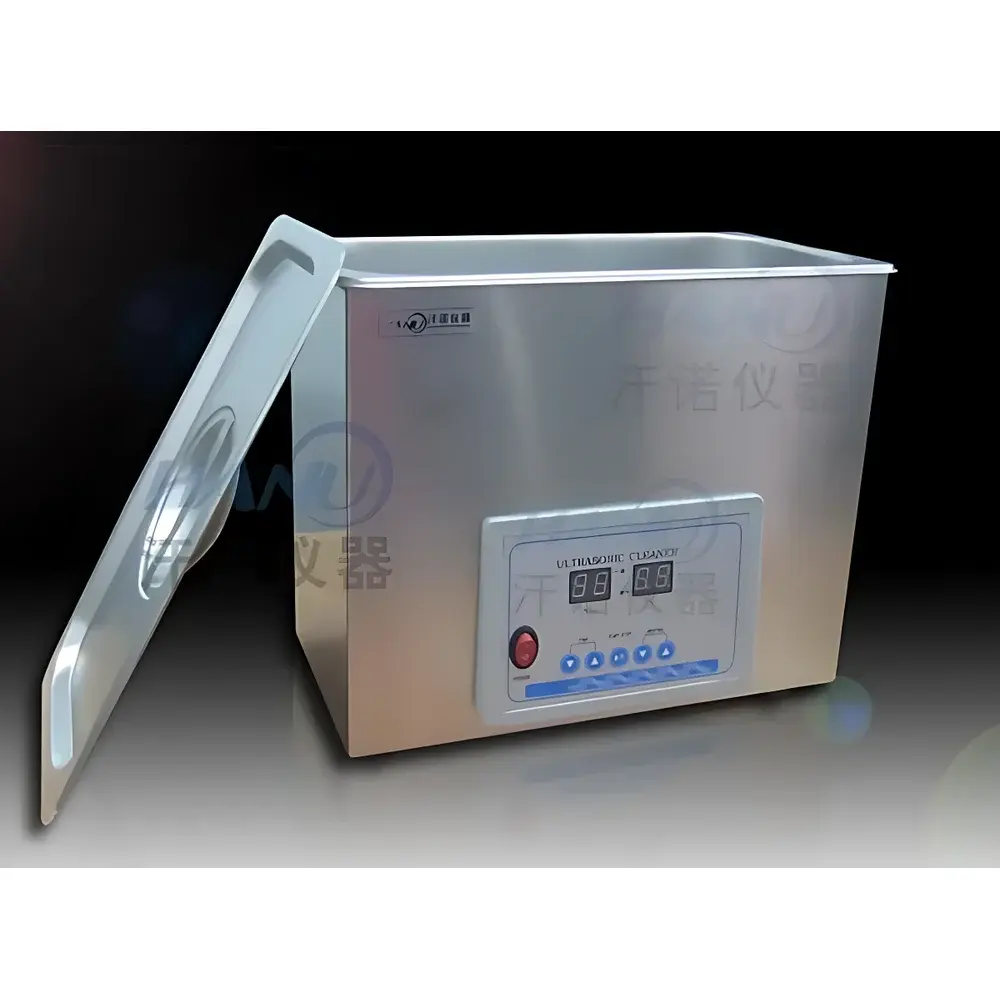
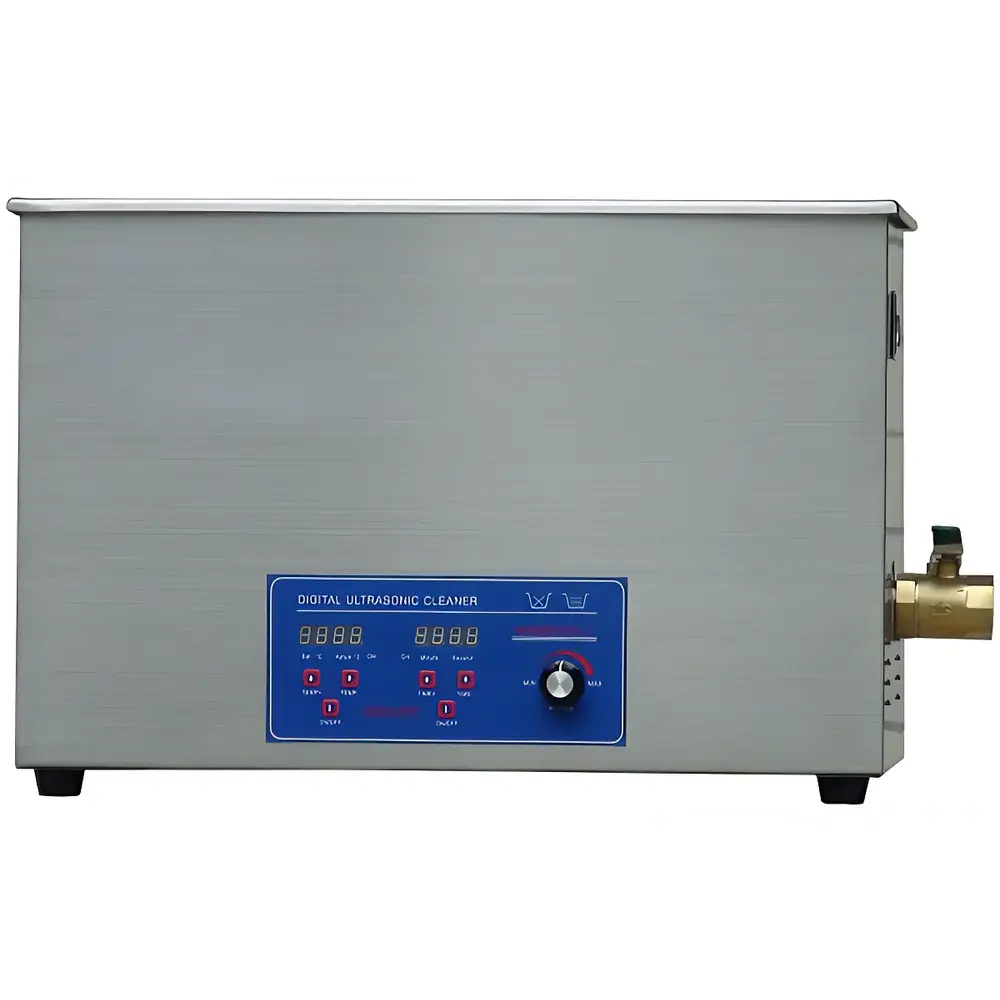
Hanuo HN-180AL Benchtop Ultrasonic Cleaner
| Brand | Hanuo |
|---|---|
| Origin | Shanghai, China |
| Model | HN-180AL |
| Capacity | 58 L |
| Ultrasonic Frequency | 28 kHz or 40 kHz (selectable, single-frequency) |
| Ultrasonic Power | 1800 W |
| Power Adjustment | Continuously variable (0–100%) |
| Heating Temperature Range | 20–80 °C |
| Timer Range | 1–30 min |
| Lid with Sound-Dampening Design | Yes |
| Manual Fill/Drain | Yes |
| Internal Tank Dimensions | 550 × 350 × 300 mm (L×W×H) |
| External Dimensions | 650 × 400 × 580 mm (L×W×H) |
| Heating Power | 1500 W |
| Weight | 68 kg |
Overview
The Hanuo HN-180AL is a heavy-duty benchtop ultrasonic cleaner engineered for precision cleaning of delicate and complex components in regulated laboratory, clinical, and industrial environments. It operates on the principle of cavitation—generated by high-frequency acoustic energy transmitted through an aqueous or solvent-based cleaning medium—to dislodge sub-micron particulate contamination, organic residues, and biofilm from surfaces inaccessible to manual or mechanical methods. With dual selectable frequencies (28 kHz and 40 kHz), the unit enables process optimization: lower frequency delivers higher cavitation intensity suited for robust parts (e.g., metal hardware, dental instruments), while 40 kHz provides finer, more uniform energy distribution ideal for fragile substrates such as optical lenses, microfluidic devices, and printed circuit boards. Its 58 L stainless steel tank (304 grade) supports batch processing of large or multiple samples, and integrated heating (20–80 °C) enhances surfactant activity and soil solubilization without thermal degradation of sensitive materials.
Key Features
- Continuously adjustable ultrasonic power (0–100%) via analog control—enables precise energy delivery tailored to substrate geometry, material hardness, and contaminant type.
- Digital timer (1–30 minutes) and temperature controller with ±1 °C stability—ensures repeatable, protocol-driven cleaning cycles compliant with internal SOPs and external quality standards.
- Sound-dampening hinged lid reduces ambient noise to <55 dB(A) at 1 m—critical for shared lab spaces and ISO 17025-accredited facilities where acoustic interference must be minimized.
- Stainless steel tank (304 SS) with rounded internal corners and seamless welds—prevents residue entrapment and simplifies validation of cleaning efficacy per ASTM F3259 and ISO 15883-5.
- Integrated 1500 W heating system with overtemperature cutoff and dry-run protection—maintains consistent thermal profiles during extended cycles and eliminates risk of heater element failure.
- Manual fill/drain port with threaded connection—facilitates rapid media exchange and integration into closed-loop solvent recovery workflows where automated plumbing is not required.
Sample Compatibility & Compliance
The HN-180AL accommodates a broad spectrum of sample types, including but not limited to: stainless steel and titanium surgical instruments; ceramic and polymer dental prosthetics; silicon wafers and MEMS assemblies; precision-machined aerospace components; and reusable labware (e.g., volumetric flasks, pipette tips, filtration housings). Its design aligns with key regulatory expectations: tank geometry and surface finish meet USP requirements for cleaning validation; temperature and time controls support GLP-compliant documentation; and electrical safety complies with IEC 61010-1 for laboratory equipment. While not certified for sterile processing per ISO 17664, it serves as a validated pre-sterilization cleaning step in ISO 13485-certified medical device manufacturing and ISO 9001 quality systems.
Software & Data Management
The HN-180AL operates via embedded microcontroller logic—no PC interface or proprietary software is required. All operational parameters (time, temperature, power level) are displayed on a backlit LED screen and retained across power cycles. Though lacking USB or Ethernet connectivity, its deterministic digital controls ensure full auditability: each cycle logs start time, setpoint values, and duration—supporting manual record-keeping under FDA 21 CFR Part 11 when paired with controlled lab notebooks or ELN entries. For labs requiring electronic data capture, optional RS-232 output (available upon request) enables integration with third-party SCADA or LIMS platforms for automated cycle reporting and trend analysis.
Applications
- Life Sciences: Removal of protein aggregates from HPLC columns, cell culture flasks, and electrophoresis combs prior to reuse.
- Dentistry & Orthopedics: Decontamination of impression trays, orthodontic brackets, and implant abutments before autoclaving.
- Electronics Manufacturing: Post-reflow cleaning of PCBAs to eliminate flux residues and prevent dendritic growth.
- Materials Research: Surface preparation of catalyst substrates, battery electrodes, and composite laminates prior to SEM/EDS analysis.
- Quality Control Labs: Cleaning of reference standards, calibration weights, and metrology fixtures to maintain traceable measurement integrity.
FAQ
Is the HN-180AL suitable for cleaning glassware used in trace metal analysis?
Yes—when operated with high-purity deionized water and low-foaming, metal-free detergents (e.g., Alconox® Liquinox®), it achieves >99.8% removal of adsorbed ions and silicates. Validation studies recommend post-cleaning acid rinses (e.g., 1% HNO₃) followed by Class 100 laminar flow drying.
Can the unit operate continuously for extended periods?
It is rated for intermittent duty (max. 3 hours ON / 30 min OFF). Continuous operation beyond 3 hours requires active cooling of the transducer stack and verification of bath temperature stability per IEC 60068-2-14.
Does the HN-180AL support degassing mode?
No—degassing is achieved passively during initial warm-up (5–10 min at 40 kHz, 40 °C) prior to introducing samples. For volatile solvent applications, optional vacuum-assisted degassing chambers may be interfaced externally.
What maintenance is required to sustain cavitation efficiency?
Transducer alignment and tank integrity should be verified annually using ASTM E1555 pulse-echo ultrasonic testing; stainless steel tank passivation is recommended every 6 months in hard-water regions.



