
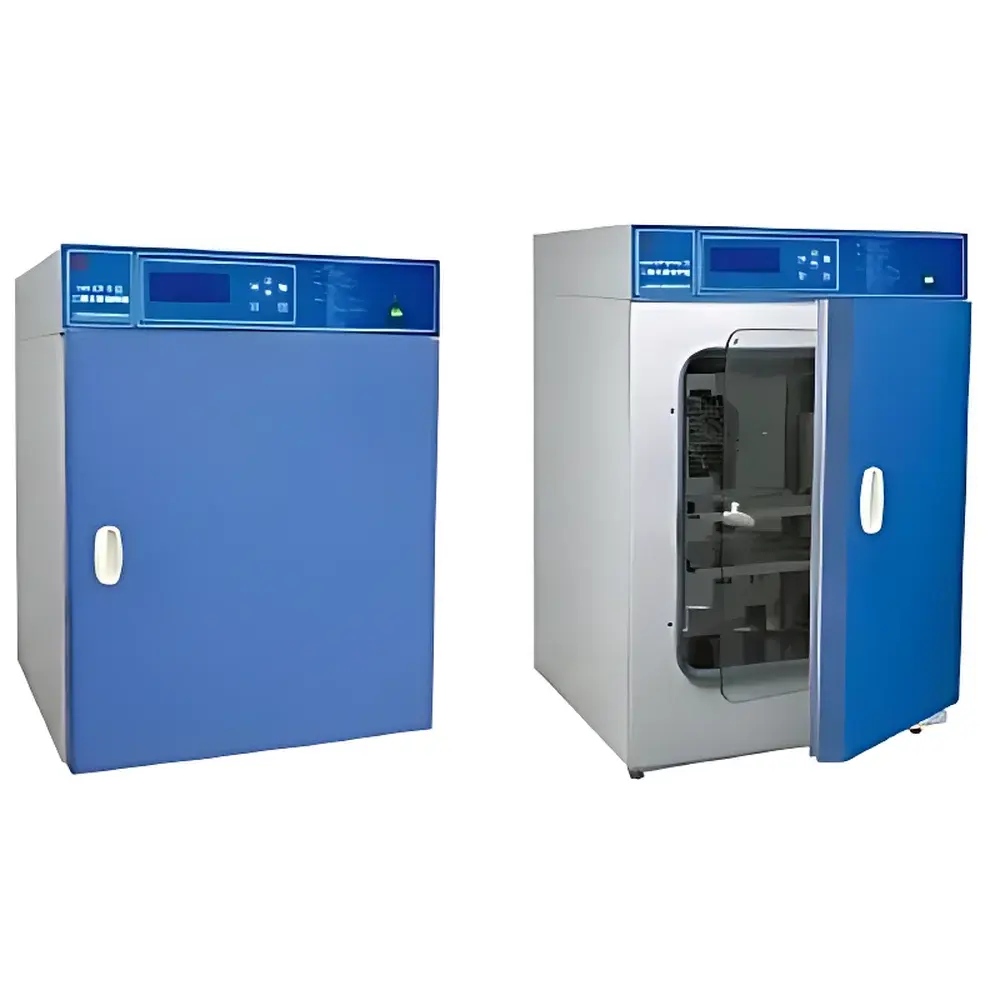
Chu Ding HH.CP-01W-II Water-Jacketed CO₂ Incubator with Microprocessor Control and Large LCD Display
| Brand | Chu Ding |
|---|---|
| Origin | Shanghai, China |
| Model | HH.CP-01W-II |
| Heating Method | Water-Jacketed |
| Temperature Range | RT+5°C to 50°C |
| Temperature Uniformity | ±0.2°C |
| Temperature Resolution | 0.1°C |
| CO₂ Range | 0–20% |
| CO₂ Sensing | Infrared (IR) Sensor |
| CO₂ Recovery Time | <5 min to 5% after 30-sec door opening |
| Humidification | Natural Evaporation |
| Chamber Volume | 160 L |
| Internal Dimensions (W×D×H) | 500×500×650 mm |
| External Dimensions (W×D×H) | 650×640×950 mm |
| Standard Shelving | 3 pcs stainless steel adjustable shelves |
| Power Consumption | 950 W |
| Input Voltage | AC 220 V, 50 Hz |
| Microbial Filtration | ≥99.99% efficiency for particles ≥0.3 µm |
| Door Heating System | Yes |
| Optional Features | UV Sterilization Lamp, Independent Over-Temperature Alarm, USB/RS485 Data Interface |
Overview
The Chu Ding HH.CP-01W-II is a water-jacketed CO₂ incubator engineered for precision cell culture under physiologically relevant conditions. Unlike forced-air (gas-jacketed) systems, its dual-wall water-jacket design provides superior thermal stability and uniformity—critical for long-term mammalian cell propagation, stem cell maintenance, and sensitive co-culture experiments. The unit maintains a tightly regulated microenvironment via an infrared (IR) CO₂ sensor, which delivers drift-free gas concentration monitoring independent of temperature or humidity fluctuations. This ensures high reproducibility in applications requiring strict adherence to ISO 13485–compliant biomanufacturing workflows or GLP-aligned preclinical research. The incubator operates within a temperature range of RT+5°C to 50°C, with a typical setpoint of 37°C and CO₂ at 5%, replicating core parameters of human physiological niches. Its water-jacket architecture inherently buffers against ambient lab temperature variation, minimizing thermal shock during door openings—a key advantage over air-jacketed alternatives in shared-core facilities.
Key Features
- Water-jacketed thermal insulation system delivering ±0.2°C temperature uniformity and minimal gradient across the 160 L stainless-steel chamber (500 × 500 × 650 mm internal dimensions)
- Infrared CO₂ sensor with fast recovery kinetics: restores 5% CO₂ setpoint in less than 5 minutes following a 30-second door opening—validated under multi-user operational stress
- Integrated door heating circuit prevents condensation on inner glass, eliminating moisture-mediated microbial ingress pathways
- HEPA-grade microbial filter (≥99.99% capture efficiency for ≥0.3 µm particles) installed inline with CO₂ supply, ensuring feed gas sterility without compromising flow dynamics
- Microprocessor-based controller with large backlit LCD display showing simultaneous real-time readouts of temperature, CO₂ concentration, and relative humidity (indirectly inferred via saturation equilibrium)
- Corrosion-resistant 304 stainless-steel interior with radius-cornered construction and tool-free removable shelving for rapid cleaning and autoclave-compatible decontamination
- Stackable two-tier configuration support (HH.CP-01W-II variant), optimizing footprint efficiency in space-constrained BSL-2 laboratories
Sample Compatibility & Compliance
The HH.CP-01W-II accommodates standard T-75, T-175, and 100-mm Petri dishes, multi-well plates (6–96-well), and roller bottles up to 5 L volume. Its natural evaporation humidification method—supported by a removable stainless-steel water pan—maintains >95% RH at 37°C without ultrasonic mist generation, thereby avoiding mineral deposition or aerosolized endotoxin risks. All materials in contact with the chamber interior comply with USP Class VI biological safety standards. The IR CO₂ sensing module meets IEC 61000-4 electromagnetic compatibility requirements, and the control firmware supports audit trail generation when paired with optional RS485/USB data logging—enabling alignment with FDA 21 CFR Part 11 electronic record integrity expectations. Routine validation protocols (IQ/OQ/PQ) can be executed using ASTM E2500-13 guidance for laboratory equipment qualification.
Software & Data Management
While the base unit features embedded microcontroller logic with non-volatile parameter storage, optional communication interfaces enable integration into centralized lab infrastructure. The RS485 port supports Modbus RTU protocol for connection to building management systems (BMS) or environmental monitoring platforms. The USB interface permits direct export of time-stamped temperature and CO₂ logs (CSV format) to external PCs for trend analysis in JMP, Python pandas, or LabArchives ELN environments. Optional firmware upgrades include configurable alarm thresholds, event-triggered email notifications (via Ethernet gateway), and encrypted data-at-rest storage—supporting institutional requirements for data integrity under ISO/IEC 17025 clause 7.5. All logged parameters are timestamped with UTC synchronization capability.
Applications
This incubator serves as a primary platform for adherent and suspension cell line expansion—including HEK293, CHO-K1, and primary human fibroblasts—in academic, pharmaceutical, and contract research settings. It supports routine QC testing per USP for cell-based potency assays, supports feeder-layer-dependent iPSC culture under low-oxygen adaptation protocols (when retrofitted with N₂/CO₂ mixing), and enables reproducible bacterial co-culture models for host-pathogen interaction studies. Its stable thermal profile also facilitates enzyme-linked immunosorbent assay (ELISA) plate incubation where extended 37°C dwell times impact antigen-antibody binding kinetics. Regulatory submissions referencing this platform typically cite its conformance to ISO 5559:2015 (incubator performance verification) and CLSI EP23-A validation frameworks.
FAQ
What distinguishes water-jacketed from air-jacketed CO₂ incubators?
Water-jacketed designs use circulating heated water between double walls to buffer thermal load, resulting in slower but more stable temperature recovery and reduced sensitivity to ambient lab fluctuations—ideal for overnight or unattended runs.
Is the IR CO₂ sensor calibrated traceable to NIST standards?
Yes; factory calibration is performed using certified gas mixtures (5.00 ± 0.05% CO₂ in N₂), with full calibration certificates provided upon request per ISO/IEC 17025-accredited procedures.
Can the unit operate in rooms exceeding 35°C ambient temperature?
Performance specifications assume ambient conditions ≤35°C and ≤70% RH; operation beyond these limits may extend CO₂ recovery time and require auxiliary cooling of the water jacket.
Does the UV lamp option meet ISO 15858 germicidal efficacy requirements?
The 254 nm low-pressure mercury UV-C lamp achieves ≥3-log reduction of Bacillus atrophaeus spores on exposed surfaces after 30 minutes, complying with ISO 15858 Annex A test methodology.
How frequently should the microbial filter be replaced?
Under continuous 5% CO₂ operation at 20 L/min flow rate, replacement is recommended every 6 months—or immediately after any documented gas line contamination event—to maintain ≥99.99% filtration integrity.
Related Products



