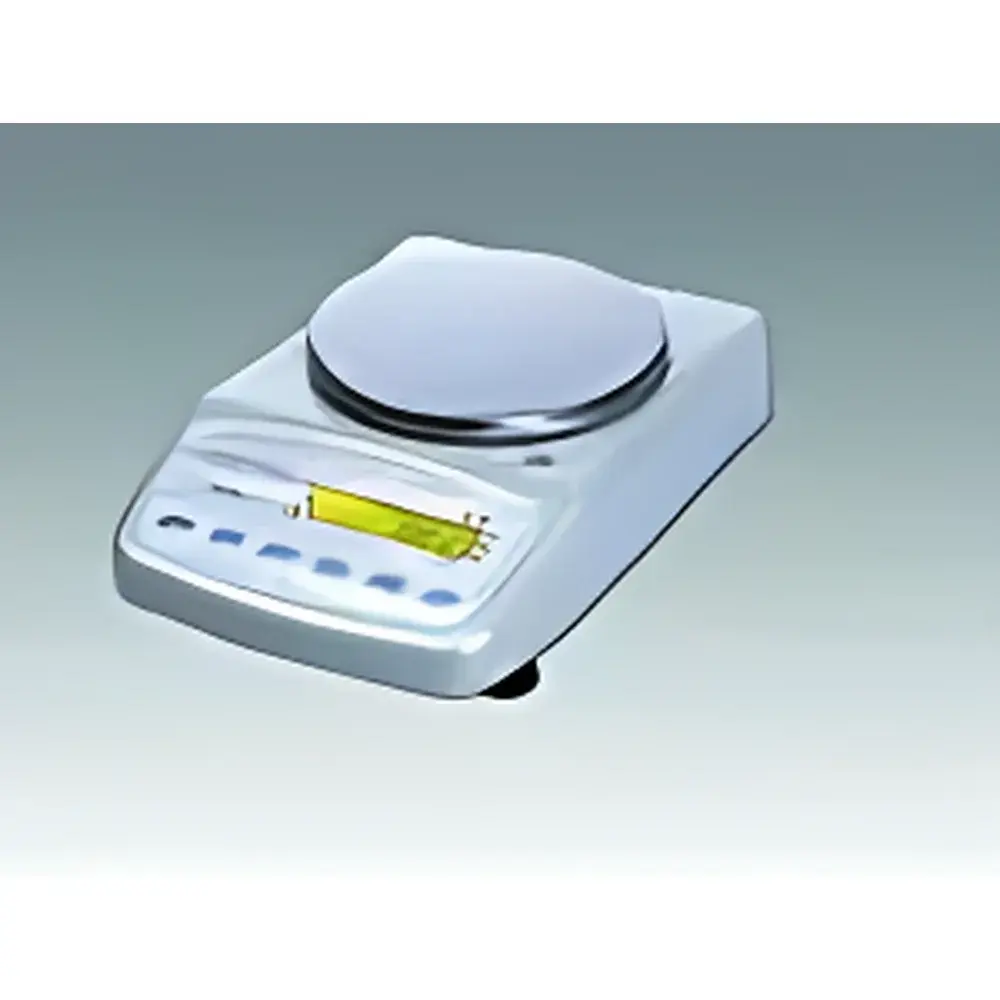
Jade Analytical Balance JA12002
| Origin | Shanghai, China |
|---|---|
| Manufacturer Type | Authorized Distributor |
| Country of Origin | China |
| Model | JA12002 |
| Capacity | 1200 g |
| Readability | 10 mg |
| Repeatability | ±10 mg |
| Linearity | ±20 mg |
| Dimensions (W×D×H) | 200 × 270 × 80 mm |
| Pan Diameter | Φ158 mm |
| Power Options | AC Adapter or 9 V DC Battery |
| Interface | RS232 |
| Display | Backlit LCD |
| Draft Shield | Five-sided glass enclosure |
| Sensor Type | Electromagnetic force compensation |
| Environmental Compensation | Dynamic temperature compensation |
| Functions | Tare, auto-zero tracking, counting, unit conversion (g, oz, ct), overload protection & alarm, under/overload indication |
Overview
The Jade Analytical Balance JA12002 is a precision laboratory balance engineered for reliable mass measurement in environments requiring consistent repeatability and traceable accuracy at the 10 mg readability level. Utilizing electromagnetic force compensation (EMFC) technology—distinct from strain-gauge-based systems—the JA12002 eliminates mechanical hysteresis and long-term drift associated with resistive transducers. This architecture delivers high reproducibility across extended operational cycles, making it suitable for routine quality control, educational laboratories, and industrial process support where ISO/IEC 17025-compliant weighing practices are applied. Its compact footprint (200 × 270 × 80 mm) and integrated five-sided glass draft shield ensure stable operation in non-climate-controlled lab spaces while maintaining unobstructed operator visibility. The balance operates on dual power sources—AC adapter or 9 V DC battery—enabling deployment in field settings or mobile workstations without dependency on fixed electrical infrastructure.
Key Features
- Electromagnetic force compensation sensor with dynamic temperature compensation for minimized thermal drift
- Backlit LCD display with adjustable contrast for legibility under varied ambient lighting conditions
- Five-sided transparent glass draft shield providing full lateral and top access while suppressing air currents
- RS232 serial interface compliant with standard ASCII protocol for direct connection to PCs, printers, or LIMS
- Programmable auto-zero tracking with user-adjustable sensitivity to accommodate minor environmental fluctuations
- Four-stage shock absorption system with configurable stabilization speed for optimized throughput vs. stability trade-offs
- Full-range tare functionality with memory retention across power cycles
- Counting mode with sample weight averaging and piece-weight calibration; supports batch quantity verification
- Unit conversion between grams (g), ounces (oz), carats (ct), and other common mass units without recalibration
- Integrated below-balance hook for density determination and suspended weighing applications
- Overload protection circuitry with audible and visual alarm indicators to prevent sensor damage
Sample Compatibility & Compliance
The JA12002 accommodates samples up to 1200 g on its stainless-steel weighing pan (Φ158 mm), supporting volumetric containers, powder samples in weighing boats, solid reference standards, and small-part assemblies. Its electromagnetic design ensures immunity to magnetic interference from nearby equipment, unlike certain permanent-magnet-based balances. While not certified to OIML R76 or NIST Handbook 44 for legal-for-trade use, the instrument meets general laboratory performance criteria aligned with ASTM E898–21 (Standard Guide for Selection and Use of Laboratory Balances) and supports GLP documentation workflows via RS232 data export. Calibration procedures follow internal self-calibration routines (with optional external calibration using Class M2 weights), and all operational parameters—including tare values, unit selections, and stabilization thresholds—are retained in non-volatile memory.
Software & Data Management
Data output via RS232 adheres to standard asynchronous serial framing (9600 baud, 8N1), enabling seamless integration with spreadsheet applications, custom LabVIEW VIs, or enterprise-grade LIMS platforms. No proprietary software is required; raw mass readings are transmitted as ASCII strings terminated by carriage return/line feed. Timestamping is managed externally, though internal event logging (e.g., tare activation, overload detection) is indicated via status flags in the display. For audit-trail compliance in regulated environments, users may configure external systems to capture timestamped weight streams alongside operator ID and sample ID inputs—supporting alignment with FDA 21 CFR Part 11 requirements when paired with validated acquisition software.
Applications
The JA12002 serves diverse functions across academic, industrial, and service laboratories: formulation of chemical reagents and pharmaceutical excipients; inventory management through piece-counting of hardware components; moisture content analysis via gravimetric loss-on-drying protocols; calibration of pipettes and volumetric glassware; preparation of standard solutions for titration and spectroscopy; and student experiments in physics and materials science courses. Its 10 mg readability and ±10 mg repeatability meet typical requirements for non-critical analytical tasks, such as bulk material sampling, packaging QA checks, and educational demonstrations of mass conservation principles.
FAQ
What calibration standards are recommended for routine verification?
Class M2 or better stainless-steel weights traceable to national metrology institutes (e.g., NIST, PTB) are recommended for daily verification and periodic recalibration.
Does the balance support automatic internal calibration?
No—the JA12002 features manual internal calibration initiated by the user; it does not include motorized calibration mass actuation.
Can the RS232 interface be used with modern Windows or macOS systems?
Yes—when paired with a USB-to-serial adapter and configured with standard terminal emulation software (e.g., PuTTY, CoolTerm), the interface remains fully functional.
Is the draft shield removable for cleaning or large-sample loading?
Yes—the five-sided glass shield is tool-free and designed for quick detachment and reinstallation without realignment.
How is temperature drift compensated during extended use?
The built-in dynamic temperature compensation algorithm continuously monitors internal sensor temperature and adjusts gain coefficients in real time to maintain linearity across ambient ranges of 10–30 °C.