
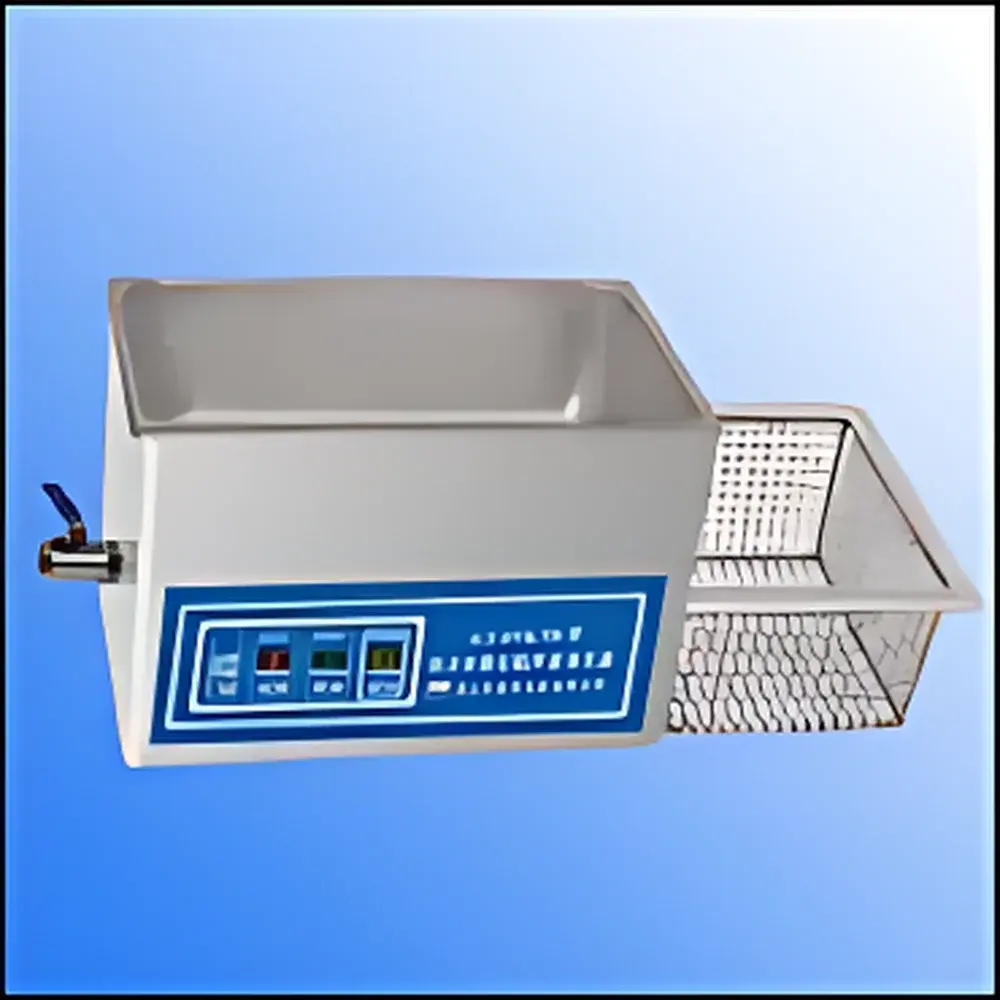
Kunshan KQ5200DB Benchtop Digital Ultrasonic Cleaner
| Origin | Shanghai, China |
|---|---|
| Manufacturer Type | Authorized Distributor |
| Country of Origin | China |
| Model | KQ-5200DB |
| Price | USD 795 (FOB Shanghai) |
| Ultrasonic Frequency | 40 kHz |
| Ultrasonic Power Output | 200 W |
| Adjustable Power Range | 40–100% |
| Tank Capacity | 10 L |
| Internal Tank Dimensions | 300 × 240 × 150 mm (L×W×H) |
| External Dimensions | 320 × 264 × 320 mm (L×W×H) |
| Heating Power | 600 W |
| Temperature Control Range | 20–80 °C |
| Timer Range | 1–480 min |
| Stainless Steel Mesh Basket | Included |
| Sound-Dampening Lid | Included |
| Drain Valve | Included |
| Tank Material | 304 Stainless Steel |
| Control System | Microprocessor-Based Digital Interface |
| Safety Protections | Low-Level Fluid Detection, Over-Temperature, Over-Voltage, Over-Current, and Auto-Shutdown |
Overview
The Kunshan KQ5200DB Benchtop Digital Ultrasonic Cleaner is an engineered solution for precision cleaning, degassing, dispersion, emulsification, and cell disruption in academic, industrial, and quality control laboratories. It operates on the principle of ultrasonic cavitation—generating high-frequency (40 kHz) acoustic pressure waves in liquid media to produce transient microbubbles that collapse violently near solid surfaces, delivering localized energy sufficient to dislodge particulate contaminants, biofilms, and residual solvents without mechanical abrasion. Unlike analog or mechanically timed units, the KQ5200DB integrates a fully digital microcontroller-based system enabling repeatable, traceable, and auditable process parameters—critical for GLP-compliant environments and method validation under ISO/IEC 17025 and ASTM D2603 guidelines.
Key Features
- Digital microprocessor control with real-time display of elapsed time, set time, bath temperature, and actual temperature—enabling precise replication of cleaning protocols across shifts and operators.
- Adjustable ultrasonic power output (40–100% in 1% increments), allowing optimization for delicate optics, fragile substrates, or heavily soiled metal parts without compromising integrity.
- Integrated 600 W heating system with ±1 °C temperature stability across the 20–80 °C range, supporting temperature-dependent applications such as wax removal, solvent-assisted extraction, and enzymatic decontamination.
- Comprehensive safety architecture: automatic shutdown triggered by low liquid level detection, over-temperature (≥85 °C), over-voltage (>±10% nominal), and over-current conditions—meeting IEC 61010-1 requirements for laboratory electrical equipment.
- Stainless steel (AISI 304) tank and mesh basket—electropolished and argon-welded for corrosion resistance, cleanability, and long-term dimensional stability in aqueous and mild organic solvent environments.
- Sound-dampening lid reduces ambient noise to ≤55 dB(A) at 1 m distance, improving operator comfort and meeting occupational health thresholds per OSHA 29 CFR 1910.95.
- Cumulative operational logging up to 999,999 hours—supporting preventive maintenance scheduling, asset lifecycle tracking, and audit readiness for FDA 21 CFR Part 11–aligned documentation systems.
Sample Compatibility & Compliance
The KQ5200DB accommodates a broad spectrum of sample types—including glassware (vials, cuvettes, pipettes), metallic components (surgical instruments, precision fixtures), ceramic substrates, silicon wafers, and polymer-based microfluidic devices—within its 10 L capacity and 300 × 240 × 150 mm internal chamber. Its 40 kHz transducer array delivers uniform energy distribution across the tank volume, validated via ASTM E1557 beam mapping methodology. The unit complies with CE marking directives (EMC 2014/30/EU, LVD 2014/35/EU), RoHS 2011/65/EU, and conforms to ISO 13485–compatible manufacturing practices. While not certified for sterile processing per ISO 17664, it is routinely deployed in pre-sterilization cleaning workflows aligned with AAMI ST79 and USP standards when paired with validated cleaning chemistries.
Software & Data Management
The KQ5200DB operates autonomously via its embedded firmware—no external PC or proprietary software required. All parameter settings (time, temperature, power) are retained in non-volatile memory after power cycling, eliminating reconfiguration errors. The digital interface supports timestamped event logging (start/stop, fault triggers, temperature excursions) accessible via front-panel navigation. For integration into centralized lab informatics platforms, optional RS-232 or USB-to-serial adapters enable ASCII protocol communication (ASCII command set available upon request), permitting remote start/stop, status polling, and basic data export compatible with LabVantage, STARLIMS, or custom Python-based monitoring scripts. Audit trail functionality satisfies GLP Annex 11 and GMP Annex 11 expectations for electronic records integrity.
Applications
- Removal of polishing compounds, flux residues, and machining oils from precision optics and MEMS components.
- Pre-analytical cleaning of HPLC vials, GC liners, and ICP-MS sample introduction hardware to minimize spectral interferences.
- Cell lysis and nucleic acid extraction support in molecular biology workflows—validated for use with Trizol-compatible buffers and DNase/RNase-free protocols.
- Degassing of solvents prior to HPLC mobile phase preparation or vacuum impregnation processes.
- Dispersion of nanomaterials (e.g., graphene oxide, TiO₂ nanoparticles) in aqueous and ethanolic suspensions for colloidal stability studies.
- Decontamination of reusable PPE (face shields, goggle lenses) and lab tools in biosafety Level 2 facilities following CDC-recommended disinfectant compatibility matrices.
FAQ
What is the maximum recommended solvent temperature for continuous operation?
The unit is rated for sustained operation at temperatures up to 80 °C using water or water-miscible solvents (e.g., ethanol, isopropanol). For chlorinated or highly volatile solvents (e.g., acetone, hexane), operation above 45 °C requires forced ventilation and adherence to NFPA 30 storage and handling guidelines.
Can the KQ5200DB be used for cleaning delicate optical coatings?
Yes—when operated at ≤50% power and 25–35 °C with low-surface-tension, non-ionic detergents (e.g., Alconox Liquinox), the device has been successfully applied to anti-reflective and dielectric-coated lenses without measurable coating degradation per MIL-C-48497A inspection criteria.
Is calibration documentation provided with the unit?
Factory calibration certificates for temperature sensor accuracy (±0.5 °C at 25 °C and 60 °C) and timer deviation (<±0.2% over 60 min) are included. Users may perform field verification using NIST-traceable thermistors and stopwatch standards per ISO/IEC 17025 Clause 6.5.
Does the drain valve support connection to laboratory waste collection systems?
The standard 1/4″ BSP threaded drain port accepts flexible PVC or silicone tubing (ID 6 mm); direct plumbing into acid-resistant waste lines is permissible when solvent compatibility is confirmed.
How often should the ultrasonic transducers be serviced?
Under normal usage (≤6 h/day, deionized or distilled water), transducer performance remains stable for ≥5 years. Annual visual inspection for delamination or epoxy cracking—and quarterly measurement of tank impedance using a calibrated LCR meter—is recommended per manufacturer’s maintenance schedule.



