
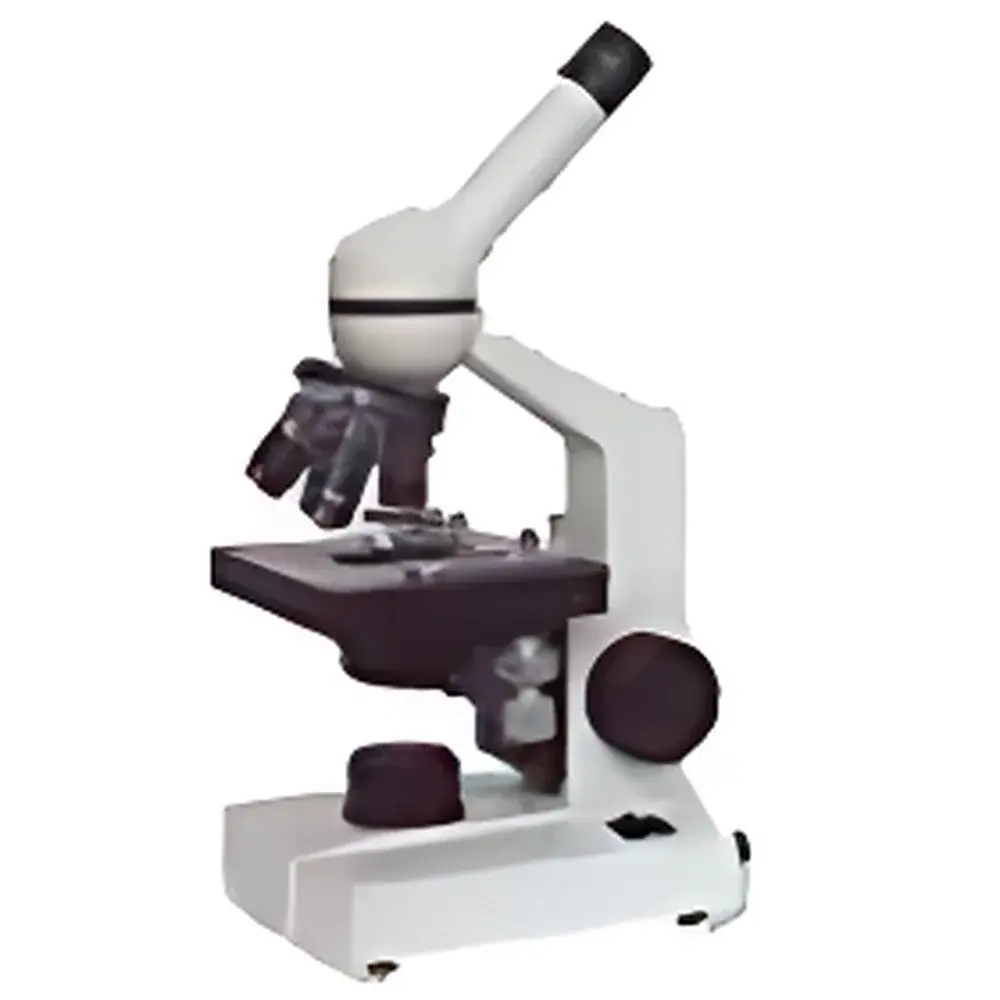
XSP-2CA Monocular Biological Microscope
| Origin | Shanghai, China |
|---|---|
| Manufacturer Type | Authorized Distributor |
| Origin Category | Domestic (PRC) |
| Model | XSP-2CA |
| Price | USD 340 (FOB Shanghai) |
| Eyepiece Tube | Monocular |
| Condenser | Abbe Condenser with Adjustable Iris Diaphragm and Color Filter Holder |
| Eyepieces | Wide-Field WF10× (18 mm FOV), Huygens H16× |
| Objectives | Achromatic 4×, 10×, 40× (Spring-Loaded), 100× (Oil Immersion, Spring-Loaded) |
| Illumination | 6 V / 20 W Halogen Lamp with Centerable Light Source |
| Power Supply | AC 100–240 V, 50/60 Hz, Integrated LED-Compatible Socket |
Overview
The XSP-2CA Monocular Biological Microscope is a precision-engineered optical instrument designed for routine brightfield observation in academic teaching laboratories, clinical pathology support settings, and entry-level research environments. Built upon classical Köhler illumination principles, it delivers consistent axial alignment, uniform field illumination, and minimal chromatic aberration across its full achromatic objective suite. Its monocular head configuration prioritizes ergonomic stability and simplified optical path integrity—ideal for extended student use or high-throughput specimen screening where binocular fatigue or parfocal complexity is undesirable. The microscope employs a rigid cast-aluminum mechanical stage with dual coaxial coarse/fine focus controls (2 mm coarse travel, 0.002 mm fine increment), ensuring reproducible focusing across repeated sample inspections. All optical components comply with ISO 8578:2017 standards for biological microscope performance verification, including resolution validation at 546 nm wavelength and depth-of-field calibration per DIN 58889.
Key Features
- Rugged all-metal frame construction with anti-corrosive black enamel finish, supporting long-term mechanical stability under continuous lab operation.
- Abbe condenser (NA 1.25) with centerable aperture diaphragm and integrated filter holder—enabling precise control of contrast, resolution, and illumination uniformity per ASTM E2823-22 guidelines.
- Two interchangeable eyepieces: Wide-field WF10× (18 mm field number) for rapid scanning and low-magnification orientation; Huygens H16× for enhanced detail at intermediate magnifications—both equipped with diopter adjustment and rubber eyecups for user-specific accommodation.
- Four-parfocal achromatic objectives (4×, 10×, 40×S, 100×S oil) featuring spring-loaded front lenses to prevent slide damage during high-magnification focusing—certified to ISO 10934-1 for lateral color correction and spherical aberration suppression.
- 6 V / 20 W halogen illumination system with built-in voltage regulation and lamp centering mechanism—ensuring stable color temperature (~3200 K) and intensity repeatability over >1,000 hours of rated service life.
- Integrated power supply accepts universal AC input (100–240 V, 50/60 Hz), eliminating need for external transformers; lamp socket compatible with optional LED retrofit modules meeting IEC 62471 photobiological safety Class 1 requirements.
Sample Compatibility & Compliance
The XSP-2CA accommodates standard 1″ × 3″ glass microscope slides (up to 1.2 mm thickness) and #0–#2 cover slips. It supports both dry-mount and oil-immersion protocols (Type A immersion oil, nD = 1.515) without mechanical interference. All optical surfaces are coated with MgF2-based anti-reflective layers to minimize stray light and maximize transmission efficiency above 92% in the 400–700 nm visible band. The instrument conforms to IEC 61010-1:2010 for laboratory electrical safety and carries CE marking under EU Directive 2014/30/EU (EMC) and 2014/35/EU (LVD). Documentation includes factory calibration certificate traceable to NIM (National Institute of Metrology, China) and compliance statement for ISO/IEC 17025-accredited quality management systems.
Software & Data Management
While the XSP-2CA operates as a standalone optical platform, its standardized trinocular port (optional accessory) enables seamless integration with third-party digital imaging systems—including CMOS sensors compliant with USB3 Vision or GigE Vision standards. When paired with validated capture software (e.g., Ocular Pro v5.2 or ImageJ-compatible drivers), the system supports time-stamped image acquisition, multi-focus Z-stack generation, and metadata embedding (objective ID, magnification, illumination intensity, date/time stamp). Audit trails and user access logs may be maintained externally in accordance with GLP-compliant workflows under FDA 21 CFR Part 11 when used in regulated QC/QA environments.
Applications
- Undergraduate biology instruction: cell morphology analysis, mitotic staging, protozoan motility observation, and basic histology slide evaluation.
- Clinical support labs: peripheral blood smear review, urinalysis sediment identification, and fungal culture morphology assessment.
- Plant science: stomatal density quantification, pollen grain characterization, and root hair development monitoring.
- Microbiology training: Gram staining interpretation, acid-fast bacilli screening, and yeast/bacterial colony isolation verification.
- Quality control in biomanufacturing: raw material particulate inspection, excipient homogeneity checks, and sterile filtration validation support.
FAQ
Is the XSP-2CA suitable for fluorescence observation?
No—it lacks epi-illumination capability, excitation/emission filter cubes, and high-NA objectives optimized for fluorescence. For such applications, consider the XSP-3CF series with modular fluorescence turret.
Can I upgrade to a binocular head?
The XSP-2CA mechanical base and focusing assembly are not mechanically compatible with binocular tubes; upgrading requires replacement with the XSP-3CB platform.
What is the maximum usable magnification with the 100× oil objective?
Effective magnification is limited by optical resolution—not just objective power. With a 10× eyepiece, total magnification reaches 1000×, but practical resolution remains constrained by the Abbe limit (~0.2 µm at 546 nm) and immersion oil refractive index matching.
Does the halogen lamp require periodic alignment?
Yes—centering should be verified quarterly using the provided alignment tool and condenser centering screws, per manufacturer’s maintenance schedule (Section 4.2 of Operation Manual Rev. B).
Is service documentation available in English?
Yes—full bilingual (English/Chinese) user manual, calibration report, and spare parts catalog are supplied digitally and on request in printed form.






