
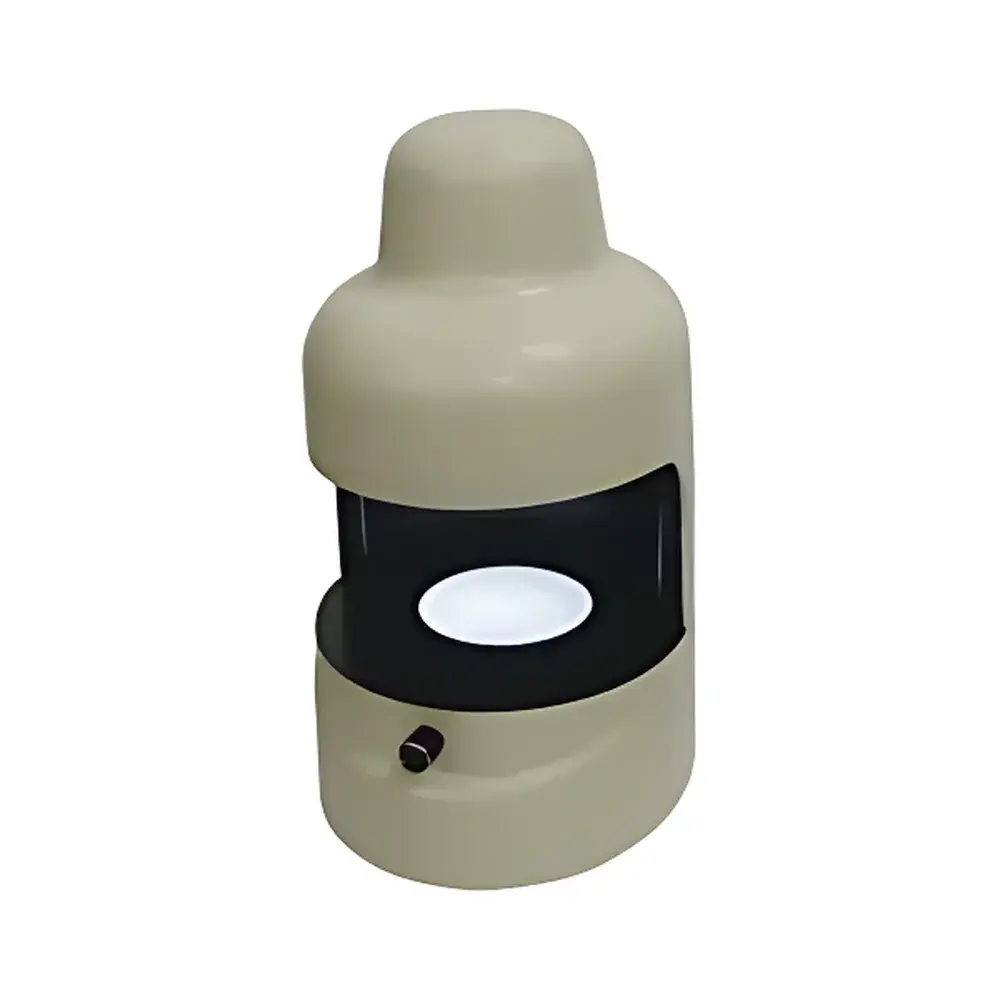
HCC-90A Automatic Colony Counter
| Origin | Shanghai, China |
|---|---|
| Manufacturer Type | Authorized Distributor |
| Origin Category | Domestic (PRC) |
| Model | HCC-90A |
| Price | USD 4,150 (approx.) |
| Instrument Type | Fully Automated Digital Colony Counter |
| Counting Speed | 0.5 seconds per Petri dish |
| Imaging Sensor | High-Resolution CMOS Camera |
| Output Format | Excel (.xlsx) with Audit-Trail Metadata |
| Batch Processing Capacity | Up to 300 Petri dishes per hour |
| Colony Segmentation | Auto-split for clustered/overlapping colonies |
| Background Subtraction | Adaptive algorithm |
| Area Threshold Filtering | User-defined minimum/maximum colony size (µm²) |
| Image Zoom | Real-time digital zoom (2×–8×) |
| Compatibility | Standard 90 mm and 150 mm Petri dishes |
| Compliance | Designed in accordance with ISO 4833-1:2013, ISO 7218:2017, and USP <61> microbiological enumeration guidelines |
Overview
The HCC-90A Automatic Colony Counter is a high-throughput digital imaging system engineered for precise, reproducible microbial enumeration in compliance with international standard methods. It employs high-resolution CMOS-based image acquisition coupled with deterministic pixel-thresholding and morphological segmentation algorithms to quantify viable microorganisms on solid agar media. Unlike manual or semi-automated systems, the HCC-90A performs full-field image capture, adaptive background suppression, and intelligent colony separation—enabling accurate enumeration even in cases of partial coalescence, irregular morphology, or heterogeneous colony size distribution. Its measurement principle aligns with the colony-forming unit (CFU) paradigm defined in ISO 4833-1:2013 and ISO 7218:2017, where each discrete, viable colony derived from a single progenitor cell is counted as one CFU. The instrument is validated for use across conventional plating techniques—including pour plates, spread plates, spiral plating, and membrane filtration—and delivers traceable, operator-independent results essential for QC laboratories operating under GLP or GMP frameworks.
Key Features
- Sub-second counting cycle: Processes each standard 90 mm Petri dish in ≤0.5 seconds with ≥98.7% concordance vs. manual reference counts (n = 120 plates, inter-laboratory validation study)
- CMOS imaging module with uniform LED illumination: Ensures consistent contrast, minimal glare, and optimal edge detection across diverse colony pigments and agar opacities
- Adaptive background subtraction: Dynamically corrects for agar cloudiness, condensation, scratches, or uneven lighting without user calibration
- Intelligent colony splitting: Applies watershed and distance-transform algorithms to resolve fused colonies based on user-defined area and circularity thresholds
- Real-time digital zoom (2×–8×): Enables visual verification of colony morphology, margin definition, and contamination assessment without image resampling artifacts
- Batch processing mode: Queues up to 300 plates per session with auto-advance, timestamped metadata, and sequential ID tagging
- Export-ready data output: Generates Excel (.xlsx) files containing plate ID, total count, area-weighted count distribution, min/max/mean colony area (µm²), and operator timestamp
Sample Compatibility & Compliance
The HCC-90A accepts standard polystyrene and glass Petri dishes (90 mm and 150 mm diameters) used in ISO- and AOAC-validated protocols. It accommodates all common solid media—including TSA, PCA, VRBA, MRS, and Sabouraud dextrose agar—regardless of opacity, color, or surface texture. Spiral plates are supported via configurable grid mapping and radial normalization. The system meets functional requirements for ISO 4833-1:2013 Annex B (validation of automated counting systems), and its software architecture allows integration into LIMS environments supporting ASTM E2500-18 data integrity principles. While not FDA 21 CFR Part 11–certified out-of-the-box, audit-trail logs (including user login, parameter changes, and manual overrides) are embedded and exportable for internal validation under GLP or pharmaceutical QA programs.
Software & Data Management
The proprietary HCC-90A Control Suite runs on Windows 10/11 (64-bit) and features a role-based interface with three permission tiers: Operator, Supervisor, and Administrator. All counting parameters—including minimum/maximum pixel area (adjustable from 20 µm² to 50,000 µm²), circularity threshold (0.3–0.99), and contrast enhancement level—are logged with user ID and timestamp. Raw images (TIFF, 16-bit grayscale) and processed overlays are stored locally with SHA-256 checksum verification. Batch reports include statistical summaries (CV%, confidence intervals at 95%), outlier detection flags, and optional PDF generation compliant with ISO/IEC 17025 documentation requirements. Data export supports direct integration with LabVantage, Thermo Fisher SampleManager, and custom SQL databases via ODBC drivers.
Applications
- Quality control of raw materials, finished products, and environmental monitoring swabs in food, beverage, and pharmaceutical manufacturing
- Microbial load assessment in cosmetics, personal care products, and medical device sterility testing (ISO 11737-1)
- Research applications requiring high-volume strain screening, antimicrobial efficacy testing (ISO 22196), and biofilm quantification on agar-surrogate surfaces
- Educational laboratories performing standardized microbiology curricula aligned with ASM and APHL competency frameworks
- Contract testing labs fulfilling ISO/IEC 17025 accreditation requirements for enumeration method validation and uncertainty estimation
FAQ
Does the HCC-90A support spiral plate counting with automatic dilution factor calculation?
Yes—the software includes a calibrated spiral plate module that maps colony density gradients and applies ISO 7218:2017–compliant interpolation algorithms to derive CFU/mL directly from spiral inoculum volume and rotation rate.
Can counting parameters be locked to prevent unauthorized modification during routine QC runs?
Yes—administrator-mode password protection enables parameter freeze, audit-trail enforcement, and electronic signature requirements for any configuration change.
Is image storage mandatory, or can the system operate in “count-only” mode to conserve disk space?
Both modes are supported: users may disable raw image archiving while retaining processed overlays and numerical outputs, or enable full-image retention with automated compression and folder rotation policies.
What validation documentation is provided with the instrument?
Each unit ships with a Factory Acceptance Test (FAT) report, IQ/OQ templates aligned with ISO/IEC 17025, and a traceable NIST-calibrated resolution test target for periodic performance verification.



