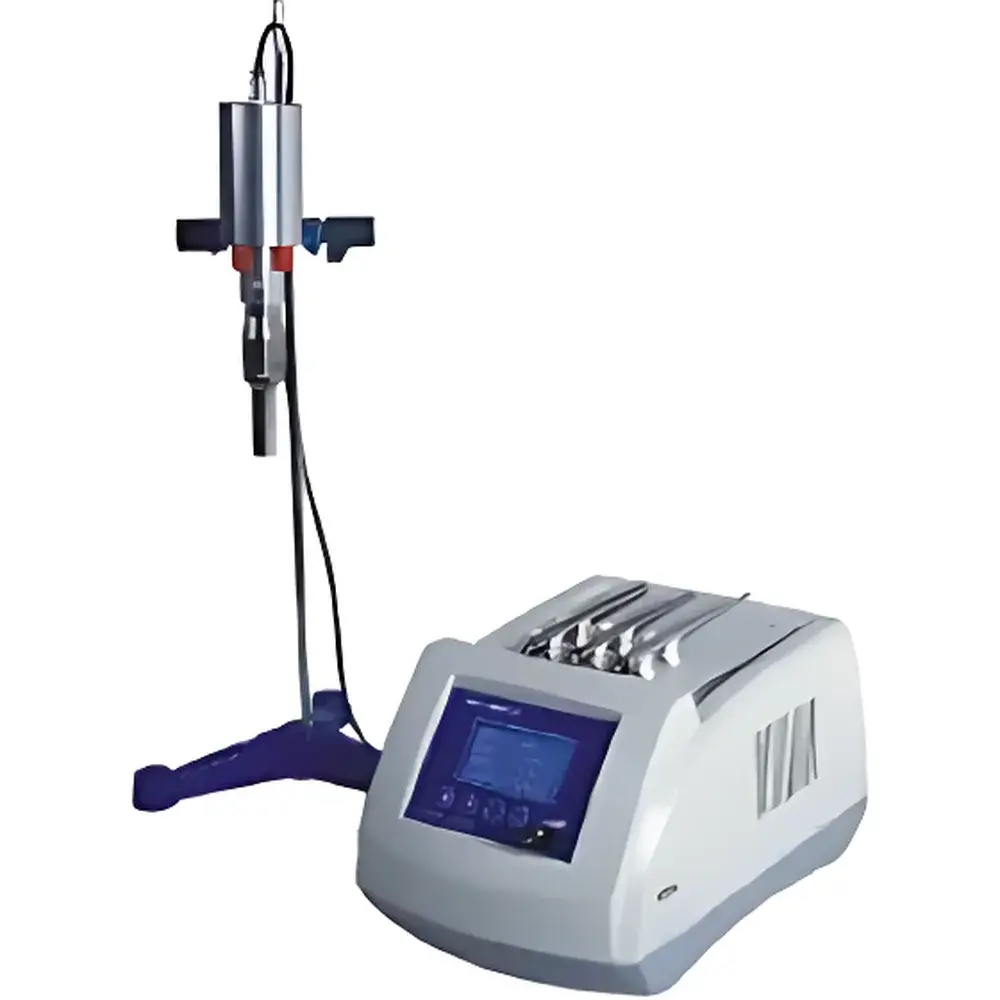
Chu Ding Technology HUP-400A Ultrasonic Cell Disruptor
| Brand | Chu Ding Technology |
|---|---|
| Origin | Shanghai, China |
| Manufacturer Type | Authorized Distributor |
| Country of Origin | China |
| Model | HUP-400A |
| Power Output | 400 W |
| Optional Sonotrodes | 1/8", 1/4", 3/8", 1/2" |
| Sample Volume Range | 250 µL – 600 mL |
| Pulse Mode Duty Cycle | 1% – 99% |
| Digital Timer | 1–99 min |
| Programmable Protocols | 5 user-defined methods |
| Energy Output Adjustment | 0–100% (linear analog control) |
Overview
The Chu Ding Technology HUP-400A Ultrasonic Cell Disruptor is a benchtop ultrasonic processor engineered for precise, reproducible cell lysis, emulsification, and homogenization in life science, pharmaceutical, and materials research laboratories. It operates on the principle of acoustic cavitation: high-frequency (typically 20–25 kHz) mechanical vibrations generated by a piezoelectric transducer are transmitted through a titanium alloy sonotrode into the liquid sample. This induces rapid formation and violent collapse of microscopic vapor cavities—generating localized shockwaves, microstreaming, and shear forces exceeding 10⁴ Pa. These physical effects disrupt cellular membranes, fragment subcellular structures, and promote interfacial mixing between immiscible phases without thermal degradation or chemical additives. Unlike rotor-stator homogenizers or bead mills, the HUP-400A delivers energy directly into the sample volume with minimal cross-contamination risk and no moving parts in contact with the medium.
Key Features
- 400 W nominal output power with real-time analog energy regulation (0–100%), enabling fine-tuned amplitude control for sensitive biological samples.
- Five programmable operating protocols stored in non-volatile memory—each defining amplitude, pulse duty cycle, total duration, and sonotrode configuration.
- Digital timer with 1-minute to 99-minute resolution; auto-standby activation upon completion ensures operator safety and energy efficiency.
- Flexible pulse mode: independently adjustable pulse width (ON time) and interval (OFF time), supporting duty cycles from 1% to 99%—critical for heat-sensitive applications such as protein extraction or viral inactivation studies.
- Modular sonotrode compatibility: standardized 1/8″, 1/4″, 3/8″, and 1/2″ tapered probes allow optimization of energy density across sample volumes from 250 µL (microcentrifuge tubes) to 600 mL (beakers or jacketed vessels).
- Front-panel LED indicators provide immediate visual feedback on operational status, energy delivery level (via bar-graph display), and active protocol number.
Sample Compatibility & Compliance
The HUP-400A accommodates a broad range of sample types including mammalian and plant tissues, bacterial cultures (E. coli, Bacillus spp.), yeast suspensions, viral particles, liposomes, and polymeric nanoparticle dispersions. Its non-invasive, solvent-free mechanism complies with Good Laboratory Practice (GLP) requirements for traceability and repeatability. While not certified to ISO/IEC 17025 or FDA 21 CFR Part 11 out-of-the-box, the device supports audit-ready workflows when integrated with external logging systems—particularly when used in conjunction with calibrated temperature monitoring (e.g., IR thermography or fiber-optic probes) during extended sonication. All titanium sonotrodes meet ASTM F136 standards for surgical-grade biocompatibility and corrosion resistance.
Software & Data Management
The HUP-400A operates via embedded firmware with no proprietary software dependency. All parameter settings—including amplitude, timing, and pulse architecture—are retained in EEPROM and recalled at power-up. For laboratories requiring electronic record-keeping, the unit’s digital interface supports optional RS-232 or TTL-level serial output (via accessory module), enabling integration with LIMS platforms or custom Python/Matlab scripts for automated protocol execution and timestamped log generation. Data integrity is maintained through write-protected memory sectors and checksum validation during boot sequence.
Applications
- Cell lysis and subcellular fractionation: Efficient disruption of Gram-negative and Gram-positive bacteria, mammalian cells (HEK293, CHO), and plant protoplasts while preserving native enzyme activity and nucleic acid integrity.
- Nanomaterial synthesis: Facilitation of solvent-assisted exfoliation of 2D materials (e.g., graphene oxide, MoS₂) and stabilization of metal-organic frameworks (MOFs) in aqueous colloids.
- Phytochemical extraction: Accelerated release of alkaloids, flavonoids, and terpenoids from dried botanical matrices under ambient or chilled conditions—reducing solvent consumption by up to 40% versus conventional maceration.
- Emulsion and nanoemulsion preparation: Production of oil-in-water and water-in-oil systems with droplet size distributions below 200 nm (Dv₅₀), validated by dynamic light scattering (DLS).
- Vaccine adjuvant formulation: Homogenization of aluminum hydroxide gels and liposomal antigen carriers to achieve uniform particle dispersion and enhanced immunogenicity profiles.
FAQ
What safety certifications does the HUP-400A hold?
The unit conforms to IEC 61000-6-3 (EMC emission limits) and IEC 61000-6-2 (immunity to electrostatic discharge and RF fields). CE marking applies to the EU market under the Low Voltage Directive 2014/35/EU.
Can the HUP-400A be used in cold rooms or under inert atmosphere?
Yes—provided appropriate probe cooling (e.g., ice-jacketed vessel or recirculating chiller) and sealed chamber integration. Titanium sonotrodes are compatible with nitrogen-purged environments.
Is calibration traceable to NIST standards?
Amplitude calibration is performed using laser vibrometry against reference transducers accredited to ISO 18436-2. Certificate of Conformance includes measurement uncertainty (k=2) and is supplied with each instrument.
How often should the sonotrode tip be inspected or replaced?
Visual inspection before each use is recommended. Tip erosion exceeding 0.2 mm radial deviation or pitting depth >5 µm requires replacement to maintain consistent cavitation intensity and avoid sample contamination.
Does the device support remote triggering via TTL signal?
Yes—via optional external trigger input (BNC connector), enabling synchronization with fluorescence imaging systems or mass spectrometry acquisition cycles.