
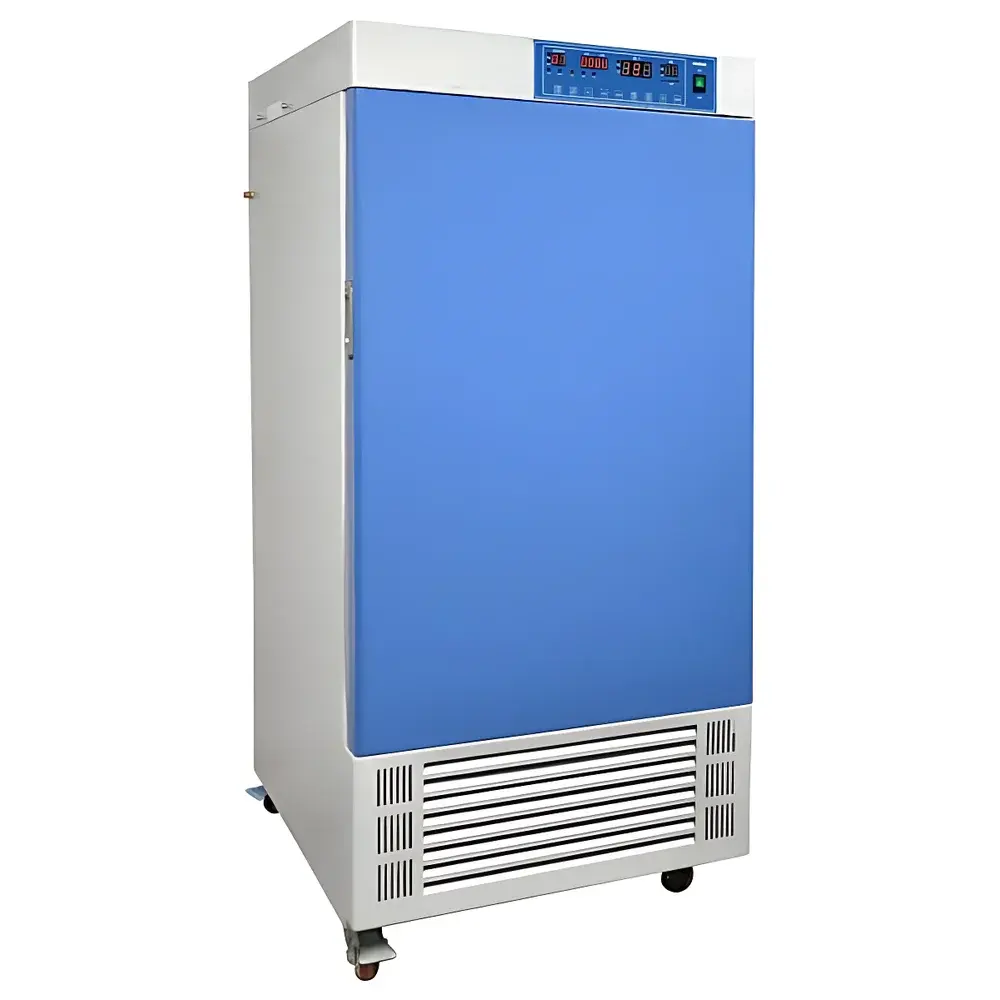
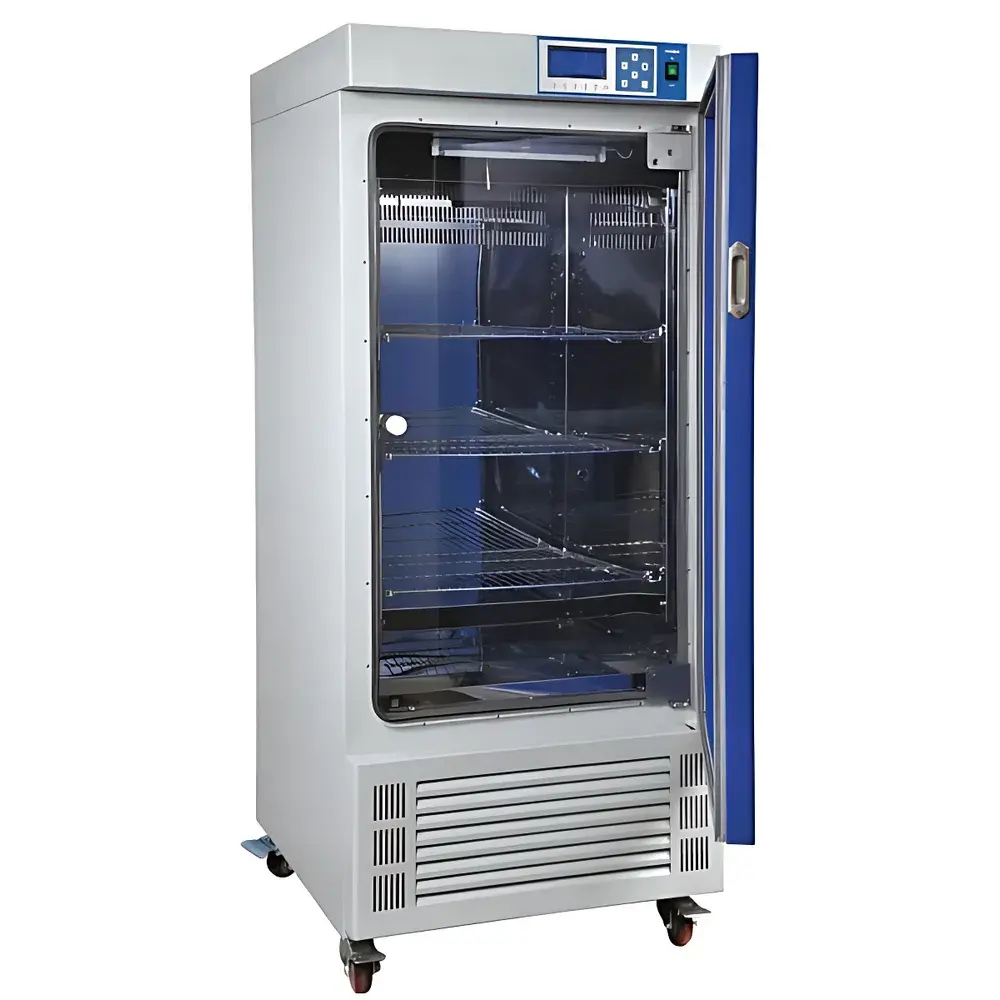
Chu Ding Technology LHS-300HC Temperature and Humidity Controlled Incubator (LCD Display, HFC-Free Refrigerant)
| Brand | Chu Ding Technology |
|---|---|
| Origin | Shanghai, China |
| Model | LHS-300HC |
| Power Supply | AC 220 V, 50 Hz |
| Temperature Range | RT+10 °C to 85 °C (heating only) |
| Humidity Range | 40–85 % RH |
| Temperature Uniformity | ±1 °C (typical, empty chamber, 20 °C ambient) |
| Temperature Resolution | 0.1 °C |
| Humidity Control Accuracy | ±3–5 % RH (dependent on setpoint and ambient conditions) |
| Chamber Volume | 300 L |
| Internal Dimensions (W×D×H) | 580 × 540 × 950 mm |
| External Dimensions (W×D×H) | 705 × 765 × 1640 mm |
| Input Power | 2000 W |
| Standard Shelving | 3 adjustable stainless steel shelves |
| Programmable Cycles | 99 cycles × 30 segments × 99 h 59 min per segment |
| Refrigerant | R134a / R406a (non-ozone-depleting, low-GWP HFC blend) |
| Compliance | Designed for GLP-compliant environmental simulation |
Overview
The Chu Ding Technology LHS-300HC is a precision-engineered temperature and humidity controlled incubator designed for long-term stability testing, accelerated aging studies, and controlled-environment biological or material conditioning in regulated laboratory and industrial quality assurance settings. It operates on a dual-mode thermodynamic principle: resistive heating combined with vapor-compression refrigeration using environmentally compliant R134a/R406a refrigerants—eliminating ozone-depleting chlorofluorocarbons (CFCs) and high-global-warming-potential (GWP) hydrochlorofluorocarbons (HCFCs). The unit maintains stable thermal gradients through forced-air convection driven by a JAKEL centrifugal circulation fan and an optimized ducted airflow architecture, ensuring uniform temperature distribution (±1 °C) across the full 300 L working volume. Its operational envelope spans from ambient +10 °C to 85 °C for dry heat applications, and 15–45 °C with active humidification (40–85 % RH), making it suitable for ICH Q1A(R3) stability protocols, ASTM D4332 conditioning, and USP environmental simulation.
Key Features
- Large backlit LCD interface displaying real-time temperature, humidity, setpoints, elapsed time, and program status—all visible at a glance without menu navigation.
- Electropolished mirror-finish stainless steel interior (304 grade) with seamless, radius-corner construction for microbial containment and ease of decontamination—compliant with ISO 14644-1 Class 8 cleanroom support requirements.
- Dual-pane insulated observation door with low-emissivity glass minimizes thermal leakage during visual monitoring and eliminates condensation under high-humidity operation.
- Modular humidity system featuring a built-in stainless steel water reservoir, submerged tubular heating elements, and a high-stability capacitive humidity sensor (Honeywell or equivalent) calibrated traceably to NIST standards.
- PID-based digital control algorithm for both temperature and humidity loops, delivering stable setpoint maintenance with minimal overshoot and recovery time after door opening.
- Programmable logic controller supporting up to 99 multi-step cycles, each comprising 30 configurable segments—enabling complex ramp-soak-hold profiles required for ICH Q5C protein stability or ASTM D7034 polymer conditioning.
- Robust refrigeration subsystem integrating a branded hermetic compressor, proprietary oil management circuitry, and adaptive defrost logic to extend service life beyond 15,000 operating hours under continuous duty.
Sample Compatibility & Compliance
The LHS-300HC accommodates standard ISO/IEC 60068-2-1 (cold), -2-2 (dry heat), and -2-78 (damp heat) test specimens up to 500 mm in height. Its internal geometry permits stacking of ICH-compliant stability chambers (e.g., 250 mm × 250 mm × 150 mm trays), pharmaceutical blister packs, textile swatches, and electronic component assemblies. Optional 25 mm or 50 mm diameter pass-through ports (IP54-rated) allow external probe insertion without compromising chamber integrity. All electrical components meet CE marking requirements under Directive 2014/30/EU (EMC) and 2014/35/EU (LVD). While not certified for GMP manufacturing environments per FDA 21 CFR Part 11 out-of-the-box, the system supports audit-ready data logging when equipped with RS485 or USB interfaces and validated third-party software.
Software & Data Management
The incubator supports optional connectivity via isolated RS485 (Modbus RTU protocol) or USB 2.0 host port for integration into centralized environmental monitoring systems (EMS). When paired with validated PC-based software (sold separately), users can configure alarm thresholds, generate PDF reports with electronic signatures, and export CSV-formatted time-series datasets—including timestamped temperature/humidity values, cycle progress, and event logs (door openings, power interruptions, sensor faults). Data retention complies with ALCOA+ principles: attributable, legible, contemporaneous, original, accurate, complete, consistent, enduring, and available. Audit trail functionality records all parameter changes, user logins, and firmware updates—meeting GLP Annex III and EU Annex 11 expectations for metadata integrity.
Applications
- Pharmaceutical stability testing per ICH Q1A(R3), Q5C, and WHO TRS 1010 guidelines—particularly for intermediate storage conditions (30 °C/65 % RH) and accelerated studies (40 °C/75 % RH).
- Textile and polymer aging per ASTM D4332, D7034, and ISO 2231:2018—evaluating tensile strength loss, colorfastness, and dimensional stability under cyclic humidity exposure.
- Microbial growth inhibition assays requiring precise hygrothermal control (e.g., Aspergillus niger challenge testing per ISO 846).
- Electronic component preconditioning prior to HALT/HASS per JEDEC JESD22-A110 and MIL-STD-810H Method 507.6.
- Seed germination and plant tissue culture support where diurnal RH cycling mimics natural microclimates (e.g., 25 °C/70 % RH day → 20 °C/85 % RH night).
FAQ
What refrigerant does the LHS-300HC use, and why is it environmentally preferable?
The unit employs a blended refrigerant composed of R134a and R406a—both hydrofluorocarbons (HFCs) with zero ozone depletion potential (ODP = 0) and significantly lower global warming potential (GWP) than legacy R22 or R12 systems. This aligns with Kigali Amendment phase-down schedules and EU F-Gas Regulation No. 517/2014 compliance pathways.
Is the humidity sensor factory-calibrated, and can it be user-recalibrated?
Yes—the capacitive RH sensor is pre-calibrated against NIST-traceable reference hygrometers at three points (30 %, 60 %, and 90 % RH) before shipment. Field recalibration requires a certified saturated salt solution kit and must be performed under ISO/IEC 17025-accredited conditions.
Does the LHS-300HC support 21 CFR Part 11 compliance for electronic records?
Out-of-the-box, the base unit does not include Part 11–compliant audit trails or electronic signature capabilities. However, when integrated with validated third-party EMS software and configured with role-based access controls, password policies, and immutable data archiving, it may serve as a compliant peripheral within a broader Part 11–validated system.
What is the maximum allowable load mass without compromising temperature uniformity?
For guaranteed ±1 °C uniformity, loading should not exceed 60 % of chamber volume by solid mass (i.e., ≤18 kg of typical density materials). Densely packed or thermally insulating samples may require extended equilibration times and empirical validation per ISO 14644-3 Annex B.
Can the unit operate continuously at 45 °C and 85 % RH?
Yes—this condition falls within its rated specification envelope. Continuous operation at this setpoint requires regular reservoir refills (every 48–72 h depending on ambient dew point) and periodic inspection of condensate drain lines to prevent microbial buildup.




