
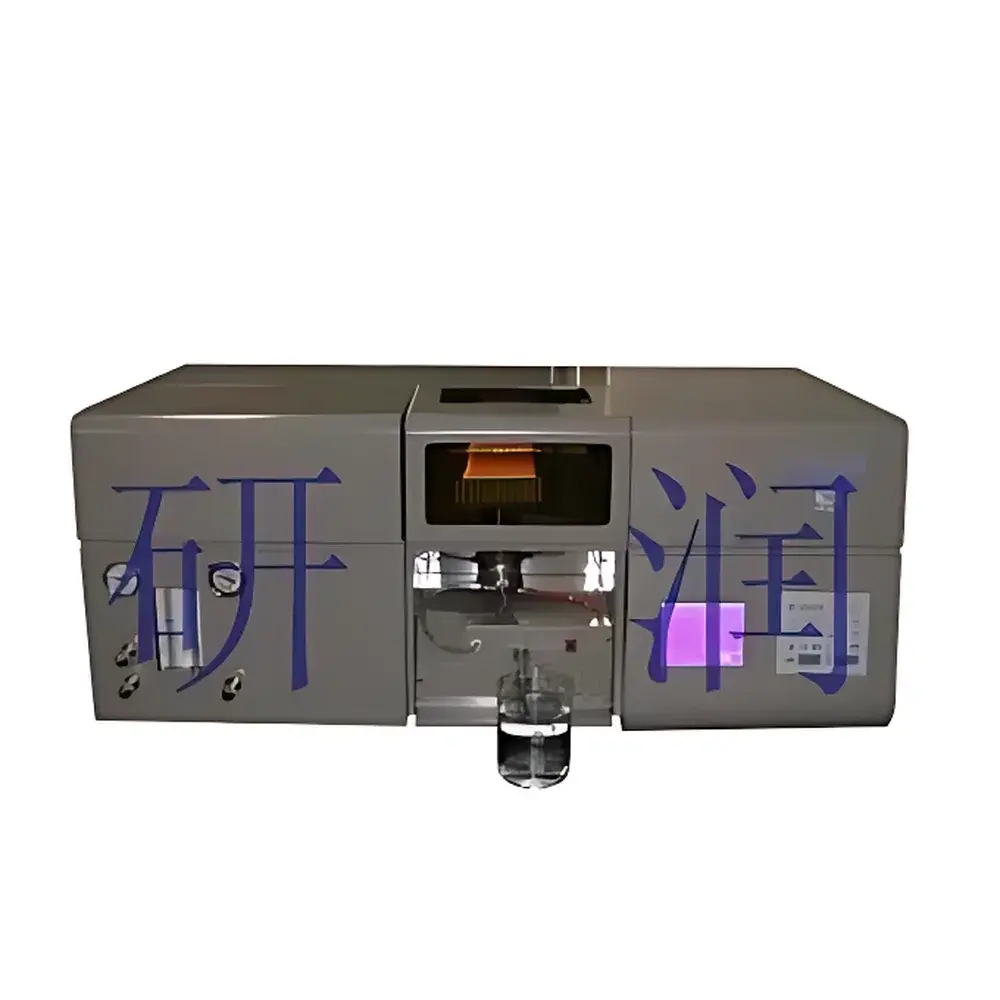
MC016-AA320CRT Atomic Absorption Spectrometer
| Origin | Shanghai, China |
|---|---|
| Manufacturer Type | Authorized Distributor |
| Origin Category | Domestic (PRC) |
| Model | MC016-AA320CRT |
| Pricing | Available Upon Request |
Overview
The MC016-AA320CRT Atomic Absorption Spectrometer is a benchtop flame/graphite furnace-compatible instrument engineered for quantitative and trace-level elemental analysis of metals in liquid samples. It operates on the fundamental principle of atomic absorption spectroscopy (AAS): ground-state free atoms—generated in a high-temperature atomizer (flame or graphite tube)—absorb characteristic radiation from hollow cathode lamps at element-specific wavelengths. The magnitude of absorbance, measured via Beer–Lambert law correlation, enables precise concentration determination down to sub-pptr levels. Designed for routine laboratory environments—including QC labs, environmental testing facilities, geological survey units, and academic research centers—the AA320CRT delivers robust performance across multi-element workflows without requiring extended lamp warm-up periods, owing to its dual-beam optical architecture and real-time drift compensation.
Key Features
- Dual-beam optical system with automatic compensation for source intensity drift, thermal wavelength shift, and detector responsivity variation—ensuring long-term baseline stability (≤0.004 Abs/30 min) and enabling immediate sample analysis without pre-heating lamps.
- Fully reflective optical path with achromatic design across 190–900 nm; optimized imaging transforms circular lamp emission into a 1×6 mm² rectangular slit illumination, maximizing photon throughput and signal-to-noise ratio in both beams.
- Corrosion-resistant atomization system: stainless-steel nebulizer chamber and a thermally balanced titanium alloy burner head with integrated heat dissipation—eliminating water cooling while maintaining sensitivity stability during prolonged operation.
- Multi-mode analytical capability: supports flame AAS, flame emission spectroscopy (FES), electrothermal (graphite furnace) AAS, and hydride generation AAS—all accessible via modular component exchange with mechanical alignment retention.
- Gas switching system compliant with EN ISO 11885 and ASTM D1688 safety protocols; enables seamless transition between air-acetylene and nitrous oxide-acetylene flames, extending measurable element coverage from >30 to >60 elements—including refractory species such as Al, Si, V, and Mo.
- Integrated analog electronics with peak-hold, integration, auto-zero, direct concentration readout, and deuterium-lamp background correction (correction factor >30); includes RS-232 interface for external PC connectivity and basic data logging.
Sample Compatibility & Compliance
The AA320CRT accepts aqueous and acid-digested samples (e.g., HNO₃/HCl/HF mixtures per EPA Method 200.7 or ISO 11047). It complies with core regulatory frameworks governing elemental quantification: USP , ASTM E1019, ISO 11170, and EN 14802 for drinking water analysis. While not natively 21 CFR Part 11–compliant, its analog output and stable hardware platform support integration into validated LIMS or ELN systems under GLP/GMP audit conditions when paired with appropriate procedural controls and electronic signature workflows.
Software & Data Management
The instrument features embedded firmware supporting manual operation and parameter storage (up to 20 methods). Raw absorbance/time data can be exported via RS-232 to third-party software (e.g., Excel, LabSolutions, or custom Python-based processing scripts). For full compliance-driven environments, users may implement external acquisition platforms that enforce audit trails, user access tiers, and electronic signatures—aligning with ALCOA+ (Attributable, Legible, Contemporaneous, Original, Accurate) data integrity principles.
Applications
- Environmental monitoring: Pb, Cd, Cr, As, and Hg quantification in wastewater, soil extracts, and airborne particulate filters (per EPA 7000B).
- Pharmaceutical excipient testing: residual catalyst metals (Pd, Pt, Ni) in active pharmaceutical ingredients (APIs) per ICH Q2(R2).
- Food safety: Na, K, Ca, Mg, Fe, Zn in fortified cereals and dairy products (AOAC 984.27).
- Geochemical analysis: Cu, Zn, Mn, Co in rock digests and ore concentrates (ISO 13877).
- Clinical toxicology: Blood lead level screening in occupational health settings (CLIA-waived protocols).
FAQ
Does the AA320CRT support graphite furnace analysis?
Yes—equipped with optional GF-320 graphite furnace module, including temperature programming, integrated argon purge control, and Zeeman-effect background correction compatibility.
What is the maximum achievable detection limit for cadmium using flame AAS mode?
Under optimized conditions (N₂O–C₂H₂ flame, 228.8 nm line), the practical detection limit is ≤0.01 µg/mL; lower values are attainable using graphite furnace mode.
Is spectral bandwidth selection automated or manual?
Bandwidth selection (0.2, 0.4, 0.7, 1.4, 2.4, or 5.0 nm) is manually set via front-panel knob, aligned with ISO 11047 recommendations for optimal resolution vs. sensitivity trade-off.
Can the instrument operate under GLP-compliant data governance?
While the base unit lacks built-in electronic audit trail functionality, it serves as a validated endpoint in regulated workflows when interfaced with compliant data acquisition software and documented SOPs.
What maintenance intervals are recommended for the nebulizer and burner head?
Nebulizer cleaning every 200 analyses; burner head inspection and acid soak every 500 flame hours—consistent with ASTM D1688 maintenance guidelines.




