
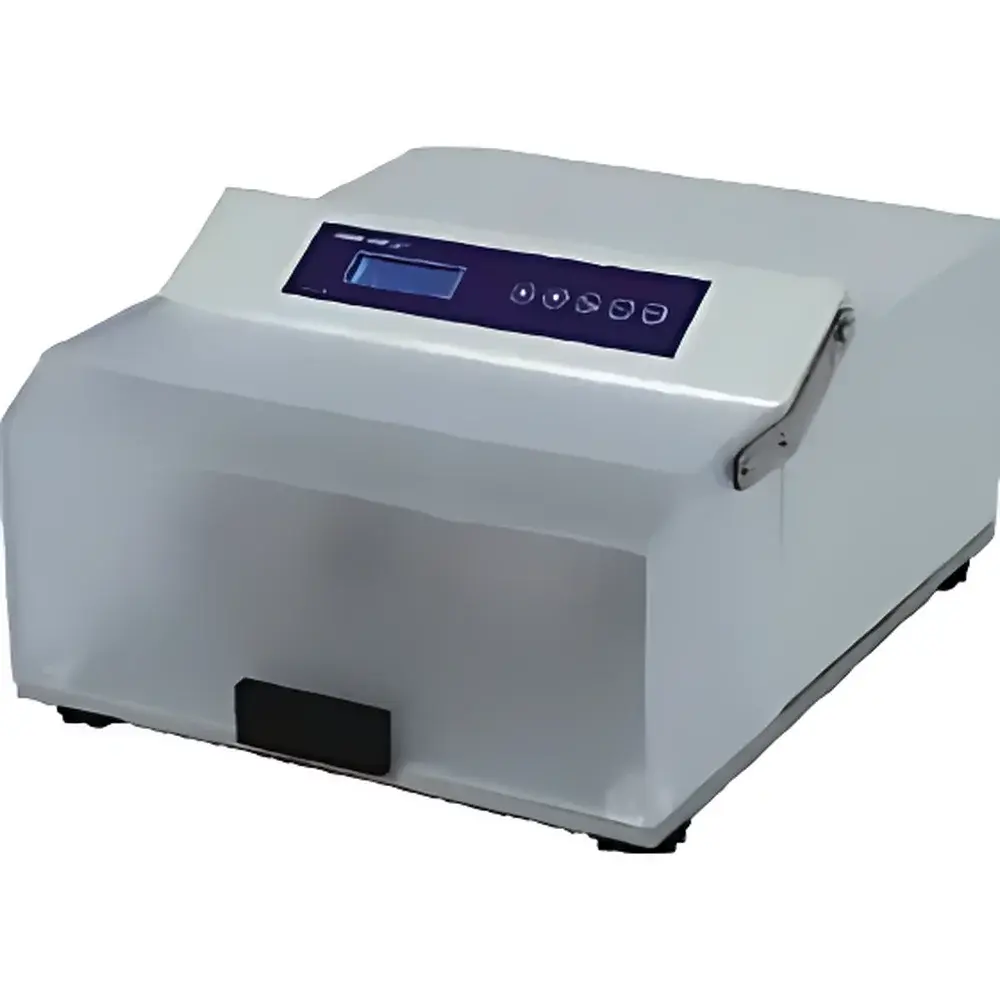
Hengao HMM-400 Planetary Ball Mill
| Origin | Shanghai, China |
|---|---|
| Manufacturer Type | Authorized Distributor |
| Origin Category | Domestic (PRC) |
| Model | HMM-400 |
| Instrument Type | Planetary Ball Mill |
| Sample Suitability | Hard, Brittle, Fibrous, Elastic & Composite Materials |
| Final Particle Size | ≤5 µm |
| Maximum Feed Size | 6 mm |
| Batch Capacity | 10 mL |
| Grinding Frequency Range | 3–20 Hz |
| Grinding Time Range | 1–99 min |
| Motor Power | 180 W |
| Dimensions (W×D×H) | 421 × 350 × 218 mm |
| Net Weight | 25 kg |
| Grinding Jar Volume | Up to 25 mL |
| Jar Material Options | Stainless Steel, Tungsten Carbide, Zirconia, Agate |
| Programmable Presets | 9 user-defined protocols |
| Sealed Vial Design | Yes |
| Reproducibility | High inter-batch consistency under identical parameter sets |
Overview
The Hengao HMM-400 Planetary Ball Mill is a high-efficiency, benchtop laboratory mill engineered for rapid, controlled size reduction of small-volume samples—particularly those exhibiting high hardness, brittleness, or structural heterogeneity. Operating on the principle of planetary motion, the instrument subjects grinding jars to simultaneous rotation around their own axis and revolution around a central sun wheel, generating intense centrifugal and Coriolis forces. This dual-axis kinematic regime enables highly energetic impact and shear between grinding media (e.g., balls) and sample particles, facilitating consistent micronization without thermal degradation when operated within recommended time and frequency limits. Designed for precision pre-treatment in analytical workflows, the HMM-400 delivers reproducible sub-5 µm particle distributions essential for X-ray fluorescence (XRF), X-ray diffraction (XRD), inductively coupled plasma (ICP) analysis, and scanning electron microscopy (SEM) sample preparation.
Key Features
- Two independent grinding stations enable parallel processing of two samples under identical or differentiated parameters—improving throughput and experimental control.
- Interchangeable grinding jars (up to 25 mL capacity) available in stainless steel, tungsten carbide, zirconia, and agate—ensuring chemical compatibility and minimizing contamination for trace-level analysis.
- Nine programmable memory slots store customized protocols including frequency (3–20 Hz), duration (1–99 min), and pause intervals—supporting method standardization across users and shifts.
- Hermetically sealed vial system prevents cross-contamination, volatile loss, and operator exposure—critical for hazardous, hygroscopic, or regulated substances (e.g., pharmaceutical actives, heavy metal standards).
- Robust cast-aluminum housing with vibration-damping feet ensures mechanical stability during high-frequency operation; integrated safety interlock halts motion if lid is opened mid-cycle.
- Energy-efficient 180 W brushless motor provides stable torque delivery across the full frequency range, minimizing thermal drift and extending service life.
Sample Compatibility & Compliance
The HMM-400 accommodates a broad spectrum of sample matrices—including geological aggregates (e.g., quartz, feldspar), metallurgical alloys, ceramic powders, biological tissues (bone, hair, plant matter), pharmaceutical tablets, polymers, and environmental solids (soil, sludge, fly ash). Its closed-system design supports compliance with ISO 13320 (laser diffraction particle sizing), ASTM D5630 (plastic ash content preparation), and USP (disintegration testing sample homogenization). When configured with inert jar materials (e.g., zirconia), it meets GLP requirements for residue-free preparation prior to ICP-MS quantification. The absence of external cooling ports does not preclude cryogenic milling; optional liquid nitrogen-cooled jars (sold separately) may be used for thermolabile compounds—subject to validated operational protocols.
Software & Data Management
While the HMM-400 operates via an intuitive front-panel LCD interface with tactile keypad navigation, its parameter logging capability supports basic audit trail functionality. All executed programs—including timestamp, selected preset ID, actual frequency, runtime, and jar identification—are retained in non-volatile memory for ≥1,000 cycles. For laboratories requiring 21 CFR Part 11 compliance, integration with third-party LIMS or ELN platforms is achievable via RS-232 serial output (optional adapter). Raw parameter logs can be exported as CSV files for inclusion in analytical batch records, supporting traceability in regulated QC/QA environments such as ISO/IEC 17025-accredited testing labs.
Applications
- Preparation of homogeneous powders for XRD phase identification and quantitative Rietveld refinement.
- Rapid comminution of ore samples prior to fusion bead preparation for XRF geochemical profiling.
- Homogenization of botanical extracts and herbal formulations to ensure representative subsampling for HPLC assay.
- Size reduction of catalyst supports and battery electrode materials for BET surface area and pore size distribution analysis.
- Mechanochemical activation of solid-state reaction precursors in materials science research.
- Fragmentation of composite materials (e.g., carbon-fiber-reinforced polymers) for failure mode analysis via SEM-EDS.
FAQ
What jar materials are compatible with the HMM-400, and how do I select the appropriate one?
Stainless steel jars are suitable for general-purpose milling of metals and oxides; tungsten carbide offers superior wear resistance for abrasive minerals; zirconia minimizes metallic contamination in semiconductor or pharmaceutical applications; agate is preferred for acid-sensitive or ultra-trace elemental analysis.
Can the HMM-400 achieve true nanoscale particle sizes?
While the instrument reliably produces median particle sizes ≤5 µm, achieving stable sub-100 nm dispersions typically requires extended milling durations (>60 min), optimized ball-to-powder ratios, and process control agents—conditions that may induce amorphization or contamination and should be validated per application.
Is maintenance required between batches?
No routine lubrication or calibration is needed. However, jar and ball surfaces must be cleaned with appropriate solvents (e.g., isopropanol for organics, dilute nitric acid for metal residues) and inspected for wear before reuse—especially after processing corrosive or ultra-hard samples.
Does the instrument support GMP documentation requirements?
Yes—when operated with defined SOPs, logged parameters, and traceable jar IDs, the HMM-400 satisfies core equipment qualification elements (IQ/OQ) for sample prep instrumentation in pharmaceutical and food safety labs.



