
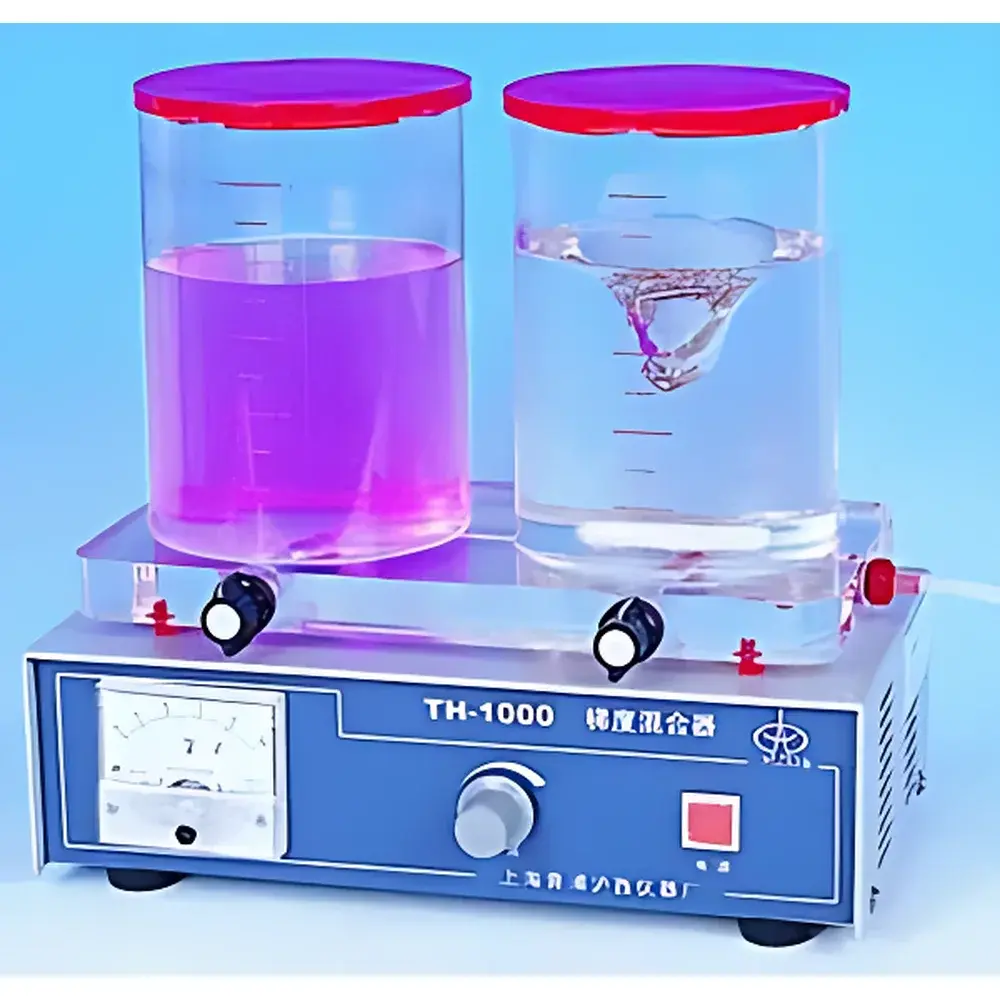
Gradient Mixer TH-1000 / TH-2000 – Shanghai Manufactured Linear Gradient Forming System
| Origin | Shanghai, China |
|---|---|
| Manufacturer Type | Authorized Distributor |
| Origin Category | Domestic (PRC) |
| Model | TH-1000 |
| Price | USD 250 (approx.) |
| Dimensions (TH-1000) | 291 × 180 × 265 mm |
| Gradient Volume Capacity | 2000 mL |
| Gradient Profile | Linear Only |
| Dimensions (TH-2000) | 300 × 200 × 300 mm |
| Gradient Volume Capacity | 4000 mL |
Overview
The Gradient Mixer TH-1000 and TH-2000 are precision-engineered linear gradient-forming systems designed for reproducible solvent or buffer blending in chromatographic sample preparation, column equilibration, and biochemical separation workflows. These instruments operate on the principle of dual-reservoir continuous mixing via gravity-fed, mechanically synchronized piston-driven or peristaltic-assisted flow control—ensuring passive hydrostatic balance between concentrated and diluted solution reservoirs. Unlike digitally controlled gradient pumps, the TH series relies on calibrated mechanical linkage and adjustable flow restrictors to generate stable, time-linear concentration gradients without electronic feedback loops. This architecture delivers robustness, low maintenance, and intrinsic compliance with environments where electromagnetic interference, power instability, or regulatory constraints on software validation limit the use of microprocessor-based gradient engines. The TH-1000 supports up to 2000 mL total gradient volume; the TH-2000 extends capacity to 4000 mL—both configured exclusively for linear (ramp-type) profiles with slope continuously adjustable via front-panel flow regulators.
Key Features
- Mechanically synchronized dual-chamber design maintains real-time liquid-level equilibrium between stock and diluent reservoirs, minimizing head-pressure drift and ensuring consistent volumetric ratio delivery.
- Independent fine-tuning knobs for inflow rate from each reservoir enable precise control over gradient slope—spanning shallow to steep linear transitions without recalibration.
- Stainless-steel and chemically resistant polymer construction ensures compatibility with common aqueous buffers, organic solvents (e.g., acetonitrile, methanol), and mild acidic/basic solutions used in HPLC, FPLC, and gel filtration applications.
- No external power supply required for core mixing function—passive operation enhances safety in explosion-proof labs or mobile field units; optional DC-powered peristaltic assist module available for elevated backpressure scenarios.
- Modular mounting footprint and standardized 1/8″ PTFE tubing ports facilitate direct integration with fraction collectors, UV monitors, and column manifolds using industry-standard fluidic interfaces.
Sample Compatibility & Compliance
The TH-1000 and TH-2000 are validated for use with biological macromolecules (proteins, nucleic acids), small-molecule standards, and particulate-free buffered saline systems. Reservoirs accept standard 1–4 L glass or HDPE bottles with screw-cap adapters. All wetted surfaces comply with USP Class VI and ISO 10993-5 cytotoxicity requirements. While not inherently 21 CFR Part 11 compliant due to absence of audit-trail-capable firmware, the devices support GLP/GMP-aligned manual recordkeeping when paired with calibrated flow meters and timestamped fraction collection logs. No ASTM or ISO standard specifically governs passive gradient mixers; however, performance aligns with the operational expectations defined in ASTM D7522 (Standard Practice for Preparative Liquid Chromatography) for manual gradient formation in method development settings.
Software & Data Management
These are hardware-only gradient formers with no embedded software, firmware, or digital connectivity. Gradient parameters—including starting composition, final composition, total volume, and elapsed time—are documented manually using lab notebooks or LIMS-integrated worksheets. For traceability, users are advised to log knob position settings, reservoir fill volumes, ambient temperature, and output flow rate (measured separately with a calibrated flowmeter) at initiation and endpoint. No data export, remote monitoring, or electronic signature capability is provided—consistent with ISO/IEC 17025 Clause 7.7 requirements for equipment used in non-automated analytical procedures.
Applications
- Preparative and analytical ion-exchange chromatography requiring reproducible salt-gradient elution.
- Gel filtration (size-exclusion) column conditioning and sample loading with controlled buffer transition.
- Protein purification workflows involving stepwise or continuous pH or conductivity gradients.
- Method scouting in HPLC system optimization where rapid, low-cost gradient prototyping is prioritized over programmable multi-segment profiles.
- Educational laboratories demonstrating fundamental principles of mass transfer, diffusion-limited mixing, and chromatographic resolution dependence on gradient steepness.
FAQ
Can the TH-1000 generate nonlinear (concave/convex) gradients?
No. The TH-1000 and TH-2000 are mechanically constrained to linear (first-order) gradients only. Nonlinear profiles require programmable dual-pump systems with time-varying flow algorithms.
Is tubing included with the instrument?
Yes—each unit ships with 2 m of 1/8″ OD PTFE tubing, two reservoir bottle adapters, and four compression fittings.
What is the maximum operating pressure tolerance?
The system is rated for ≤ 0.5 bar (7 psi) backpressure; exceeding this may disrupt hydrostatic balance and compromise gradient linearity.
Can I use the TH-1000 with viscous solutions like glycerol-water mixtures?
Viscosities above 15 cP are not recommended—increased resistance disrupts passive flow synchronization; pre-dilution or heated reservoirs (up to 40 °C) may mitigate this limitation.
Does the device meet CE or RoHS certification requirements?
As a passive mechanical apparatus without electrical components, it falls outside CE marking scope; all materials comply with RoHS Directive 2011/65/EU Annex II substance restrictions.
Related Products



