
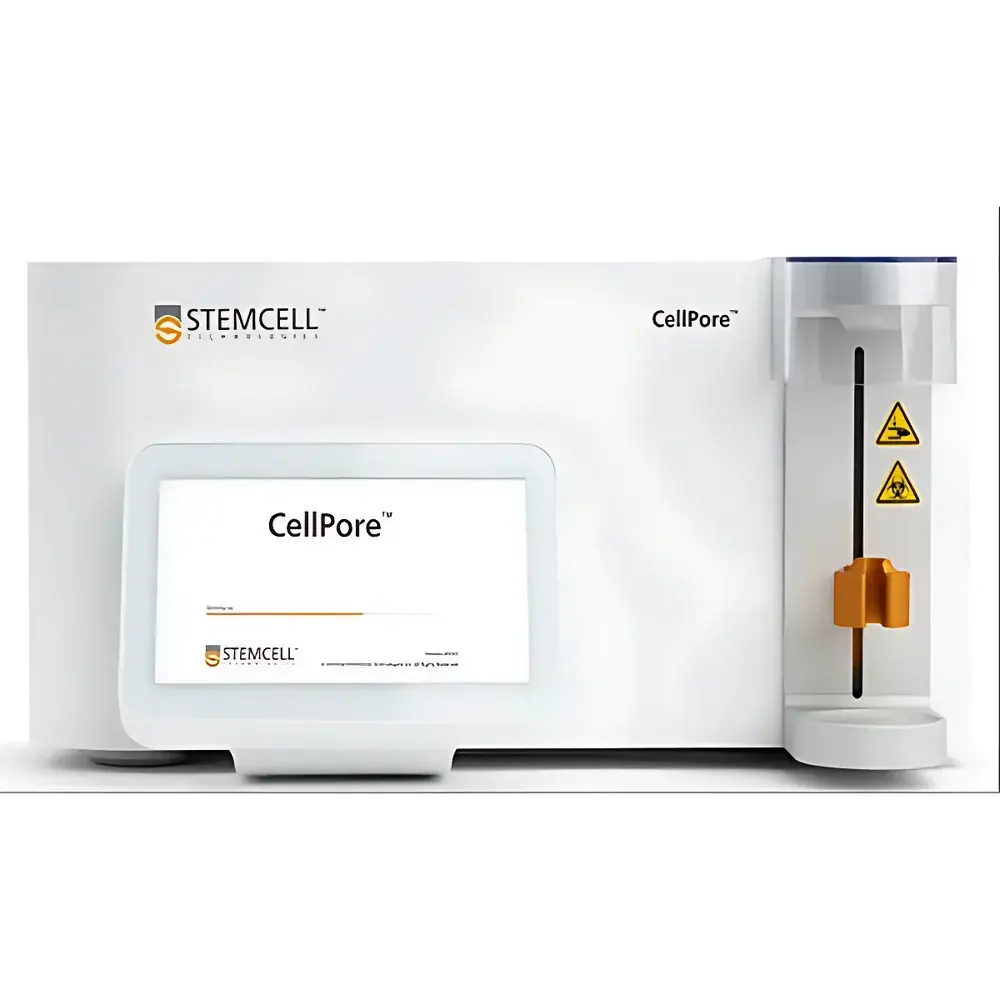
CellPore™ Microfluidic Transfection System
| Brand | CYSEA |
|---|---|
| Origin | Beijing, China |
| Manufacturer Type | Direct Manufacturer |
| Regional Classification | Domestic (China) |
| Dimensions | 40 × 31 × 20 cm |
| Operating Temperature Range | 15–30°C (50–86°F) |
Overview
The CellPore™ Microfluidic Transfection System is a benchtop, non-viral physical delivery platform engineered for high-efficiency intracellular delivery of nucleic acids (e.g., mRNA, sgRNA/Cas9 RNP complexes), proteins, and small molecules into primary and hard-to-transfect mammalian cells—including human unstimulated T cells, hematopoietic stem cells (HSCs), and induced pluripotent stem cells (iPSCs). Unlike electroporation or lipid-based methods, CellPore™ employs deterministic microfluidic cell squeezing—a contact-free, shear-controlled mechanical perturbation mechanism rooted in microscale hydrodynamic confinement. As cells traverse parallel, precisely fabricated microchannels (typically 5–10 µm in hydraulic diameter) under controlled pressure-driven flow, transient, reversible membrane poration occurs without chemical mediators or electrical pulses. This process preserves native cell physiology, minimizes cytotoxicity (<10% post-processing apoptosis in validated primary T-cell workflows), and maintains functional viability—enabling downstream applications such as adoptive cell therapy manufacturing and CRISPR-based genome editing.
Key Features
- Microfluidic squeezing-based transfection: No electroporation cuvettes, no cationic lipids, no viral vectors—eliminates batch-to-batch variability and immunogenic concerns.
- Integrated temperature-stabilized fluidic actuation: Maintains consistent thermal environment (15–30°C) during operation to prevent thermal stress-induced RNA degradation or cytoskeletal disruption.
- Single-use, sterile, pre-validated delivery cartridges (CellPore™ Transfection Cartridge 300): Each cartridge contains aligned microchannel arrays with defined geometry and surface passivation to ensure reproducible pore formation kinetics and minimal protein adsorption.
- Modular workflow compatibility: Designed for seamless integration with standard biosafety cabinets, centrifuges, and CO₂ incubators; supports ≤3 × 10⁶ cells per run with >70% transfection efficiency in unactivated human T cells (as verified per ISO 13485-aligned internal validation protocols).
- CE-marked design architecture compliant with IEC 61010-1 safety standards for laboratory equipment; meets essential requirements for Class I medical device manufacturing environments.
Sample Compatibility & Compliance
The CellPore™ system demonstrates broad compatibility across suspension and adherent cell types, including but not limited to primary CD4⁺/CD8⁺ T lymphocytes, NK cells, monocytes, Jurkat, K562, HEK293T, and iPSC-derived neural progenitors. It accommodates payloads ranging from 20 nt siRNA to full-length 5 kb mRNA transcripts and multiprotein RNP complexes. All consumables are manufactured under ISO 13485-certified conditions and supplied sterile-filtered (0.22 µm). The instrument’s operational parameters align with GLP-compliant documentation practices: audit trails for run logs, user access control, and timestamped metadata export support 21 CFR Part 11 readiness when paired with CYSEA’s optional LIMS-integrated software module.
Software & Data Management
The CellPore™ system operates via an embedded touchscreen interface with firmware v2.1+, supporting protocol selection, real-time pressure monitoring, and automated cartridge recognition. Run data—including inlet pressure profiles, total processed volume, ambient temperature log, and user ID—are stored locally in encrypted CSV format and exportable via USB or network share. Optional CYSEA Connect™ software (v3.0+) enables remote monitoring, SOP versioning, electronic signature capture, and automatic generation of ALCOA+ compliant reports (Attributable, Legible, Contemporaneous, Original, Accurate, Complete, Consistent, Enduring, Available). Integration with LabVantage and Thermo Fisher SampleManager is supported through HL7 and RESTful API interfaces.
Applications
- Manufacturing of clinical-grade CAR-T and TCR-T cells without activation-induced differentiation or exhaustion.
- Rapid prototyping of base-edited or prime-edited iPSC lines with reduced off-target indels compared to electroporation.
- Functional screening of therapeutic mRNA constructs in primary immune cells under physiologically relevant conditions.
- Delivery of fluorescently labeled proteins for live-cell trafficking studies without fixation artifacts.
- High-throughput optimization of RNP stoichiometry in CRISPR knock-in workflows using titrated Cas9-sgRNA complexes.
FAQ
What cell types have been experimentally validated with CellPore™?
Primary human T cells (unstimulated and activated), NK cells, CD34⁺ HSCs, Jurkat, K562, THP-1, HEK293T, and iPSCs—with published transfection efficiencies ≥65% and viability ≥85% post-processing.
Can CellPore™ deliver multiple payloads simultaneously?
Yes—co-delivery of mRNA + protein, or dual-guide RNAs with Cas9 RNP, has been demonstrated in peer-reviewed studies without cross-interference or payload aggregation.
Is the system compatible with GMP-compliant production environments?
The hardware architecture and cartridge manufacturing meet ISO 13485 requirements; full GMP validation packages—including IQ/OQ/PQ documentation templates—are available upon request for qualified clients.
Does CellPore™ require specialized training or certification?
Operators require ≤2 hours of hands-on training; all protocols include visual SOPs and QC checkpoints aligned with CLSI EP23-A guidelines for assay verification.
How does CellPore™ compare to conventional electroporation in terms of editing fidelity?
Published data show up to 3.2× lower frequency of large deletions and chromosomal rearrangements in primary T cells edited via CellPore™ versus Neon™ or MaxCyte® systems under matched RNP dosing conditions.
Related Products



