
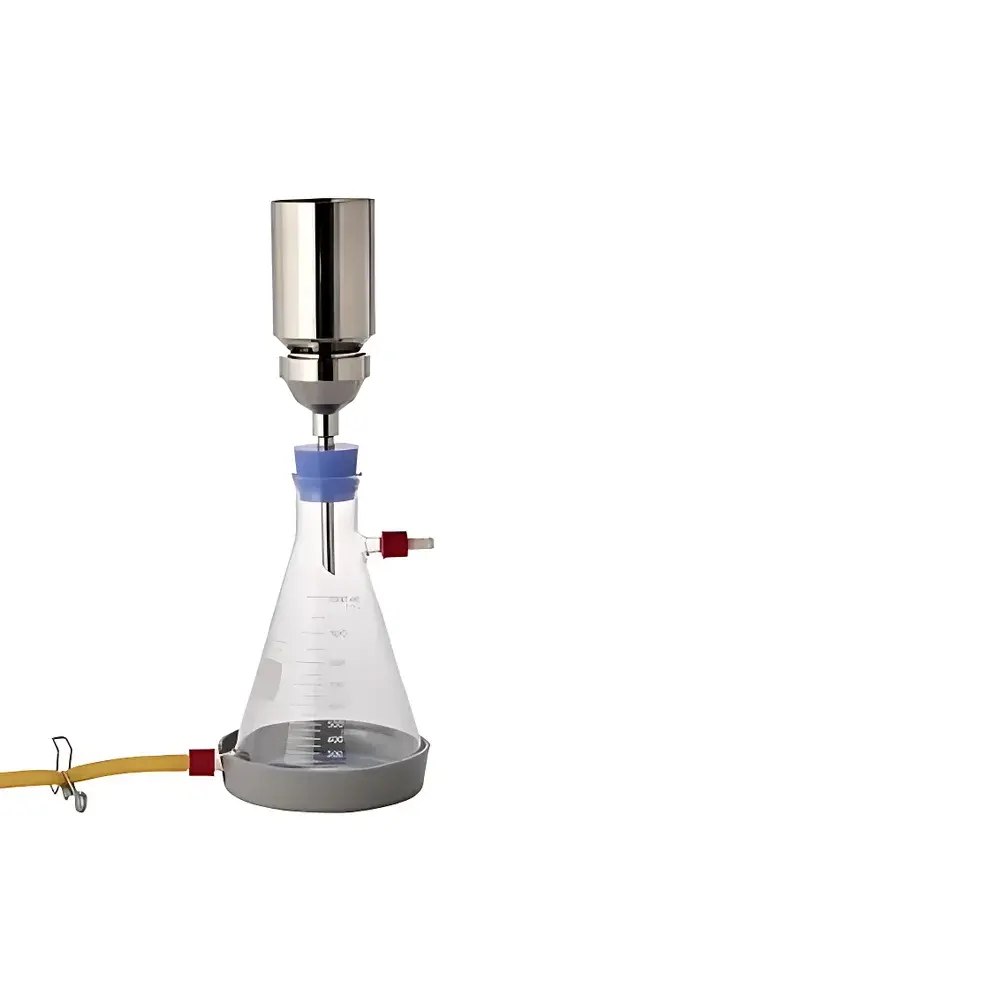
Rocker VF9 Stainless Steel Filtration Assembly
| Brand | Rocker |
|---|---|
| Origin | Taiwan |
| Model | VF9 |
| Filter Funnel Capacity | 300 mL |
| Receiver Bottle Capacity | 1000 mL |
| Compatible Membrane Diameter | 47 mm / 50 mm |
| Hose Inner Diameter | 8 mm (5/16 in.) |
| Effective Filtration Area | 9.6 cm² |
| Funnel & Base Material | SUS316 Stainless Steel |
| Membrane Support Plate Material | SUS316 Stainless Steel |
| Stopper Material | Silicone (No. 16) |
| Receiver Bottle Material | Borosilicate Glass |
| Sterilization Compatibility | Autoclave, Dry Heat, Flame |
| Patent | M381450 (Rotary Snap-Lock Mechanism) |
Overview
The Rocker VF9 Stainless Steel Filtration Assembly is a precision-engineered vacuum filtration system designed for demanding life science and bioprocessing applications where chemical resistance, thermal stability, and repeatable sterility assurance are critical. Built upon the principles of gravity- and vacuum-assisted dead-end filtration, the VF9 integrates a 300 mL SUS316 stainless steel filter funnel with a 1000 mL rapid-drain borosilicate glass receiver bottle to enable efficient, contamination-controlled sample processing. Its architecture supports both routine laboratory filtration and regulated workflows requiring documented sterilization cycles—such as microbial assay preparation, solvent-based sample purification, and pre-sterile buffer clarification prior to downstream chromatography or cell culture operations.
Key Features
- SUS316 Stainless Steel Construction: The entire filtration funnel—including upper cup, base, and membrane support plate—is fabricated from medical-grade SUS316 stainless steel, offering superior resistance to chloride-induced pitting, organic solvents, and aggressive acids/bases compared to standard 304 grades.
- Rotary Snap-Lock Mechanism (Patent No. M381450): A proprietary bayonet-style coupling eliminates the need for clamps or O-ring compression tools, enabling one-handed, leak-tight assembly and disassembly under vacuum. This design ensures consistent sealing force across repeated use cycles and reduces operator-induced variability during setup.
- Rapid Drain Valve System: Integrated into the base of the receiver bottle, this valve allows full waste discharge without breaking vacuum or dismantling the assembly—minimizing exposure risk and preserving sterile integrity during multi-step filtrations.
- Weighted Magnetic Base: A high-strength neodymium magnet embedded in a dense polymer housing provides stable fixation on stainless steel work surfaces, preventing accidental tipping during high-flow vacuum operation or frequent handling in biosafety cabinets.
- Reinforced Hose Interface Guard: A molded silicone collar surrounds the vacuum port to absorb lateral stress during tubing insertion, preventing fracture of the glass neck or misalignment of the vacuum seal—a common failure point in high-pressure vacuum environments.
Sample Compatibility & Compliance
The VF9 system accommodates standard 47 mm and 50 mm diameter membranes—including mixed cellulose ester (MCE), polyethersulfone (PES), nylon, and PVDF—enabling broad compatibility with aqueous, alcoholic, and low-polarity organic solvents. Its SUS316 components withstand repeated autoclaving (121 °C, 20 min), dry-heat sterilization (180 °C, 2 h), and direct flame treatment, supporting GLP-compliant documentation of sterilization parameters per ISO 13408-1 and USP . The borosilicate glass receiver conforms to ASTM E438 Type I, Class A specifications, ensuring dimensional accuracy and thermal shock resistance. All silicone stoppers meet USP Class VI biological safety requirements.
Software & Data Management
As a manually operated, non-electronic filtration platform, the VF9 does not incorporate onboard software or digital data logging. However, its mechanical design supports integration into validated laboratory workflows governed by FDA 21 CFR Part 11 and EU Annex 11 through complementary documentation practices: standardized SOPs for assembly validation, sterilization log sheets with batch-specific timestamps, and filter lot traceability via integrated labeling zones on component housings. Optional accessories—including calibrated vacuum gauges and inline pressure regulators—can be paired to generate auditable process records.
Applications
- Microbiological testing: Sterile filtration of water, pharmaceutical excipients, and culture media prior to membrane filtration assays (e.g., EPA Method 1603, ISO 9308-1).
- Biopharmaceutical pre-filtration: Clarification of crude lysates or harvest streams before depth filtration or tangential flow ultrafiltration (TFF).
- Environmental analysis: Acid digestion residue filtration in heavy metal testing (EPA SW-846 Method 3050B).
- Quality control laboratories: Solvent-compatible particulate removal from HPLC mobile phase stocks and reference standard solutions.
- Academic research: Reproducible preparation of sterile-filtered growth supplements and enzyme reaction quenching buffers under laminar flow conditions.
FAQ
Can the VF9 funnel be sterilized using ethylene oxide (EtO)?
Yes—SUS316 stainless steel and medical-grade silicone are compatible with EtO sterilization protocols; however, residual gas desorption must be validated per ISO 10993-7 for specific application contexts.
Is the magnetic base suitable for use on coated stainless steel surfaces?
Performance depends on coating thickness and ferromagnetic substrate integrity; we recommend verifying holding force empirically on your specific surface prior to routine deployment.
What is the maximum recommended vacuum pressure for continuous operation?
The system is rated for sustained operation at ≤ 700 mbar vacuum (≥ 100 mbar absolute); exceeding this may compromise seal integrity or accelerate hose fatigue.
Are replacement membrane support plates available separately?
Yes—SUS316 support plates (Part No. 167100-31) are sold individually and retain full interchangeability with original assemblies.
Does the rapid drain valve require periodic maintenance?
The PTFE-coated valve stem requires no lubrication; cleaning with 70% ethanol followed by air-drying is sufficient between uses to prevent crystalline deposit buildup.





