
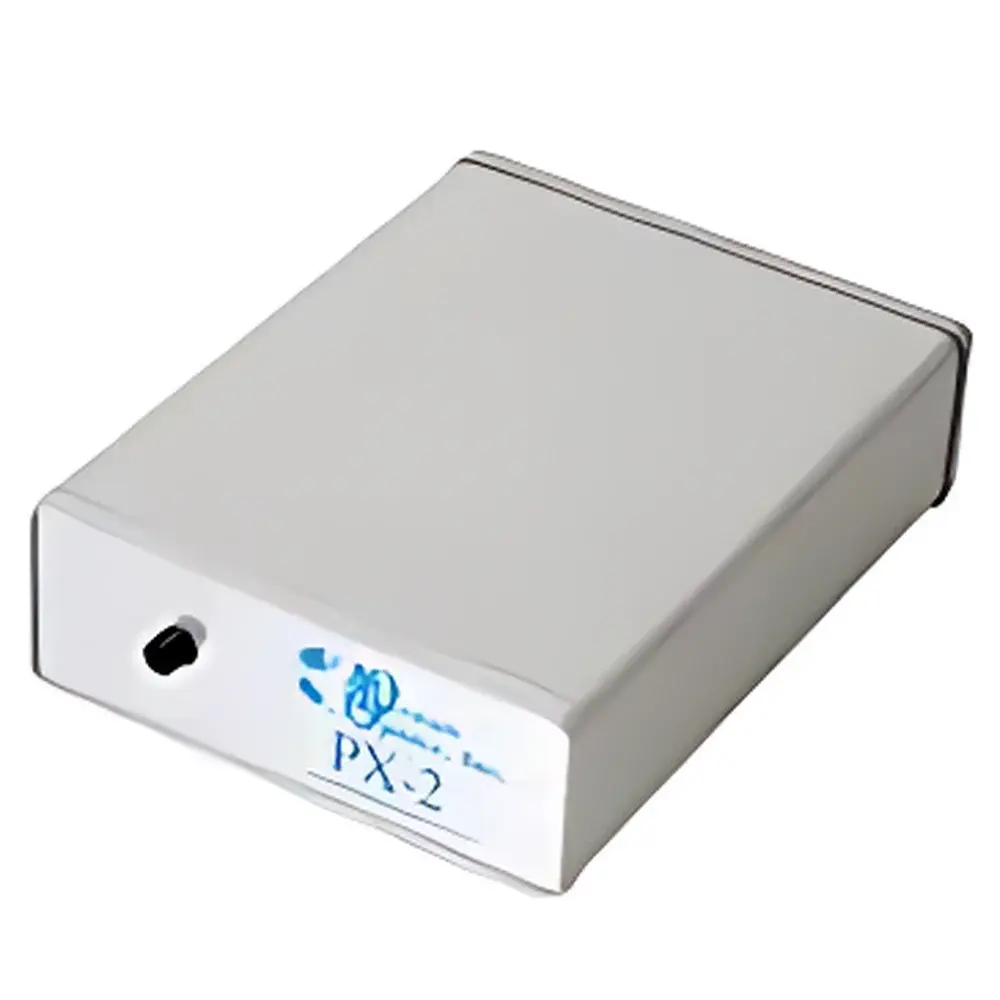
Ocean Optics PX-2 Pulsed Xenon Light Source
| Brand | Ocean Optics |
|---|---|
| Origin | USA |
| Model | PX-2 |
| Light Source Type | Pulsed Xenon Lamp |
| Spectral Range | 220–750 nm |
| Pulse Frequency | Up to 220 Hz |
| Pulse Width | 5 µs (FWHM) |
| Pulse Energy | up to 45 µJ per flash |
| Average Lamp Power | 9.9 W |
| Dimensions | 14 × 10.5 × 4 cm (L×W×H) |
| Input Power | 1.3 A @ 11 V (at 220 Hz), 100 mA @ 12 V (at 10 Hz) |
| Trigger Interface | TTL-compatible positive pulse via 15-pin D-sub connector |
| Fiber Coupling | SMA 905 |
| Lifetime | 1 × 10⁹ flashes (≈230 days at 50 Hz) |
Overview
The Ocean Optics PX-2 Pulsed Xenon Light Source is a compact, high-stability broadband illumination system engineered for demanding optical spectroscopy applications where thermal load, photodegradation, or temporal synchronization are critical constraints. Based on a short-arc pulsed xenon discharge lamp, the PX-2 delivers intense, spectrally continuous output from 220 nm to 750 nm—covering deep UV through visible wavelengths—with negligible near-IR emission. Unlike continuous-wave (CW) sources, its microsecond-duration pulses (5 µs full width at half maximum) minimize sample heating and photochemical damage, making it especially suitable for light- and heat-sensitive biological samples, thin-film coatings, organic fluorophores, and photolabile reference standards. The PX-2 operates in two distinct synchronization modes—multichannel and single-channel—enabling precise temporal alignment with detector integration windows across diverse spectrometer platforms, including Ocean Insight’s USB-based and OEM-grade miniature spectrometers.
Key Features
- Stable pulsed output with ≤0.5% RMS intensity fluctuation over 1 × 10⁹ flashes (rated lifetime at 50 Hz)
- Programmable pulse frequency from 1 Hz to 220 Hz, controllable via external TTL trigger or internal oscillator
- Dual-mode triggering architecture: multichannel mode maintains constant flash timing per integration period; single-channel mode synchronizes one flash per spectrum acquisition
- Integrated 15-pin D-sub interface supporting TTL trigger input, spectrometer sync signals, and lamp status feedback
- SMA 905 fiber port compatible with Ocean Insight’s full range of sampling accessories—including CUV-FL-DA cuvette holders, reflection probes, and collimating optics
- Low thermal dissipation design (9.9 W average lamp power) enables stable operation without active cooling or forced airflow
- Compact footprint (14 × 10.5 × 4 cm) optimized for benchtop integration into automated optical test stations and OEM instrumentation
Sample Compatibility & Compliance
The PX-2 is routinely deployed in GLP-compliant laboratories for quantitative absorbance, reflectance, fluorescence excitation, and phosphorescence decay studies where spectral fidelity and repeatability are essential. Its UV-rich output (down to 220 nm) supports ASTM E308-compliant colorimetric analysis, ISO 13406-2 optical safety assessments, and USP spectrophotometric method validation. Because the source emits no significant radiation below 220 nm, it avoids ozone generation and eliminates the need for nitrogen purging in standard UV-Vis setups. The absence of continuous thermal load ensures minimal baseline drift during extended kinetic measurements—critical for compliance with FDA 21 CFR Part 11 data integrity requirements when paired with validated Ocean Insight software platforms.
Software & Data Management
The PX-2 integrates natively with Ocean Insight’s OceanView, OmniDriver, and SDK-based applications via serial or USB-to-serial emulation. Trigger latency is deterministic (<100 ns jitter), enabling sub-millisecond synchronization with spectrometer A/D sampling clocks. Audit-trail-capable logging (including timestamped flash count, trigger source, and operating frequency) is supported through configurable metadata embedding in spectral data files (.OOI, .CSV, .SPE). Firmware updates and operational diagnostics are accessible via command-line interface (CLI) over RS-232 or virtual COM port, facilitating remote maintenance in distributed lab environments. All control parameters—including pulse rate, mode selection, and TTL polarity—are programmable via ASCII SCPI-like commands, ensuring compatibility with LabVIEW, Python (PySerial), MATLAB, and custom C/C++ instrument drivers.
Applications
- Time-resolved absorbance and reflectance measurements in photochemical reaction monitoring
- Excitation source for time-gated fluorescence and phosphorescence lifetime assays
- Reference illumination in multi-spectral imaging systems requiring pulse-to-pulse consistency
- Calibration traceability for UV-Vis-NIR spectrophotometers using NIST-traceable standards
- OEM integration into portable environmental sensors (e.g., water quality analyzers, gas-phase absorption cells)
- High-speed spectral profiling of transient phenomena such as plasma ignition, laser-induced breakdown, or electrochromic switching
FAQ
What is the spectral irradiance stability over the lamp’s lifetime?
Output stability remains within ±1.2% (peak-to-peak) across the 220–750 nm band for the first 5 × 10⁸ flashes under nominal operating conditions (220 Hz, 11 V).
Can the PX-2 be triggered externally by a function generator or DAQ device?
Yes—any TTL-compatible positive-edge signal (2.5–5 V, ≥100 ns pulse width) applied to Pin 1 of the 15-pin D-sub connector will initiate a flash, with jitter <50 ns.
Is the PX-2 compatible with non-Ocean Insight spectrometers?
Yes—provided the spectrometer supports external TTL triggering and accepts SMA 905-coupled illumination; users must configure timing logic independently via hardware or host software.
Does the PX-2 require warm-up time before achieving spectral stability?
No—pulsed xenon lamps exhibit no warm-up drift; spectral shape and intensity stabilize within the first flash after power-on.
How is lamp end-of-life determined in practice?
Lamp failure is defined as >10% drop in peak pulse energy at 254 nm or inability to sustain rated pulse frequency at specified voltage; firmware logs cumulative flash count for predictive maintenance scheduling.




