
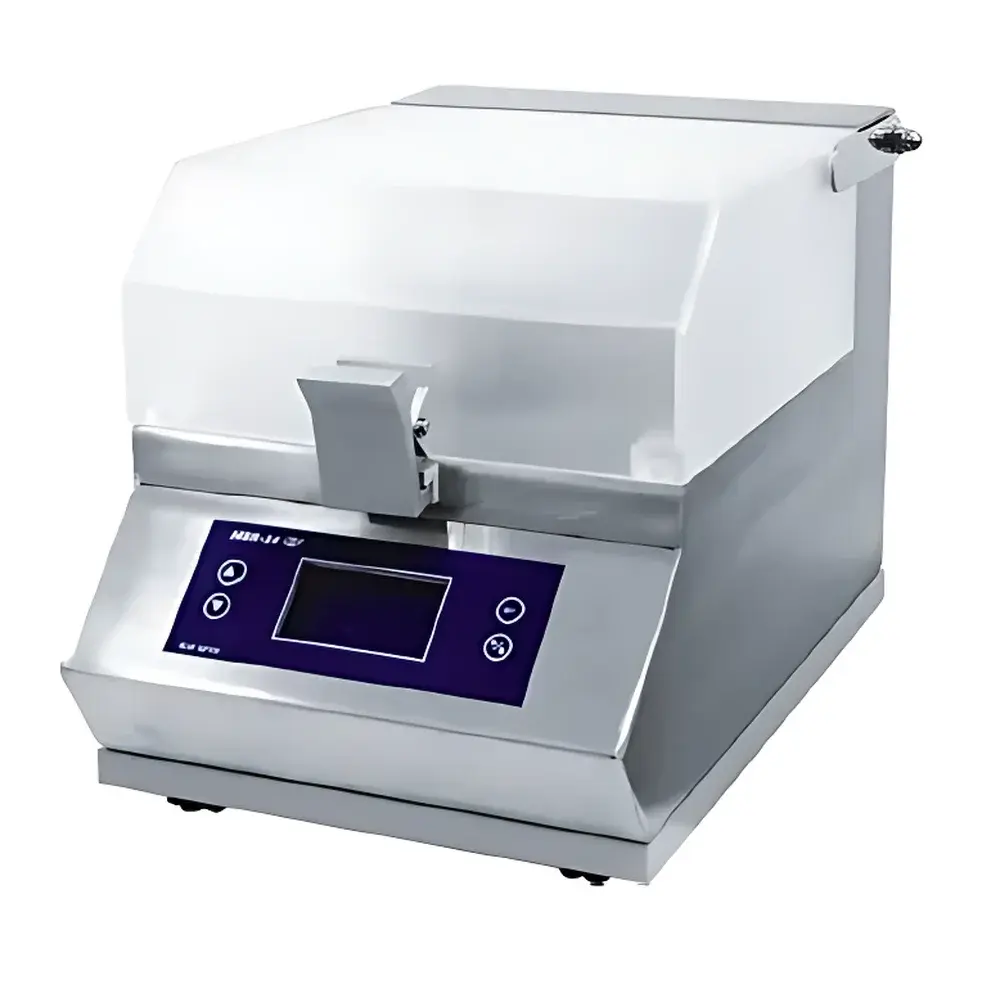
HBR-24 High-Throughput Bead Mill Homogenizer
| Origin | Shanghai, China |
|---|---|
| Manufacturer Type | Authorized Distributor |
| Origin Category | Domestic (China) |
| Model | HBR-24 |
| Price | USD 8,200 (FOB Shanghai) |
| Instrument Type | Bead Mill Homogenizer |
| Dimensions (W×D×H) | 350 × 440 × 300 mm |
| Sample Volume Range | 10–40 mL per tube |
| Operating Speed | 5,000–6,800 rpm (100 rpm increments) |
| Programmable Cycles | Up to 5 per protocol |
| Cycle Duration | 1–99 s (1 s increment) |
| Inter-Cycle Pause | Adjustable from 1 s |
| Maximum Throughput | 24 samples per run |
| Typical Homogenization Time | 10–40 s for standard biological tissues |
Overview
The HBR-24 High-Throughput Bead Mill Homogenizer is an engineered solution for rapid, reproducible mechanical lysis and homogenization of diverse biological matrices. It operates on the principle of high-frequency orbital shaking combined with inert bead impact—leveraging kinetic energy transfer from precisely controlled vertical and horizontal motion to accelerate grinding media (e.g., glass, ceramic, or stainless steel beads) within sealed sample tubes. This mechanism ensures efficient cell disruption while minimizing thermal degradation, making it suitable for downstream applications requiring intact nucleic acids, native proteins, or metabolites. Designed for routine use in molecular biology, microbiology, and translational research labs, the HBR-24 delivers consistent shear forces across all 24 positions without requiring tube balancing—a critical advantage over centrifugal or rotor-stator systems.
Key Features
- True 24-position parallel processing with independent tube loading—no balancing required prior to operation.
- Adjustable rotational speed from 5,000 to 6,800 rpm in 100-rpm increments, enabling method optimization for soft tissues, tough matrices (e.g., bone, hair, soil), or microbial cells.
- Five user-programmable protocols, each supporting up to five sequential cycles with customizable duration (1–99 s) and inter-cycle pause intervals (≥1 s).
- Low thermal load design: average temperature rise <4 °C during typical 30-s runs at 6,500 rpm, verified using calibrated thermocouple probes embedded in sample tubes.
- Sealed-tube architecture eliminates aerosol generation and cross-contamination risk; compatible with standard 2.0 mL microcentrifuge tubes and deep-well plates.
- Robust aluminum alloy chassis with vibration-damping feet and IP20-rated enclosure for stable benchtop deployment in shared lab environments.
Sample Compatibility & Compliance
The HBR-24 accommodates a broad spectrum of recalcitrant and heterogeneous samples—including mammalian and plant tissues, Gram-positive and Gram-negative bacteria, fungal mycelia, spores, keratin-rich materials (hair, nails), calcified tissues (bone, teeth), fecal pellets, and environmental substrates (soil, sediment). Its performance aligns with established lysis validation criteria outlined in ISO 17025-accredited workflows for nucleic acid extraction and protein solubilization. While not certified to specific regulatory standards, the instrument supports GLP-compliant documentation when integrated with electronic lab notebooks (ELNs) and audit-trail-enabled software (see Software & Data Management). Tube compatibility includes polypropylene and reinforced polymer variants rated for ≥7,000 × g centrifugation—ensuring integrity during post-homogenization handling.
Software & Data Management
The HBR-24 operates via an intuitive front-panel LCD interface with tactile membrane keys. All protocol parameters—including speed, cycle count, duration, and pause timing—are stored non-volatile memory and retain settings after power cycling. For traceability in regulated environments, optional RS-232 or USB-to-serial connectivity enables integration with laboratory information management systems (LIMS) or ELNs. When paired with validated third-party software (e.g., LabArchives, Benchling), users can generate timestamped execution logs compliant with FDA 21 CFR Part 11 requirements—including operator ID, protocol name, start/stop timestamps, and deviation flags. No proprietary cloud service or mandatory subscription is required for basic operation or data export.
Applications
- Routine DNA/RNA isolation from fibrous or lipid-rich tissues where enzymatic or sonication methods yield fragmented yields.
- High-yield protein extraction for native PAGE, co-immunoprecipitation, or activity assays—validated by increased specific enzyme activity versus mortar-and-pestle or probe sonication.
- Microbiome sample preparation: uniform lysis of mixed-species biofilms and spore-forming organisms without bias toward easily lysed taxa.
- Environmental metagenomics: reproducible disruption of soil aggregates and root-associated rhizosphere material for unbiased community profiling.
- Pharmaceutical QC: batch homogenization of excipient-blended formulations for dissolution testing or particle size analysis.
- Biobanking: scalable processing of cryopreserved specimens under controlled temperature conditions (when used with pre-chilled adapters).
FAQ
Is the HBR-24 compatible with cryogenic operation?
Yes—when equipped with optional aluminum or stainless-steel cooling adapters and operated inside a refrigerated room (4 °C) or cold chamber, the unit maintains stability down to −20 °C ambient. Pre-chilled tubes and beads are recommended for temperature-sensitive analytes.
What bead sizes and materials are supported?
Standard configurations accommodate 0.1–2.0 mm diameter beads in glass (SiO₂), zirconia (ZrO₂), or stainless steel (316 SS). Bead-to-sample volume ratio guidelines are provided in the operator manual per matrix type.
Can I validate cleaning procedures between runs?
The open-tube design allows visual inspection and ethanol/water wipe-down of the platform surface. UV-C irradiation (254 nm, 30 min) of the chamber interior is recommended weekly for biosafety compliance in BSL-2 settings.
Does the device meet electromagnetic compatibility (EMC) standards for EU laboratories?
Yes—the HBR-24 conforms to EN 61326-1:2013 for laboratory equipment and carries CE marking under the Low Voltage Directive (2014/35/EU) and EMC Directive (2014/30/EU). Declaration of Conformity is available upon request.
How often does calibration verification need to be performed?
Speed accuracy should be verified annually using a handheld tachometer traceable to NIST standards. No factory recalibration is required unless mechanical damage occurs to the drive shaft or motor assembly.
Related Products



