
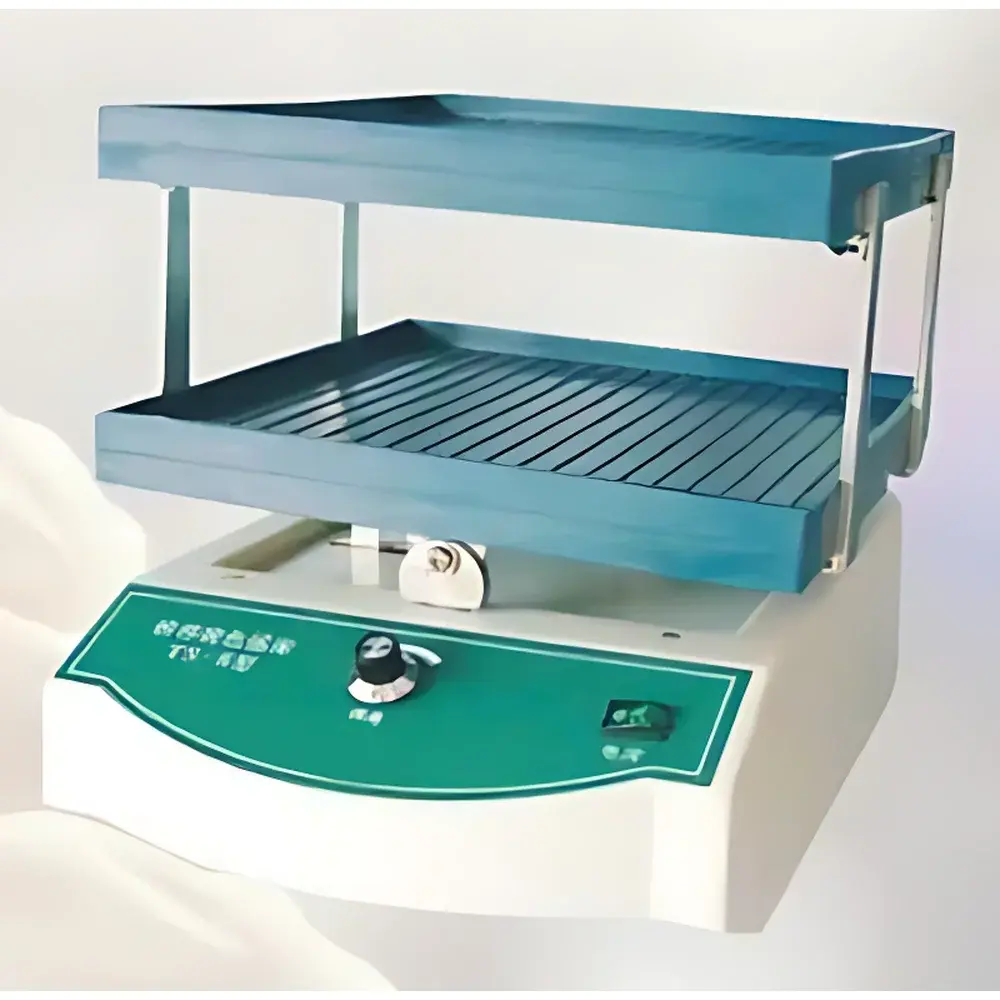
TS-8 Transfer and Destaining Shaker
| Origin | Shanghai, China |
|---|---|
| Manufacturer Type | Authorized Distributor |
| Origin Category | Domestic (PRC) |
| Dimensions (W×D×H) | 350 × 260 × 260 mm |
| Power Supply | 220 V AC |
| Power Consumption | 30 W |
| Oscillation Frequency Range | 0–80 rpm |
| Adjustable Speed | Continuously Variable |
| Tray Dimensions | 280 × 260 × 2 mm |
| Vertical Stroke Amplitude | 200 mm |
| Product Code | ZH149 |
Overview
The TS-8 Transfer and Destaining Shaker is an engineered laboratory shaker designed specifically for electrophoretic membrane transfer (e.g., Western blotting), gel destaining, hybridization, and gentle agitation of low-viscosity biological samples in standard-sized containers. It operates on a vertical reciprocating motion principle—distinct from orbital or rotary shakers—with a fixed 200 mm stroke amplitude optimized to ensure uniform liquid displacement across gels and membranes without shear-induced damage. Its mechanical architecture prioritizes stability during extended operation (up to 72 h continuous duty), minimal vibration transmission to adjacent benchtop equipment, and consistent motion reproducibility across the full 0–80 rpm range. The device complies with IEC 61010-1 safety standards for laboratory electrical equipment and meets electromagnetic compatibility (EMC) requirements per EN 61326-1 for use in regulated research environments.
Key Features
- Vertically oscillating platform with precisely calibrated 200 mm stroke—engineered to maximize buffer exchange efficiency during membrane transfer and Coomassie/silver destaining protocols.
- Continuously variable speed control (0–80 rpm) via analog potentiometer, enabling fine-tuned optimization for sensitive applications such as antibody incubation or nucleic acid hybridization.
- Robust aluminum alloy tray (280 × 260 × 2 mm) with non-slip silicone surface coating—compatible with standard electrophoresis cassettes, mini-gel tanks, hybridization bottles (up to 500 mL), and multi-well plates placed in supportive frames.
- Compact footprint (350 × 260 × 260 mm) and low power draw (30 W at 220 V AC)—designed for space-constrained biosafety cabinets, cold rooms, and shared core facility benches.
- Thermally stable motor housing and sealed bearing assembly—ensuring operational reliability under ambient temperatures ranging from 4 °C to 35 °C and relative humidity up to 80% non-condensing.
- No microprocessor-based electronics or firmware—eliminating software validation requirements and supporting long-term GLP-compliant usage where instrument traceability relies solely on mechanical calibration logs.
Sample Compatibility & Compliance
The TS-8 accommodates common life science consumables including polyacrylamide and agarose gels (up to 20 × 20 cm), nitrocellulose/PVDF membranes mounted in transfer cassettes, glass hybridization tubes (12–500 mL), and 6-/12-/24-well plates secured with optional clamping fixtures. It supports protocols referenced in ISO 13843:2020 (molecular biology—nucleic acid hybridization) and ASTM D7299-17 (standard practice for Western blotting procedures). While not FDA 21 CFR Part 11 compliant by design (due to absence of digital data logging), its mechanical simplicity facilitates straightforward IQ/OQ documentation for GMP-aligned QC laboratories performing routine blot processing.
Software & Data Management
The TS-8 is a fully analog, hardware-only shaker with no embedded software, touchscreen interface, or data output ports. All operational parameters—including speed setting and runtime—are manually configured and recorded externally via lab notebook entries or LIMS-integrated electronic batch records. This architecture eliminates cybersecurity vulnerabilities, avoids periodic firmware updates, and simplifies audit readiness for ISO 17025-accredited testing labs where instrument qualification focuses exclusively on mechanical performance verification (e.g., rpm accuracy ±3% verified annually with optical tachometer).
Applications
- Electrophoretic transfer of proteins from SDS-PAGE gels to solid supports (wet, semi-dry, and rapid transfer formats).
- Post-staining destaining of polyacrylamide gels using methanol/acetic acid/water solutions.
- Low-shear hybridization of DNA/RNA probes to blots or membranes under controlled temperature conditions (when used inside incubators).
- Gentle mixing of antigen-antibody complexes during ELISA plate blocking and washing steps.
- Agitation of cell lysates during immunoprecipitation wash cycles to minimize pellet disruption.
- Equilibration of tissue sections in staining buffers prior to histological processing.
FAQ
Is the TS-8 suitable for use inside a 4 °C cold room?
Yes—the motor and drive mechanism are rated for continuous operation between 4 °C and 35 °C; however, condensation management on the tray surface is recommended when transitioning between temperature zones.
Can the stroke amplitude be adjusted?
No—the 200 mm vertical stroke is mechanically fixed to maintain optimal fluid dynamics for transfer and destaining; variable amplitude is not supported.
Does the unit include a timer function?
No—timing must be managed externally using a laboratory timer or building management system; this preserves design simplicity and regulatory transparency.
What maintenance is required?
Annual visual inspection of belt tension (if belt-driven variant), lubrication of linear guide rails with food-grade silicone grease, and verification of rpm accuracy using a certified handheld tachometer.
Is the tray compatible with vacuum-based blotting systems?
No—the TS-8 is not rated for vacuum or pressure differentials; it is intended for atmospheric-pressure applications only.




