
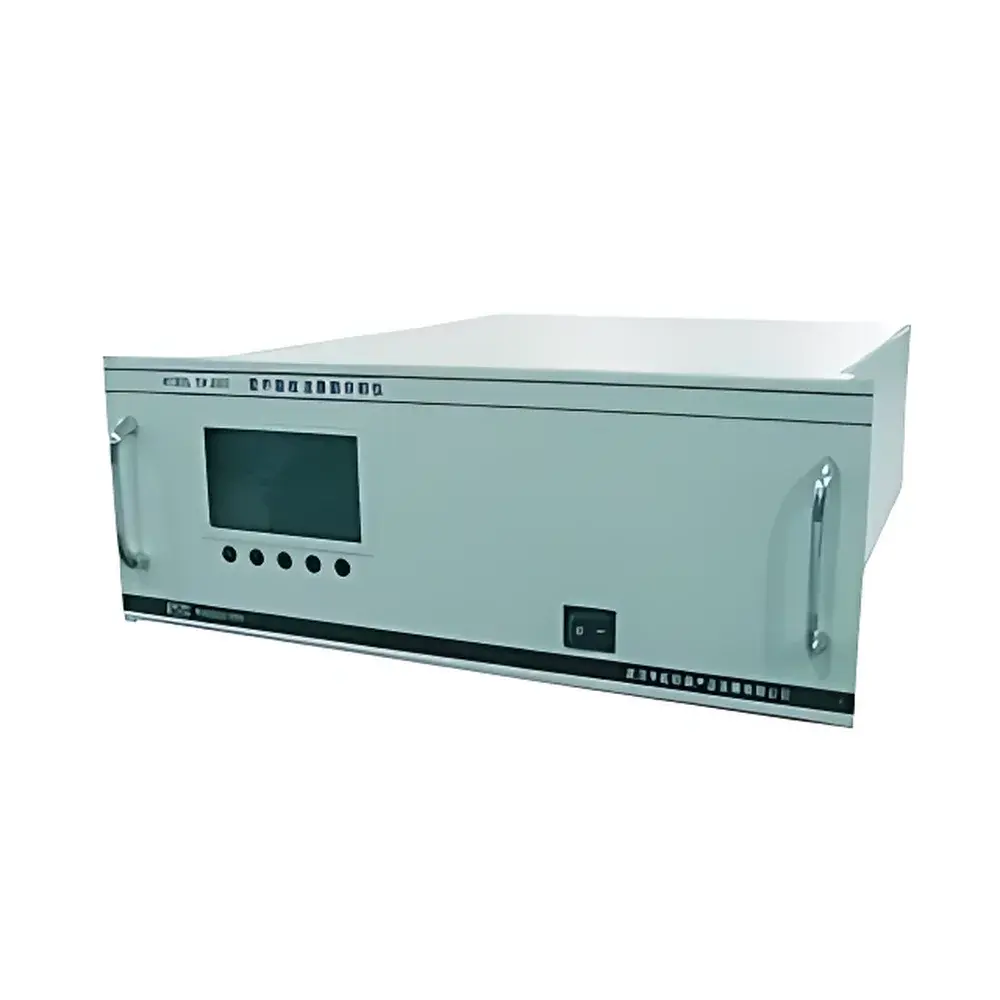
TH-2003 UV Absorption Ozone Analyzer
| Origin | Hubei, China |
|---|---|
| Manufacturer Type | Authorized Distributor |
| Origin Category | Domestic (China) |
| Model | TH-2003 |
| Pricing | Upon Request |
Overview
The TH-2003 UV Absorption Ozone Analyzer is a precision gas-phase analytical instrument engineered for continuous, real-time quantification of ozone (O3) concentration in ambient air, industrial process streams, or laboratory-generated gas mixtures. It operates on the fundamental principle of ultraviolet absorption spectroscopy at the characteristic 254 nm wavelength—where ozone exhibits strong and selective absorbance according to the Beer–Lambert law. The analyzer employs a single-beam optical architecture with time-multiplexed sampling: the same absorption cell sequentially receives the sample gas stream and a reference (zero) gas stream (typically ozone-scrubbed air or nitrogen), enabling differential photometric measurement without dual-path optical alignment complexity. This design ensures high stability, low drift, and robust performance under variable environmental conditions. Integrated temperature and pressure sensors provide real-time compensation to normalize concentration output to standard reference conditions (e.g., 25 °C, 101.325 kPa), supporting traceable, metrologically sound reporting in both ppmv and mg/m³ units.
Key Features
- Single-beam UV photometric detection at 254 nm using a low-noise, high-stability deuterium or mercury-vapor lamp source and silicon photodiode detector
- Time-division multiplexed gas handling system with solenoid-driven 3-way valves for precise alternation between sample and reference gas paths into a common absorption cell
- Optical path length optimized for sensitivity and dynamic range—typically 100–500 mm, configurable per application requirements
- Onboard microprocessor control for fully automated operation: sampling sequence management, analog-to-digital conversion (16-bit A/D), linearization via polynomial calibration curves, and digital-to-analog output generation
- Comprehensive self-diagnostic suite including lamp intensity monitoring, detector saturation detection, valve timing verification, and optical window contamination alerting
- RS-232 serial interface compliant with EIA/TIA-232 standards for bidirectional communication with SCADA systems, data loggers, or host PCs
- Front-panel LCD display with intuitive menu navigation for real-time concentration readout, status flags, and diagnostic logs
Sample Compatibility & Compliance
The TH-2003 is validated for use with clean, dry, particle-free gas matrices—ambient air, compressed air, nitrogen, oxygen, and synthetic air are routinely supported. For humid or particulate-laden samples, optional Nafion™ dryer modules or Teflon-coated particulate filters must be installed upstream to prevent condensation-induced scattering or optical surface fouling. The analyzer complies with core principles outlined in ISO 13964:2021 (Air quality — Determination of ozone — UV photometric method) and aligns with EPA Method IO-3 (Ultraviolet Photometry for Ambient Ozone Monitoring). While not certified for regulatory compliance out-of-the-box, its measurement traceability supports GLP/GMP-aligned validation protocols when paired with NIST-traceable ozone calibrators and documented SOPs.
Software & Data Management
The TH-2003 does not include proprietary PC software but delivers ASCII-formatted output via RS-232, compatible with industry-standard platforms including LabVIEW, MATLAB, Python (pySerial), and commercial SCADA/HMI systems (e.g., Ignition, WinCC). Output frames include timestamp (UTC or local), measured O3 concentration (ppm and mg/m³), compensated temperature (°C), static pressure (kPa), lamp intensity (%), and diagnostic status codes. All internal calibration coefficients, zero/span settings, and linearization parameters are stored in non-volatile EEPROM with write-protection logic to ensure audit trail integrity. When deployed in regulated environments, users may implement external data acquisition systems compliant with FDA 21 CFR Part 11 requirements—including electronic signatures, audit trails, and secure user access controls.
Applications
- Ambient air quality monitoring networks (AQMS) for regulatory reporting and trend analysis
- Ozone generator output verification and dose control in water treatment plants and semiconductor cleanrooms
- Process gas purity assurance in pharmaceutical manufacturing (e.g., sterilization tunnels)
- Research-grade ozone kinetics studies requiring stable, low-drift baseline measurements
- Calibration transfer and field validation of portable ozone sensors and electrochemical analyzers
- Indoor air quality assessment in HVAC commissioning and building health audits
FAQ
What is the typical lower detection limit (LDL) for the TH-2003 under standard operating conditions?
The LDL is instrument-configuration-dependent but typically falls within 1–2 ppb (0.001–0.002 ppm) for a 100-mm path length and 1-second averaging time. Longer integration times or enhanced optical configurations can improve signal-to-noise ratio accordingly.
Does the TH-2003 require periodic recalibration with ozone standards?
Yes—routine zero and span calibration is required per ISO 13964 recommendations: zero calibration every 24 hours and span calibration at least weekly, using NIST-traceable ozone generators or certified permeation devices.
Can the analyzer operate continuously in outdoor enclosures?
It is rated for indoor use only (IP20). For outdoor deployment, it must be housed in a climate-controlled, vibration-isolated enclosure with filtered, temperature-stabilized purge air.
Is the RS-232 interface capable of remote firmware updates?
No—the firmware is factory-programmed and not field-upgradable via serial interface; hardware-level modifications require return to authorized service centers.
How is optical path length defined and verified during installation?
Path length equals the physical distance between UV-transparent quartz windows inside the absorption cell. It is fixed during manufacturing and verified via interferometric measurement; users do not adjust it in the field.







