
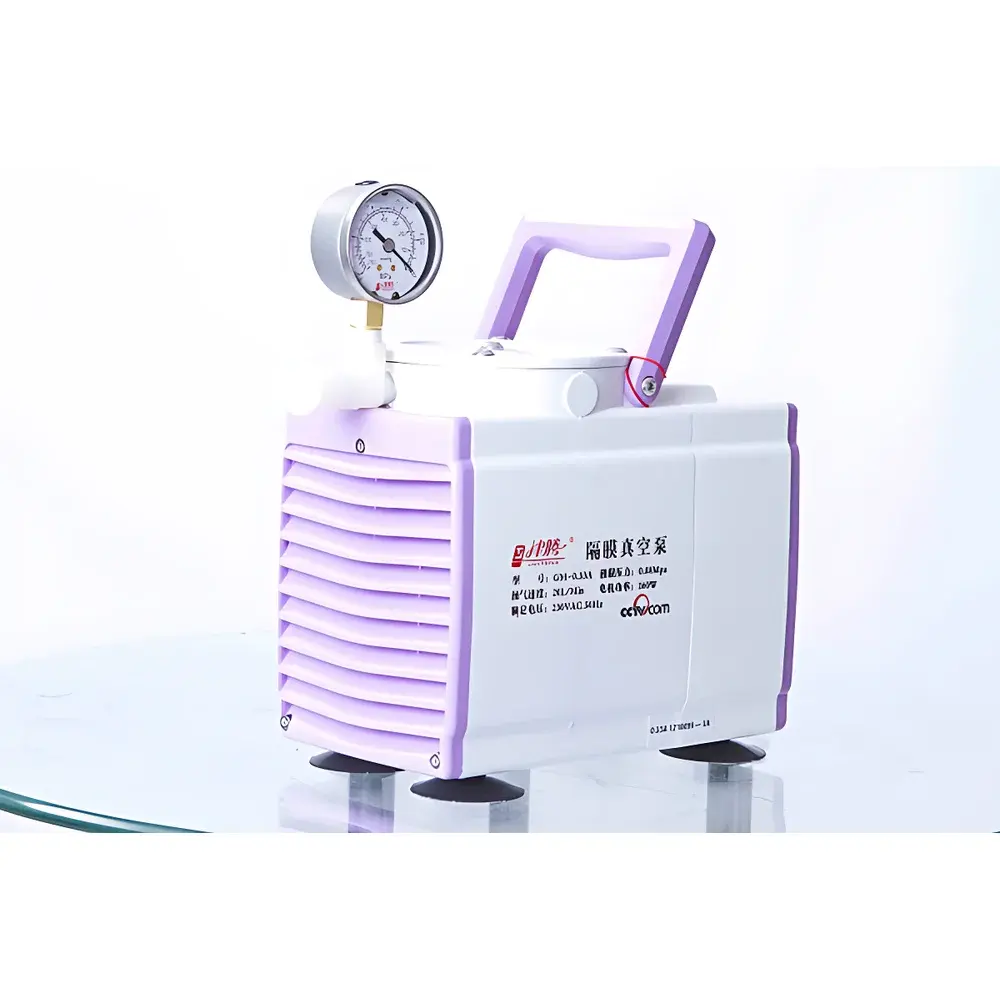
Chu Ding Technology GM-0.33A Oil-Free Diaphragm Vacuum Pump
| Brand | Chu Ding Technology |
|---|---|
| Origin | Shanghai, China |
| Pump Type | Diaphragm Vacuum Pump |
| Ultimate Vacuum Pressure | ≤ 0.08 MPa (≤ 200 mbar) |
| Air Displacement Rate | 20 L/min |
| Motor Power | 160 W |
| Operating Temperature Range | 7–40 °C |
| Max. Surface Temperature | < 60 °C |
| Noise Level | < 55 dB(A) |
| Inlet Port Diameter | Ø6 mm |
| Dimensions (L×W×H) | 235 × 140 × 210 mm |
| Net Weight | 7.5 kg |
| Construction | Aluminum Alloy Die-Cast Housing with Corrosion-Resistant Coating |
| Pressure Regulation | Adjustable Output Vacuum |
| Continuous Duty Rating | 24/7 Operation Capable |
Overview
The Chu Ding Technology GM-0.33A Oil-Free Diaphragm Vacuum Pump is an engineered solution for laboratories requiring clean, reliable, and maintenance-free vacuum generation. Unlike oil-lubricated rotary vane pumps, this diaphragm-based system operates without any working fluid—eliminating oil vapor backstreaming, hydrocarbon contamination, or periodic oil changes. Its core principle relies on the reciprocating motion of a reinforced elastomeric diaphragm driven by an eccentric cam mechanism, creating alternating expansion and compression cycles within the sealed pumping chamber. This positive displacement architecture ensures consistent volumetric flow and stable ultimate vacuum performance up to 0.08 MPa (200 mbar absolute), making it suitable for applications where sample integrity, operator safety, and regulatory compliance are critical. Designed specifically for integration with analytical instrumentation—including HPLC solvent degassers, SPE manifolds, vacuum filtration assemblies, and GC carrier gas purging systems—the GM-0.33A delivers repeatable performance under continuous operation while maintaining low thermal load and acoustic signature.
Key Features
- Oil-free operation ensures zero risk of sample contamination—essential for trace-level analysis in pharmaceutical QC, forensic toxicology, and environmental testing.
- Aluminum alloy die-cast housing with electrophoretic coating provides mechanical robustness, corrosion resistance, and thermal stability across ambient conditions from 7 °C to 40 °C.
- Adjustable vacuum regulation allows users to fine-tune suction pressure between atmospheric and 200 mbar, optimizing filtration speed and membrane integrity for diverse sample matrices.
- Low-noise design (<55 dB[A]) enables placement in shared lab environments, laminar flow hoods, or near sensitive instrumentation without interference.
- Diaphragm-driven mechanism eliminates sliding friction, minimizing heat generation and extending service life beyond 10,000 hours under typical duty cycles.
- Compact footprint (235 × 140 × 210 mm) and lightweight construction (7.5 kg) support benchtop mobility and space-constrained installations.
Sample Compatibility & Compliance
The GM-0.33A is compatible with standard laboratory consumables including polypropylene, PTFE, and nylon filter holders (Ø47 mm and Ø90 mm), glass fritted funnels, and commercial SPE cartridges (1 mL, 3 mL, and 6 mL formats). It meets general requirements for ISO/IEC 17025-accredited laboratories regarding equipment suitability for routine vacuum-assisted preparation steps. While not certified to specific medical device standards (e.g., ISO 13485), its dry operation supports GLP-compliant workflows where documentation of contamination control is required. The pump does not emit volatile organic compounds or particulates, aligning with OSHA permissible exposure limits (PELs) for laboratory air quality and supporting adherence to USP guidelines on analytical instrument qualification.
Software & Data Management
As a standalone analog vacuum source, the GM-0.33A does not incorporate digital controls or embedded firmware. All operational parameters—including on/off state and pressure adjustment—are managed manually via front-panel knobs and toggle switches. This architecture eliminates cybersecurity vulnerabilities, simplifies validation protocols, and avoids dependency on proprietary drivers or operating system compatibility. For laboratories implementing 21 CFR Part 11-compliant data governance, external pressure transducers (e.g., calibrated capacitance manometers) may be integrated into the vacuum line to log real-time pressure traces via validated SCADA or LIMS interfaces. No internal audit trail or electronic recordkeeping functionality is provided—consistent with Class I laboratory equipment classification per FDA guidance.
Applications
- Vacuum-assisted filtration of aqueous, organic, and mixed-phase samples during HPLC mobile phase preparation and buffer degassing.
- Sample loading and elution steps in solid-phase extraction (SPE) workflows for pesticide residue screening, mycotoxin quantification, and drug metabolite isolation.
- Evaporative concentration of volatile analytes using rotary evaporators equipped with secondary cold traps.
- Supporting vacuum desiccation of lyophilized reference standards and calibration stock solutions.
- Providing stable negative pressure for gas chromatography inlet purging and detector baseline stabilization.
- Enabling controlled aspiration in cell culture hoods during media exchange and supernatant removal procedures.
FAQ
Is the GM-0.33A suitable for use with aggressive solvents such as chloroform or THF?
Yes—when used with chemically resistant tubing (e.g., fluorinated ethylene propylene, FEP) and appropriate filter membranes, the pump’s PTFE-coated valves and EPDM diaphragm provide broad compatibility with common organic solvents. However, prolonged exposure to strong oxidizers (e.g., nitric acid vapors) or halogenated hydrocarbons above 40 °C is not recommended.
Can this pump achieve high vacuum levels required for mass spectrometry applications?
No—the GM-0.33A is designed for rough vacuum generation (200 mbar range) and is not intended for high-vacuum or ultra-high-vacuum systems. It serves preparatory stages only, such as sample cleanup prior to introduction into MS-compatible instrumentation.
What maintenance intervals are recommended for long-term reliability?
Under normal laboratory use, diaphragm replacement is advised every 12–18 months or after 5,000 hours of cumulative runtime. Valve assemblies should be inspected annually; no lubrication or oil replenishment is required.
Does the pump include overload or thermal protection circuitry?
Yes—a built-in thermal cutoff switch automatically de-energizes the motor if housing temperature exceeds 75 °C, preventing damage during extended operation or restricted airflow conditions.
Is the GM-0.33A compliant with CE or UL safety directives?
The unit complies with IEC 61000-6-3 (EMC Emission) and IEC 61000-6-1 (Immunity) standards. CE marking is applied per EU Machinery Directive 2006/42/EC; UL listing is not available for this model.



