
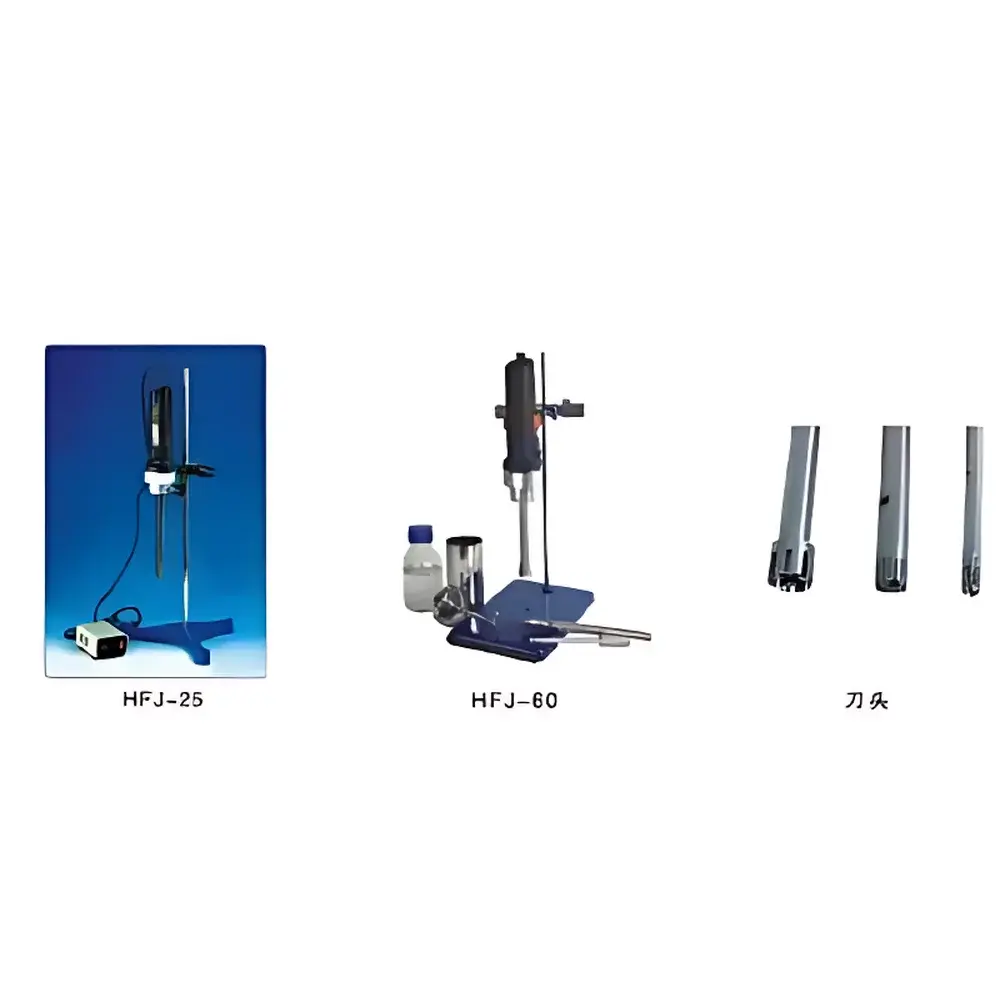
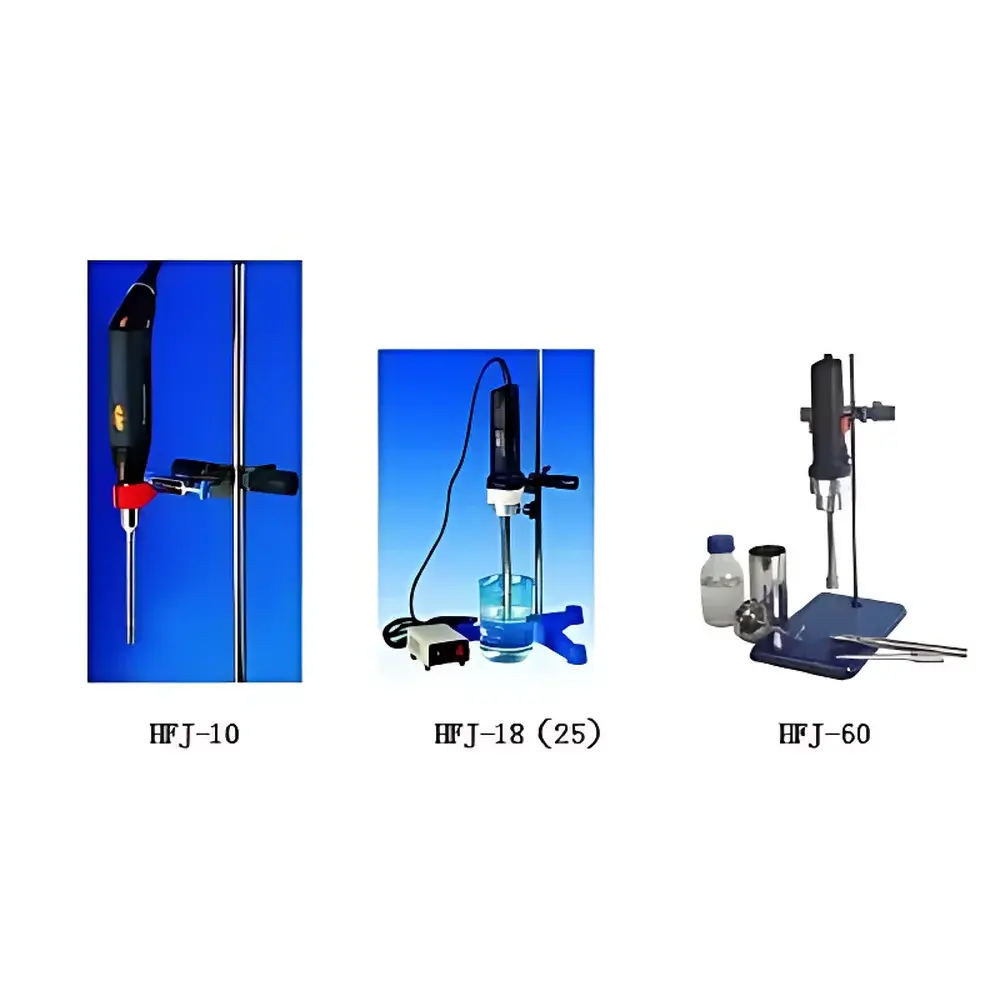
Chu Ding HFJ-18 High-Speed Inline Homogenizer
| Brand | Chu Ding |
|---|---|
| Origin | Shanghai, China |
| Model | HFJ-18 |
| Motor Speed | 31,000 rpm |
| Probe Diameter | 18 mm |
| Power | 500 W |
| Max. Sample Volume (Water) | 5,000 mL |
| Material of Wetted Parts | ASTM F899 Grade 316 Stainless Steel |
| Probe Configuration | Interchangeable Rotor-Stator Assembly with Angled Shear Edges |
| Drive Type | Direct-Drive Brushless Motor |
| Cooling | Air-Cooled Housing |
| Compliance | CE-marked per EN 61000-6-2/6-4 & EN 60335-1 |
Overview
The Chu Ding HFJ-18 High-Speed Inline Homogenizer is an engineered solution for rapid, scalable mechanical homogenization in research and quality control laboratories. Operating on the principle of high-shear rotor-stator fluid dynamics, the device subjects samples to intense hydrodynamic cavitation and turbulent shear forces generated by the relative motion between a precision-machined rotating rotor and a concentric stationary stator. This architecture enables efficient disruption of cellular structures—including plant cell walls, animal tissue membranes, and microbial cells—while maintaining sample integrity under controlled thermal conditions. Unlike batch-type immersion homogenizers, the HFJ-18’s inline probe design allows direct insertion into vessels ranging from conical tubes to beakers and jacketed reactors, supporting both small-scale optimization (≥5 mL) and process-relevant volumes up to 5 L (water-equivalent). Its brushless motor delivers stable torque across the full 31,000 rpm operating range, minimizing speed drift during extended operation—a critical factor for reproducible particle size reduction and emulsion formation.
Key Features
- High-performance inline probe with 18 mm diameter stainless steel rotor-stator head, optimized for viscous and fibrous matrices including leaf tissue, liver homogenates, and seed slurries.
- Interchangeable probe assemblies: standardized quick-connect interface permits tool-free replacement of rotor-stator sets (e.g., narrow-gap for nano-emulsions, wide-gap for coarse tissue fragmentation).
- Wetted components fabricated from ASTM F899-certified 316 stainless steel—resistant to organic solvents, acidic buffers (pH ≥2), and enzymatic reagents; compatible with autoclaving (121°C, 20 min) and CIP/SIP protocols.
- Angled-edge rotor and stator geometry increases localized shear rate by >40% compared to conventional radial-cut designs, enhancing membrane lysis efficiency without requiring chemical lysis agents.
- Air-cooled motor housing with thermal cut-off protection prevents overheating during continuous operation (>30 min at rated load); integrated tachometer provides real-time RPM feedback via front-panel LED display.
Sample Compatibility & Compliance
The HFJ-18 accommodates heterogeneous biological and industrial samples including fibrous plant material (e.g., wheat straw, soybean cotyledons), soft animal tissues (muscle, spleen, adipose), bacterial pellets, and polymer dispersions. It supports ISO 13320-compliant wet dispersion for laser diffraction particle sizing prep and meets GLP documentation requirements when used with validated SOPs. While not certified to FDA 21 CFR Part 11 out-of-the-box, its analog speed control and non-networked architecture permit integration into Part 11–compliant environments via external audit-trail logging systems. The unit conforms to IEC 61000 electromagnetic compatibility standards and carries CE marking for laboratory use within the European Economic Area.
Software & Data Management
The HFJ-18 operates via analog speed control with no embedded firmware or digital interface. All operational parameters—including setpoint RPM, runtime, and ambient temperature—are recorded manually or via external data loggers synchronized to start/stop triggers. For regulated environments, users may deploy third-party LabArchives or Electronic Lab Notebook (ELN) platforms to capture instrument metadata, calibration certificates (traceable to NIST SRM 2806a), and procedural deviations. Routine maintenance logs—including probe wear inspection intervals and lubrication records—align with ISO/IEC 17025 Clause 6.4.3 for equipment management.
Applications
- Pre-analytical sample preparation for proteomics and metabolomics workflows requiring intact subcellular fractionation.
- Routine homogenization of clinical biopsy specimens prior to nucleic acid extraction (compatible with Qiagen AllPrep and Promega Maxwell kits).
- Development of food-grade emulsions (e.g., plant-based dairy alternatives) where thermal degradation must be avoided.
- Cell disruption for recombinant protein recovery in E. coli and Pichia pastoris fermentation harvests.
- Dispersion of nanocellulose suspensions and graphene oxide colloids for rheological characterization.
FAQ
What is the maximum viscosity this homogenizer can process?
The HFJ-18 is rated for aqueous and low-viscosity suspensions (<500 mPa·s at 25°C); for higher-viscosity media (e.g., xanthan gum solutions), reduce volume by 50% and limit run time to ≤90 seconds per cycle.
Can the probe be sterilized in an autoclave?
Yes—the entire probe assembly (rotor, stator, shaft, and collar) is autoclavable at 121°C for 20 minutes; avoid prolonged exposure to alkaline cleaning agents (>pH 11) to prevent passive layer degradation.
Is there a recommended maintenance schedule?
Inspect rotor-stator clearance every 50 hours of cumulative operation using a 0.05 mm feeler gauge; replace probes after 200 hours or upon visible pitting or edge rounding.
Does the unit include overload protection?
Yes—an internal thermal cutoff interrupts power if housing temperature exceeds 75°C; automatic reset occurs after cooling to <45°C.
How does it compare to ultrasonic homogenizers for nucleic acid yield?
Rotor-stator homogenization typically achieves 15–20% higher DNA recovery from fibrous tissues versus sonication, with lower shearing-induced fragmentation—validated against ISO 20387 Annex B protocols.



