
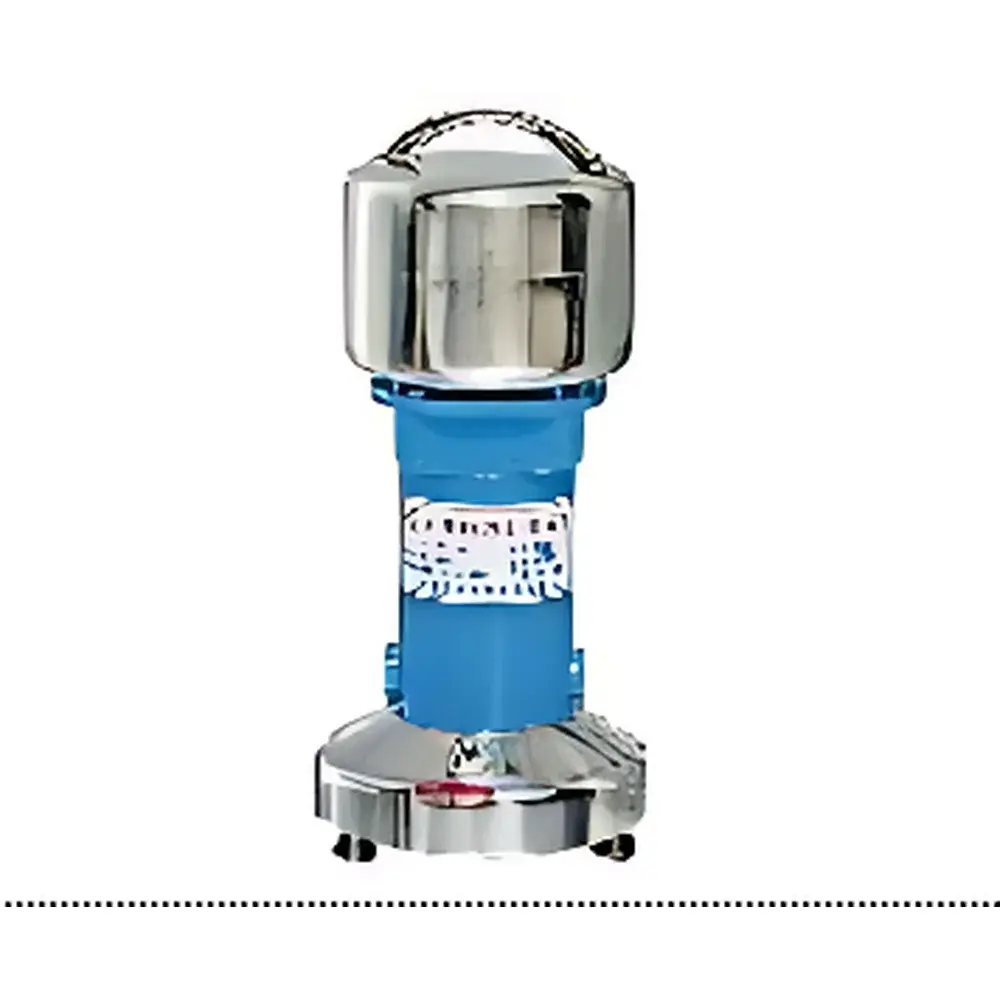
FW100/FW80 High-Speed Universal Laboratory Grinder
| Key | Origin: Shanghai, China |
|---|---|
| Manufacturer Type | Authorized Distributor |
| Country of Origin | PRC |
| Model | FW-100 / FW-80 / F102 |
| Power Supply | FW-80: 200 W, 220 V |
| FW-100 | 460 W, 220 V |
| F102 | 180 W, 220 V |
| Rotational Speed | FW-80: 10,000 rpm |
| FW-100 | 24,000 rpm |
| F102 | 1,400 rpm |
| Dimensions (L×W×H) | FW-80: φ130 × 250 mm |
| FW-100 | φ140 × 290 mm |
| F102 | 300 × 185 × 300 mm |
| Particle Size Range | 60–180 µm (FW-80/FW-100) |
| Construction | Stainless steel grinding chamber |
Overview
The FW-100 and FW-80 High-Speed Universal Laboratory Grinders are engineered for rapid, reproducible size reduction of diverse solid samples in research, quality control, and preparatory laboratories. These benchtop grinders operate on the principle of high-speed rotor–stator impact milling: a precision-balanced rotating blade assembly interacts with fixed counter-blades or a hardened grinding chamber wall to generate shear, impact, and attrition forces—enabling efficient comminution of brittle, fibrous, soft, and moderately oily materials. Designed for routine sample homogenization prior to elemental analysis (e.g., ICP-OES, AAS), moisture determination (ASTM D4442, ISO 4471), proximate analysis (AOAC 925.10, USP <1112>), and extraction workflows, the FW series delivers consistent particle size distribution within the 60–180 µm range—critical for analytical method validation and inter-laboratory comparability.
Key Features
- Stainless steel grinding chamber (AISI 304) ensures chemical inertness, corrosion resistance, and trace-metal-free operation—essential for environmental soil testing (EPA Method 3050B), pharmaceutical excipient processing, and feedstuff analysis.
- Interchangeable rotor configurations: FW-100 employs a dual-blade high-RPM impeller optimized for hard granular matrices (minerals, grains, dried botanicals); FW-80 utilizes a compact single-rotor design suited for low-volume, high-purity applications (e.g., herbal powder standardization).
- F102 variant features adjustable stator–rotor clearance—enabling controlled shearing of resilient organic tissues (animal hide, muscle, plant stems) without thermal degradation, supporting protocols requiring intact macromolecular integrity (e.g., DNA/RNA preservation pre-extraction).
- Robust cast-aluminum housing with vibration-dampening feet and integrated thermal cutoff (120 °C auto-shutdown) comply with IEC 61000-6-2 EMC immunity and IEC 60335-1 safety standards.
- Tool-free chamber disassembly facilitates rapid cleaning, cross-contamination prevention, and GLP-compliant workflow documentation per FDA 21 CFR Part 11 requirements for audit trails.
Sample Compatibility & Compliance
The FW-100/FW-80 grinders accommodate heterogeneous dry or low-moisture (<12% w/w) samples including agricultural grains (wheat, rice, soybean), geological aggregates (clay, shale, limestone), pharmaceutical tablets and herbs, clinical tissue specimens, and industrial powders (carbon black, talc, calcium carbonate). They are routinely deployed in laboratories adhering to ISO/IEC 17025:2017 accreditation criteria for sample preparation, as well as ASTM D5630 (ash content), ISO 6579 (microbiological sampling homogenization), and Chinese Pharmacopoeia 2020 Edition General Chapter 0211 (herbal powder fineness testing). All units bear CE marking and meet RoHS Directive 2011/65/EU material restrictions.
Software & Data Management
While the FW series operates as a standalone mechanical instrument without embedded firmware, its design supports full integration into regulated digital lab environments. Optional external timers (0.1–999 s) with programmable ramp-up profiles enable SOP-driven repeatability. Raw operational data—including runtime, batch ID, operator code, and maintenance logs—can be recorded in LIMS-compatible spreadsheets or ELN platforms. For GMP/GLP audits, users may implement electronic signatures and version-controlled SOPs (e.g., SOP-GRIND-001) governing calibration frequency (biweekly torque verification), chamber sterilization (autoclave cycle log), and wear-part replacement (rotor blade service life: ≤500 cycles at rated load).
Applications
- Pre-analytical sample conditioning for NIR spectroscopy calibration models (ASTM E1655)
- Homogenization of certified reference materials (CRMs) for proficiency testing (e.g., NIST SRM 1944, BCRI Soil CRM)
- Particle size standardization prior to sieve analysis (ISO 9276-1) or laser diffraction (ISO 13320)
- Preparation of uniform test portions for fat extraction (Soxhlet, AOAC 920.39), protein quantification (Kjeldahl, AOAC 984.13), and starch assay (AOAC 975.25)
- Routine QC grinding of raw herbal materials per Chinese Pharmacopoeia monographs (e.g., Ginseng Radix, Scutellariae Radix)
FAQ
What is the maximum recommended sample volume per batch for the FW-100?
For optimal particle size consistency and thermal management, the FW-100 should not exceed 100 g per cycle when processing dense materials (e.g., corn kernels, quartz sand); 50 g is advised for fibrous or oily samples.
Can the FW-80 be used for cryogenic grinding?
No—the unit lacks liquid nitrogen porting or cold-stage integration; ambient-temperature operation only. For sub-zero comminution, consider dedicated cryo-grinders (e.g., SPEX CertiPrep 6870D).
Is stainless steel construction compliant with USP <231> heavy metals testing?
Yes—AISI 304 SS meets USP <231> material compatibility requirements for sample contact surfaces when validated per internal SOP against leachables (ICP-MS detection limit: <0.1 ppb Pb/Cd/As).
How often should rotor blades be replaced?
Blade replacement is required after 500 operational cycles or upon visible edge rounding, chipping, or >5% deviation in mean particle size (measured by laser diffraction per ISO 13320).
Does the F102 model support regulatory audit documentation?
Yes—its manual gap adjustment mechanism allows traceable parameter logging (gap setting, runtime, ambient temperature), satisfying ALCOA+ principles for data integrity in GLP-regulated studies.



