
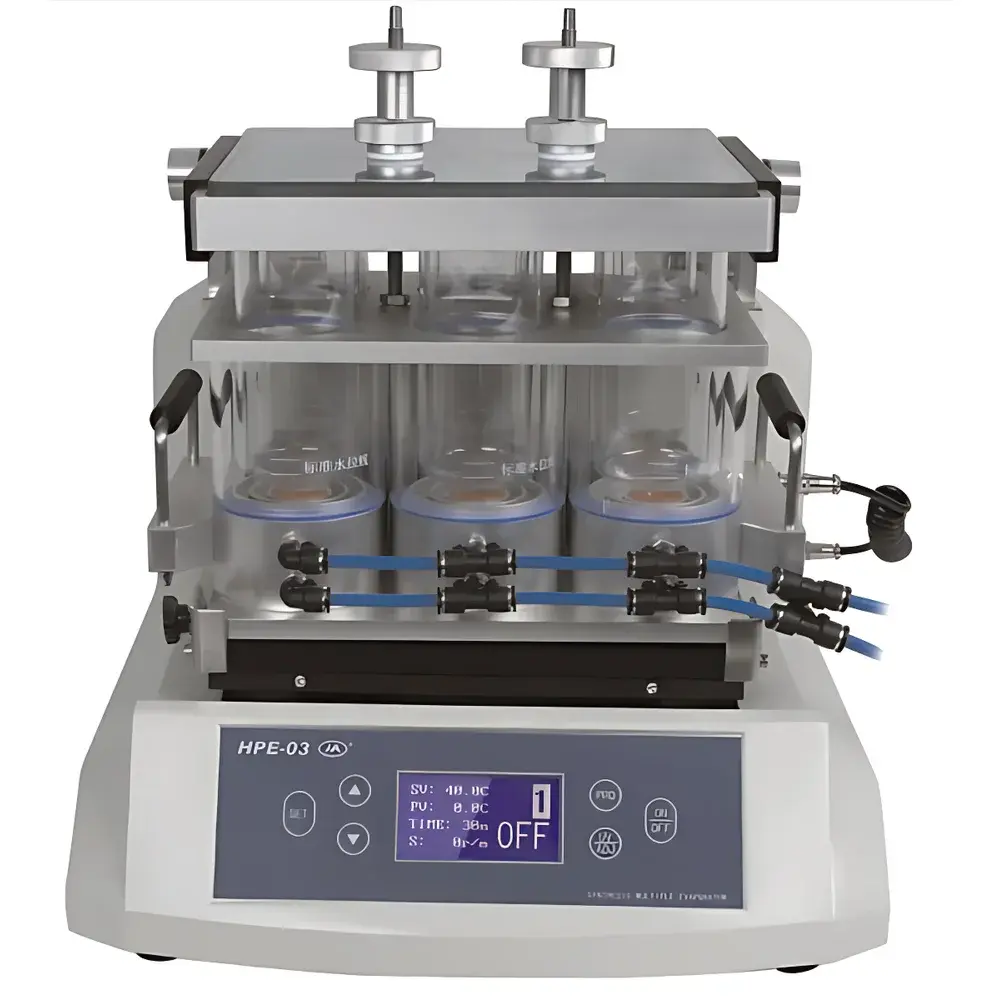
Chu Ding HPE-03 Automated Quantitative Parallel Evaporator
| Brand | Chu Ding |
|---|---|
| Model | HPE-03 |
| Instrument Type | Automated Quantitative Concentrator |
| Heating Temperature Range | RT + 5 °C to 100 °C |
| Temperature Control Accuracy | ±1 °C |
| Rotation Speed | 50–420 rpm |
| Orbit Diameter | 5 mm |
| Power Consumption | 1100 W |
| Net Weight | 32 kg |
| Dimensions (W×D×H) | 380 × 510 × 420 mm |
| Sample Capacity | 6 positions, 250 mL per tube |
| Solvent Recovery | Integrated condensation system |
| Operation Mode | Digital timer-controlled, vacuum-assisted evaporation |
| Compliance | Designed for GLP-compliant labs |
Overview
The Chu Ding HPE-03 Automated Quantitative Parallel Evaporator is an engineered solution for high-throughput, reproducible solvent removal under controlled vacuum and regulated thermal conditions. Based on the principle of simultaneous rotary evaporation under reduced pressure—enhanced by precise temperature ramping, orbital shaking, and integrated cold-finger condensation—the HPE-03 enables parallel processing of up to six 250 mL samples without manual intervention or sample transfer. Unlike traditional single-vessel rotovaps, this system eliminates cross-contamination through independent sealed pathways for each sample vessel, while its vacuum-compatible design ensures consistent vapor pressure control across all positions. The instrument is specifically optimized for applications requiring strict endpoint volume definition—such as pesticide residue analysis in food safety testing, trace organic extraction in environmental monitoring (e.g., EPA Method 525.3), and preparative cleanup steps prior to GC-MS or LC-MS/MS analysis. Its compact footprint and closed-loop solvent recovery eliminate dependence on fume hoods, supporting safe, space-efficient operation in ISO 17025-accredited laboratories.
Key Features
- Quantitative endpoint control via digital timer—no manual supervision required; programmable run duration ensures repeatability across batches.
- Independent sealed sample channels with individual O-ring seals prevent carryover and cross-contamination between vessels.
- Integrated refrigerated condenser recovers >95% of common organic solvents (e.g., ethyl acetate, dichloromethane, hexane), minimizing environmental release and operational cost.
- Orbital shaking (50–420 rpm, 5 mm orbit) combined with adjustable heating (RT + 5 °C to 100 °C, ±1 °C accuracy) accelerates evaporation kinetics—especially for high-boiling-point analytes such as PAHs or PCB congeners.
- No nitrogen purge required: gradient temperature programming replaces inert gas sparging, reducing infrastructure dependency and lab gas consumption.
- Robust aluminum alloy chassis and corrosion-resistant chamber lining ensure long-term stability in routine QC/QA environments.
Sample Compatibility & Compliance
The HPE-03 accommodates standard 250 mL borosilicate glass test tubes (optional adaptors available for 50–500 mL formats). It is compatible with aqueous, acidic, basic, and moderately polar organic matrices—validated for use with EPA SW-846 Methods 3510C (separatory funnel extraction) and 3550C (sonication extraction), as well as ISO 1833-1:2018 for textile extractables. All electronic controls meet IEC 61010-1 safety standards for laboratory equipment. While not inherently 21 CFR Part 11 compliant, the system supports integration with validated LIMS or ELN platforms for electronic record retention, audit trail generation, and user-access logging—enabling alignment with GLP and GMP documentation requirements.
Software & Data Management
The HPE-03 operates via a dedicated front-panel interface with real-time display of setpoint temperature, elapsed time, and vacuum status. Though standalone, its timer-based architecture allows synchronization with external data loggers (e.g., Omega OM-DAQPRO-5300) for CSV-exported run logs—including start/stop timestamps, thermal profiles, and operator ID inputs when interfaced via RS-232 or USB-to-serial adapters. Firmware updates are performed offline via SD card, ensuring integrity during regulatory audits. No cloud connectivity or proprietary software installation is required—reducing validation burden in regulated settings.
Applications
- Environmental laboratories: Concentration of large-volume water extracts (e.g., 1 L SPE eluates) prior to GC-ECD analysis of organochlorine pesticides.
- Food safety QA/QC: Parallel reduction of QuEChERS acetonitrile extracts from multi-residue pesticide screening workflows.
- Pharmaceutical R&D: Removal of reaction solvents from parallel synthesis libraries while preserving thermolabile intermediates.
- Clinical toxicology: Pre-concentration of urine or plasma extracts for LC-MS quantification of benzodiazepines and opioids.
- Materials science: Solvent stripping from polymer nanoparticle dispersions without aggregation.
FAQ
Does the HPE-03 support fixed-volume endpoint detection like the HPE-02?
No—HPE-03 uses time-based termination rather than optical or gravimetric volume sensing. For true quantitative endpoint control (e.g., stop at exactly 0.5 mL), the HPE-02 model is recommended.
Can the system handle viscous or foaming samples?
Yes—orbital agitation minimizes foam formation, and optional anti-bumping glass inserts are available for high-surface-tension matrices.
Is vacuum pump included?
No—a separate oil-free diaphragm vacuum pump (ultimate vacuum ≤10 mbar) must be connected via standard 8 mm hose barb fittings.
What maintenance is required?
Monthly cleaning of the condenser coil and O-rings; annual calibration of the PT100 temperature sensor using NIST-traceable reference baths.
Is service support available outside China?
Yes—Chu Ding partners with authorized distributors in EU, North America, and APAC regions offering on-site technical support, spare parts logistics, and ISO/IEC 17025-aligned performance verification.



