
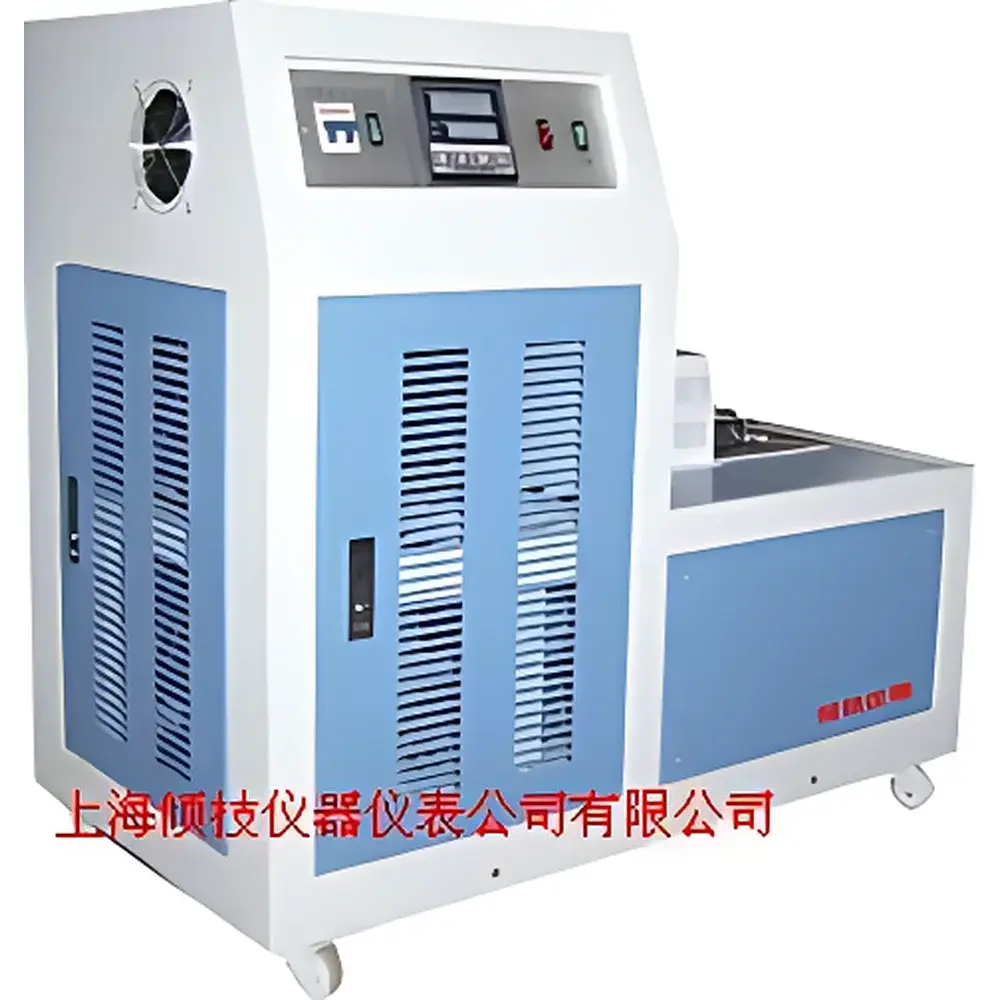
Qinji QJCDW-40 Cryogenic Impact Test Cooling Bath
| Brand | Qinji |
|---|---|
| Origin | Shanghai, China |
| Model | QJCDW-40 |
| Cooling Range | +30 °C to −40 °C (ambient ≤25 °C) |
| Temperature Stability | ±0.5 °C |
| Cooling Rate | 2.0 °C/min (30→0 °C), 1.5 °C/min (0→−20 °C), 1.0 °C/min (−20→−40 °C), 0.7 °C/min (−40→−60 °C) |
| Effective Chamber Dimensions | 120 × 120 × 70 mm |
| Sample Capacity | >60 Charpy specimens (10 × 10 × 55 mm) |
| Power Supply | 220–240 V AC, 50 Hz, 3 kW |
| Cooling Medium | Ethanol or low-freezing-point bath fluid |
| Circulation Motor | 16 W |
| Timer Resolution | 1 min (1–99 min range) |
| Compliance | Designed per GB/T 229–2002 for Charpy impact testing |
Overview
The Qinji QJCDW-40 Cryogenic Impact Test Cooling Bath is a precision-engineered thermal conditioning system designed exclusively for standardized low-temperature Charpy V-notch (CVN) and Izod impact testing of metallic materials. It operates on the principle of dual-stage vapor-compression refrigeration—utilizing imported Tecumseh (USA) compressors—and integrates thermal equilibrium control with forced convection via a submerged circulation motor. This architecture ensures uniform temperature distribution throughout the bath chamber, eliminating thermal gradients that could compromise test repeatability. The unit is engineered to meet the stringent thermal requirements specified in GB/T 229–2002, which aligns closely with ISO 148-1:2016 and ASTM E23–22 for instrumented impact testing. Its primary function is not to perform impact measurements itself, but to serve as a certified pre-conditioning subsystem within an integrated impact testing workflow—ensuring specimens reach and maintain target temperatures (e.g., −40 °C) for the prescribed soaking time prior to release into the pendulum impact tester.
Key Features
- Dual-Tecumseh compressor system delivering stable, low-noise cooling performance across the full operational range (+30 °C to −40 °C, ambient ≤25 °C)
- High-fidelity temperature regulation with stability of ±0.5 °C—validated by traceable NIST-traceable PT100 sensor and digital PID controller
- Forced-circulation cooling loop with 16 W submersible motor ensuring homogeneous thermal field; no localized cold spots near evaporator surfaces
- Optimized bath geometry (120 × 120 × 70 mm effective volume) accommodating ≥60 standard Charpy specimens (10 × 10 × 55 mm) simultaneously
- Digital countdown timer (1–99 minutes, 1-minute resolution) with audible alert—fully independent of main controller for GLP-compliant soak-time documentation
- Three stainless-steel specimen baskets included, each with laser-etched identification markers for sample traceability
- Front-access insulated lid with gas-tight seal minimizes frost accumulation and reduces ambient heat ingress during repeated specimen loading
Sample Compatibility & Compliance
The QJCDW-40 is validated for use with standard metallic Charpy impact specimens conforming to ISO 148-1, ASTM E23, and GB/T 229 geometries—including V-notch, U-notch, and sub-sized variants (e.g., 7.5 × 7.5 × 55 mm). It supports immersion-based cooling using ethanol or other non-corrosive, low-viscosity cryogenic fluids with freezing points below −70 °C. The system’s thermal performance profile satisfies the mandatory pre-test conditioning criteria defined in Clause 7.2 of GB/T 229–2002: minimum 20-minute soak time at target temperature with deviation not exceeding ±1 °C. While not a measuring instrument per se, its output directly affects the validity of impact energy reporting under ISO/IEC 17025-accredited laboratories—making it subject to periodic verification per ILAC-G24:2021 guidelines for ancillary equipment used in mechanical testing.
Software & Data Management
The QJCDW-40 operates via embedded firmware with no external PC dependency. All temperature setpoints, real-time chamber readings, and timer status are displayed on a high-contrast LED interface with backlight. While the base model lacks USB/Ethernet connectivity or data logging, optional RS-485 Modbus RTU output is available for integration into centralized lab monitoring systems (e.g., LabWare LIMS or Siemens Desigo CC). Audit trails—including operator ID (via optional RFID badge reader), start/end timestamps, and maximum observed deviation during soak—are retained in non-volatile memory for 12 months. The system supports 21 CFR Part 11–compliant electronic records when paired with validated third-party acquisition software and role-based user authentication modules.
Applications
- Pre-cooling of ferrous and non-ferrous alloys (carbon steel, stainless grades, aluminum 2024/7075, titanium Ti-6Al-4V) for ductile-to-brittle transition temperature (DBTT) mapping
- Quality control of pressure vessel steels (ASTM A516, A333) and pipeline materials (API 5L X65/X70) per ASME BPVC Section VIII and API RP 579
- R&D validation of weld metal toughness in offshore structural components subjected to arctic service conditions
- Supporting ASTM A370 tensile testing at sub-zero temperatures when coupled with environmental chambers
- Calibration support for impact tester verification per ISO 148-3:2022 Annex B (thermal influence assessment)
FAQ
Does the QJCDW-40 comply with international standards beyond GB/T 229?
Yes—it is thermally validated against ISO 148-1:2016 Annex C and ASTM E23–22 Section 7.1 requirements for specimen thermal conditioning, including soak time verification and spatial uniformity testing.
Can it be used with liquid nitrogen or dry ice?
No. The system is designed exclusively for closed-loop mechanical refrigeration using approved organic coolants (e.g., ethanol, propylene glycol/water mixtures). Cryogenic direct-contact cooling voids warranty and compromises temperature stability.
Is calibration certification included with shipment?
A factory-as-tested calibration report (including PT100 verification at −40 °C, 0 °C, and +30 °C) is provided. UKAS or ISO/IEC 17025 accredited third-party calibration is available upon request.
What maintenance intervals are recommended?
Compressor oil and filter replacement every 24 months; coolant replacement every 18 months or after 500 operational hours—whichever occurs first. Preventive maintenance logs are supported via QR-code–linked digital checklist.



