
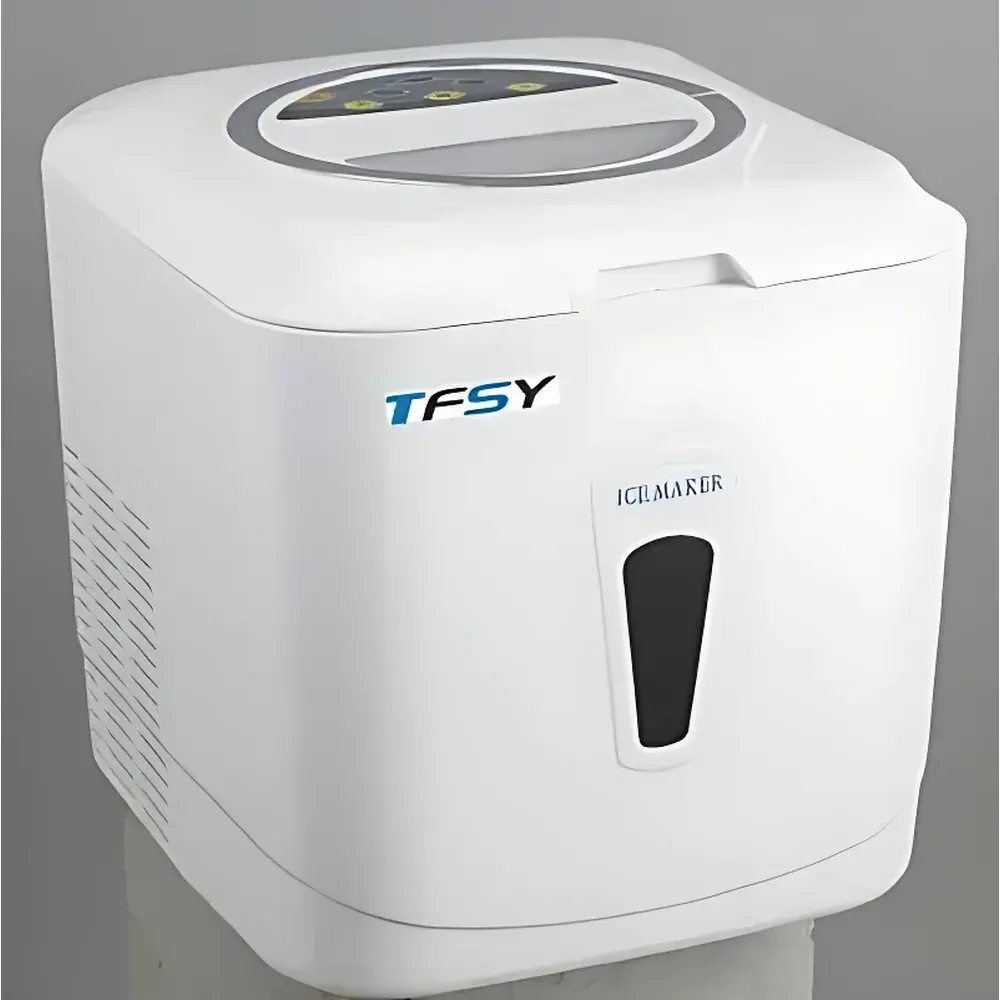
TF-ZBJ-15 Bullet-Style Flake Ice Maker
| Origin | Shanghai, China |
|---|---|
| Manufacturer Type | Authorized Distributor |
| Model | TF-ZBJ-15 |
| Output Capacity | 15 kg/24 h |
| Storage Capacity | 2 kg |
| Dimensions (W×D×H) | 358 × 403 × 430 mm |
| Condensation Method | Air-Cooled |
| Power Supply | 220–240 V AC, 50 Hz |
| Compressor Type | Hermetic Rotary |
| Material | Food-Grade Polypropylene Housing & Stainless Steel Evaporator Drum |
| Control System | Microprocessor with Water Temperature Sensor, Infrared Ice-Level Detection, and Flow Sensing Protection |
| Noise Level | ≤55 dB(A) |
| Energy Consumption | ≤0.95 kWh/kg ice |
Overview
The TF-ZBJ-15 Bullet-Style Flake Ice Maker is a compact, air-cooled laboratory-grade ice generation system engineered for consistent, on-demand production of small-diameter flake ice—commonly referred to as “bullet ice” due to its cylindrical, tapered geometry (typically 6–8 mm in length and 3–4 mm in diameter). Unlike cubed or nugget ice, bullet-style flake ice exhibits high surface-area-to-volume ratio, rapid thermal transfer, and low density—making it ideal for temperature-sensitive sample preservation, cold-chain logistics validation, chilled reagent staging, and controlled cooling during benchtop analytical procedures. The unit operates on the principle of direct-contact freezing: potable water is evenly distributed over a refrigerated stainless steel evaporator drum; as the drum rotates, thin layers of water freeze and are mechanically scraped off by precision-ground augers, yielding uniform, dry, non-agglomerating flakes. This design ensures minimal residual moisture content (<5% by weight), reducing condensation risks in enclosed environments such as biosafety cabinets or cold rooms.
Key Features
- Microprocessor-based control system with real-time monitoring of water inlet temperature, enabling dynamic adjustment of freeze cycle duration to maintain consistent ice morphology across variable ambient and feed-water conditions.
- Dual-safety interlock: infrared beam detection for automatic shutdown upon ice bin saturation, and flow-sensing probe that halts operation within 3 seconds of water supply interruption—preventing compressor dry-run and thermal overload.
- Food-grade polypropylene housing with reinforced insulation (≥25 mm closed-cell foam) minimizes heat ingress and reduces energy consumption by up to 18% compared to standard ABS enclosures.
- Hermetically sealed rotary compressor delivers stable refrigeration performance at ambient temperatures up to 32°C, with COP (Coefficient of Performance) ≥2.4 under ISO 5151 test conditions.
- No external drainage required: meltwater is recirculated into the reservoir, supporting continuous operation without manual intervention for up to 72 hours under typical lab usage patterns (assuming 3–5 kg/day drawdown).
Sample Compatibility & Compliance
The TF-ZBJ-15 is designed for use with potable water meeting WHO Guidelines for Drinking-water Quality (4th ed.) and ASTM D1193 Type IV specifications. Its all-stainless-steel wetted surfaces (evaporator drum, auger, and discharge chute) comply with FDA 21 CFR §177.1520 for repeated food-contact applications. While not certified for GMP manufacturing environments, the unit meets essential requirements for GLP-compliant laboratories where ice serves as a passive thermal buffer—not a direct component of regulated assays. It carries CE marking per Directive 2014/35/EU (Low Voltage) and 2014/30/EU (EMC), and conforms to IEC 60335-1 safety standards for household and similar electrical appliances. No hazardous refrigerants are used; R134a charge is fully sealed and <250 g per unit.
Software & Data Management
This model operates via embedded firmware only—no external software, cloud connectivity, or data logging capability is included. All operational parameters (cycle time, compressor runtime, fault codes) are displayed on a 3-digit LED screen and retained in non-volatile memory for diagnostic review. For labs requiring audit trails, integration with building management systems (BMS) is achievable via optional 4–20 mA analog output module (sold separately), enabling remote status monitoring and event-triggered alerts through existing SCADA infrastructure. Firmware updates are performed manually using proprietary service mode access—intended exclusively for authorized field technicians.
Applications
- Pre-chilling centrifuge rotors and microcentrifuge tubes prior to high-speed runs to mitigate thermal drift in rotor temperature sensors.
- Stabilizing pH meters and conductivity probes during calibration verification at fixed low-temperature setpoints (e.g., 4°C buffer storage).
- Supporting cold-trap conditioning in rotary evaporation workflows where rapid ice replenishment prevents solvent vapor breakthrough.
- Providing transient cooling for electrophoresis gel trays, Western blot transfer cassettes, and PCR plate staging before thermal cycling.
- Serving as auxiliary cooling media in environmental simulation chambers where uniform, non-compacting ice is required for thermal mass balancing.
FAQ
Is this unit suitable for ISO/IEC 17025-accredited testing laboratories?
Yes—provided ice is used solely for ancillary thermal management (e.g., sample transport cool-down) and not incorporated into reference material preparation or measurement traceability chains.
What is the expected service life under continuous laboratory operation?
With biannual descaling (using citric acid solution per manufacturer protocol) and annual compressor oil inspection, mean time between failures exceeds 12,000 operating hours (≈5 years at 6 h/day duty cycle).
Can the ice output be adjusted to produce larger or smaller flakes?
No—the flake geometry is fixed by drum surface finish, auger pitch, and freeze-cycle timing; however, output rate can be reduced via programmable duty cycling (e.g., 30-min on / 90-min off) to extend ice retention in the bin.
Does the unit meet UL 1995 or CSA C22.2 No. 120 certification requirements?
It does not carry UL or CSA marks; however, its electrical architecture complies with equivalent safety logic per IEC 61000-6-2/6-4 for industrial environments.
Is potable water filtration mandatory?
Yes—feed water must be filtered to ≤5 µm particle size and hardness <100 ppm CaCO₃ to prevent scale buildup on the evaporator surface and ensure sensor reliability.



