
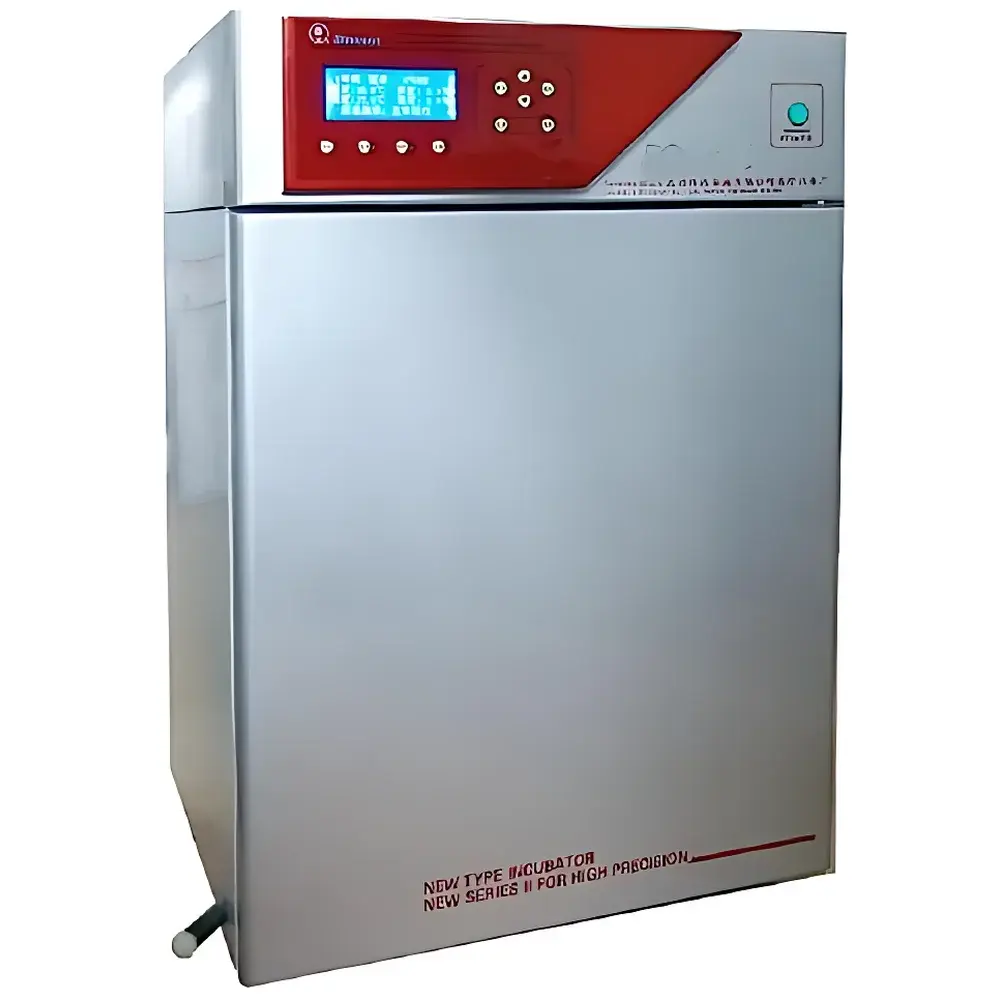
BOXUN BC-J160S / BC-J80S CO₂ Incubator
| Brand | BOXUN |
|---|---|
| Origin | Shanghai, China |
| Model | BC-J160S / BC-J80S |
| Power Supply | AC 220 V ±10%, 50 Hz ±2% |
| Input Power | 550 W |
| Heating Method | Water-jacketed |
| Temperature Range | Ambient +5 °C to 60 °C |
| Temperature Resolution | 0.1 °C |
| Temperature Uniformity | ≤ ±0.2 °C |
| Temperature Stability (at 37 °C) | ≤ ±0.1 °C |
| CO₂ Range | 0–20% (v/v) |
| CO₂ Control | Infrared (IR) sensor, accuracy ±0.1% |
| CO₂ Recovery Time | ≤ concentration value × 1.2 min |
| Humidification | Natural evaporation |
| Chamber Volume | 160 L / 80 L |
| Interior Dimensions (W×D×H) | 550 × 500 × 650 mm |
| Exterior Dimensions (W×D×H) | 700 × 620 × 980 mm |
| Shelving | 3 adjustable stainless-steel shelves |
| Filtration | HEPA-grade filter, ≥99.998% efficiency for particles ≥0.3 µm |
| Interface | RS-485 port with PC connectivity and included data logging software |
| Safety Features | Dual independent temperature control circuits, UV sterilization lamp, door-heating anti-condensation system, power-failure parameter retention and auto-recovery |
Overview
The BOXUN BC-J160S and BC-J80S are precision water-jacketed CO₂ incubators engineered for reliable, long-term cell culture under tightly controlled physiological conditions. Designed in accordance with fundamental requirements of mammalian cell growth—stable CO₂ partial pressure, uniform temperature distribution, and contamination mitigation—these incubators employ non-dispersive infrared (NDIR) sensing technology for real-time, high-fidelity CO₂ monitoring and feedback-controlled gas regulation. Unlike thermal conductivity (TCD) sensors, NDIR sensors offer superior specificity, linearity, and immunity to cross-sensitivity from humidity or ambient gases—critical for applications requiring compliance with ISO 13485, USP , or GLP-aligned workflows. The water-jacketed thermal architecture ensures exceptional thermal inertia and minimal temperature fluctuation during door openings, while the double-walled chamber construction minimizes heat loss and improves energy efficiency over air-jacketed alternatives.
Key Features
- Water-jacketed heating system providing stable thermal environment with ≤ ±0.1 °C stability at 37 °C and ≤ ±0.2 °C uniformity across the chamber volume.
- High-accuracy NDIR CO₂ sensor (±0.1% full scale), enabling precise regulation within 0–20% range and rapid recovery (≤ concentration × 1.2 min) after door access.
- LCD-based microprocessor controller with simultaneous real-time display of chamber temperature, relative humidity (via capacitive sensor), and CO₂ concentration.
- Dual independent temperature control circuits: primary PID loop with secondary safety cutoff—ensuring fail-safe operation per IEC 61010-1 requirements.
- Integrated UV-C germicidal lamp (254 nm) for periodic decontamination of interior surfaces; validated against common mycoplasma, bacterial, and fungal contaminants.
- Anti-condensation door heating system preventing fogging on inner glass, maintaining optical clarity for uninterrupted observation.
- HEPA-grade particulate filtration (≥99.998% capture efficiency for ≥0.3 µm particles) integrated into the recirculation airflow path.
- Stainless-steel interior with seamless, radius-cornered construction facilitating cleaning and reducing microbial harborage points.
- RS-485 serial interface compliant with Modbus RTU protocol, supporting integration into centralized lab management systems and automated data archiving.
- Power-loss memory function retaining all setpoints and operational parameters; automatic resumption upon grid recovery without manual reconfiguration.
Sample Compatibility & Compliance
The BC-J160S/BC-J80S supports a broad spectrum of adherent and suspension cultures—including primary human cells, hybridomas, stem cell lines, and engineered organoids—across academic, clinical, and biomanufacturing settings. Its chamber geometry, airflow design, and humidity maintenance strategy comply with recommendations outlined in ASTM E1283 (Standard Guide for Biological Safety Cabinets and Related Equipment) and ISO 5667-19 (water quality sampling—microbiological analysis). The incubator’s validation-ready architecture—including audit-trail-capable software, configurable alarm thresholds, and traceable calibration logs—facilitates alignment with FDA 21 CFR Part 11 requirements when used in GMP-regulated environments. All electrical components meet CE marking standards (EN 61010-1, EN 61326-1) for laboratory equipment safety and electromagnetic compatibility.
Software & Data Management
The included PC software provides bidirectional communication via RS-485, enabling remote configuration, real-time monitoring, and time-stamped data export in CSV format. Users may define custom alarm profiles (e.g., CO₂ deviation >0.3%, temperature excursion >0.5 °C), schedule UV sterilization cycles, and generate PDF-formatted operational reports suitable for internal QA review or regulatory submission. Data integrity safeguards include user-level access control, electronic signature prompts for critical parameter changes, and tamper-evident log files—all supporting ALCOA+ principles (Attributable, Legible, Contemporaneous, Original, Accurate, Complete, Consistent, Enduring, Available).
Applications
These incubators serve as core infrastructure in cell biology laboratories conducting routine passaging, transfection assays, co-culture studies, and bioreactor seed train preparation. They are routinely deployed in immunology labs for lymphocyte expansion, in oncology research for tumor spheroid development, and in biopharma QC for stability testing of therapeutic cell products. Their consistent performance under repeated door access makes them especially suited for high-throughput workflows involving robotic liquid handlers or automated imaging platforms. In agricultural biotechnology, they support plant protoplast culture and fungal strain preservation where elevated CO₂ levels enhance metabolic activity.
FAQ
What is the difference between water-jacketed and air-jacketed CO₂ incubators?
Water-jacketed models provide superior thermal stability due to the high specific heat capacity of water, minimizing temperature perturbations during frequent door openings—ideal for sensitive long-term cultures.
Is the CO₂ sensor calibrated at the factory and field-serviceable?
Yes, each NDIR sensor undergoes multi-point factory calibration against NIST-traceable gas standards; recalibration kits and service procedures are available through authorized BOXUN technical support centers.
Can the incubator be validated for GMP use?
The hardware architecture, software audit trail functionality, and documentation package (IQ/OQ templates, calibration certificates) support IQ/OQ/PQ execution per Annex 15 and EU GMP guidelines.
Does the unit include humidity monitoring and active humidification?
Relative humidity is continuously monitored via a capacitive sensor, but humidification relies on natural evaporation from a stainless-steel water pan—no ultrasonic or steam generator is integrated.
Are replacement parts such as UV lamps and HEPA filters available separately?
Yes, genuine BOXUN UV-C lamps (G25T4, 254 nm) and certified HEPA filter cartridges are stocked and supplied with batch-specific test reports.
Related Products



