
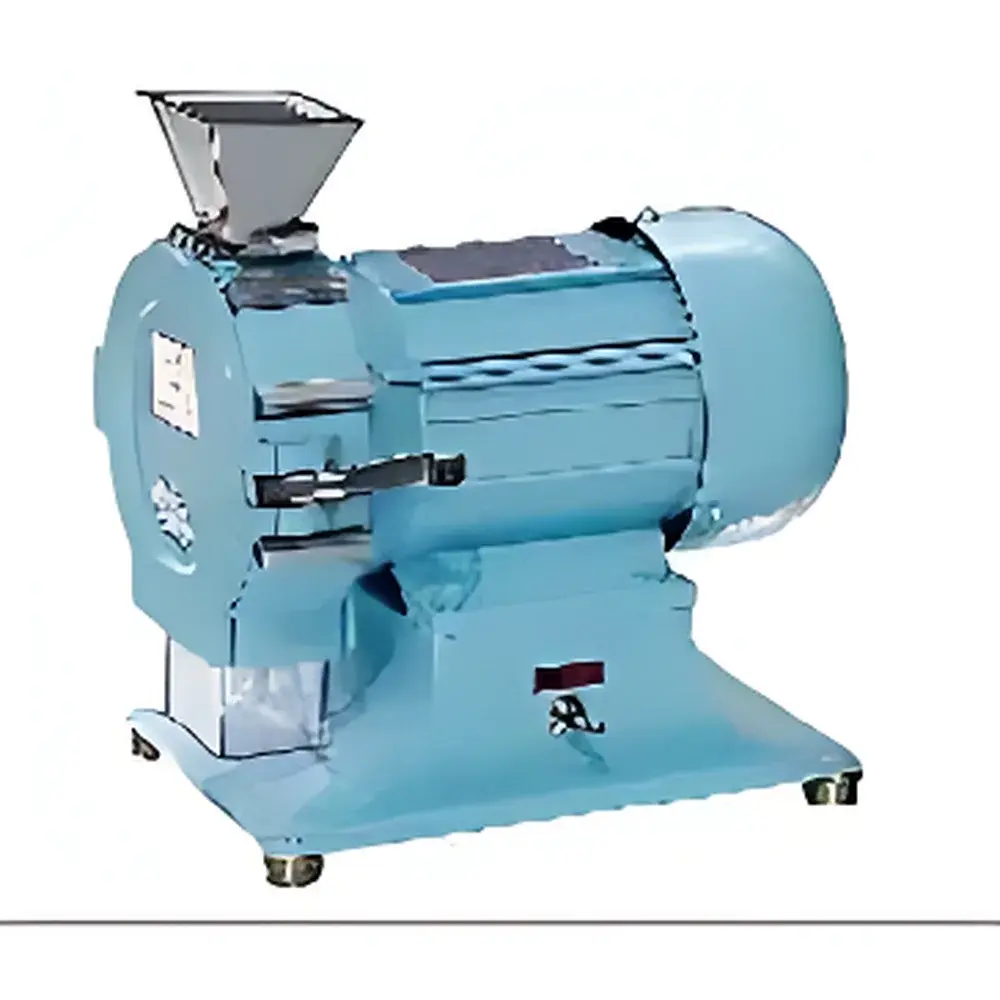
F120 Herbal & Botanical Grinder
| Power | 180 W |
|---|---|
| Voltage | 220 V AC |
| Speed | 1400 rpm |
| Dimensions (L×W×H) | 300 × 185 × 300 mm |
| Particle Size Range | 60–200 µm |
| Construction | Stainless Steel Grinding Chamber |
| Application | Dry, brittle, fibrous, and moderately oily botanical samples |
| Compliance | Designed for laboratory-scale sample preparation per ISO 17025-aligned workflows |
Overview
The F120 Herbal & Botanical Grinder is a compact, benchtop laboratory grinder engineered for consistent, reproducible size reduction of dry plant materials—including traditional Chinese herbs, medicinal roots, leaves, seeds, bark, and agricultural grains. It operates on the principle of high-torque rotary shearing: a hardened stainless steel rotating blade engages with an adjustable stationary cutting plate to generate controlled mechanical shear forces. This configuration enables effective comminution of fibrous, tough, or mildly oily botanical matrices without thermal degradation—critical for preserving analyte integrity prior to moisture, protein, lipid, or active compound quantification (e.g., HPLC, GC-MS, Kjeldahl, Soxhlet extraction). Unlike high-speed impact mills, the F120’s moderate rotational speed (1400 rpm) minimizes heat buildup and particle agglomeration, supporting GLP-compliant sample homogenization for QC/QA laboratories in pharmaceutical, nutraceutical, food safety, and academic phytochemical research settings.
Key Features
- Stainless steel grinding chamber and cutting components—corrosion-resistant and compliant with USP General Chapter <1058> requirements for material compatibility in analytical sample prep.
- Adjustable gap between rotating and stationary blades—enables fine-tuning of particle size distribution across the 60–200 µm range to match downstream analytical method specifications (e.g., ASTM D7429 for botanical particle sizing).
- Compact footprint (300 × 185 × 300 mm) and low power draw (180 W @ 220 V)—optimized for shared lab environments with limited bench space and stable electrical infrastructure.
- Sealed grinding chamber design—prevents cross-contamination between batches and facilitates rapid cleaning per laboratory SOPs; no lubricants contact sample path.
- Thermally stable motor housing—maintains consistent torque output during extended operation (up to 5 min continuous duty cycle), ensuring repeatability across replicate preparations.
Sample Compatibility & Compliance
The F120 is validated for dry, non-sticky, low-moisture (<12% w/w) botanicals including dried rhizomes (e.g., *Polygonum cuspidatum*, *Curcuma longa*), leaf powders (*Ginkgo biloba*, *Camellia sinensis*), cereal grains (wheat, rice, soybean), and coarse herbal granules. It is not suitable for wet, viscous, or highly resinous materials (e.g., fresh ginger paste, propolis, or essential oil–rich tissues). All structural materials meet EU Directive 2002/72/EC for food-contact compliance where applicable. The unit supports traceability in regulated environments: batch records may include grinder ID, operator, date/time, sample ID, and post-grind sieve analysis data—aligning with FDA 21 CFR Part 11 expectations when integrated into validated LIMS workflows.
Software & Data Management
The F120 is a standalone electromechanical instrument with no embedded firmware or digital interface. However, its operational parameters are fully documentable within electronic lab notebooks (ELNs) and quality management systems (QMS). Recommended practice includes logging: grinding duration, blade gap setting (mm), pre- and post-sieve mass distribution (via standard ASTM E11 test sieves), and environmental conditions (temperature, humidity). For labs implementing ISO/IEC 17025:2017, calibration of the motor speed (±10 rpm tolerance) and dimensional verification of blade clearance (using calibrated feeler gauges) should be performed annually or after maintenance.
Applications
- Preparation of homogeneous subsamples for moisture content determination (AOAC 950.46, ISO 6540).
- Particle size standardization prior to near-infrared (NIR) spectral calibration for active ingredient prediction.
- Routine grinding of reference herbal materials used in pharmacopoeial monographs (ChP, EP, USP).
- QC sample prep for pesticide residue analysis (QuEChERS workflow) requiring ≤200 µm particle size to ensure extraction efficiency.
- Grinding of feedstock for enzymatic hydrolysis studies in biofuel or biopolymer research.
FAQ
What types of samples are incompatible with the F120 grinder?
Samples with moisture content >12%, high oil/resin content (e.g., clove bud, frankincense), or thermolabile compounds requiring cryogenic milling are not recommended.
Can the F120 be used for GMP-regulated production environments?
It is intended for laboratory-scale R&D and QC sample preparation—not for commercial manufacturing. Validation documentation (IQ/OQ) must be developed internally per your facility’s qualification protocol.
How often should the cutting blades be replaced?
Under typical use (≤10 samples/day), stainless steel blades retain functional geometry for ≥12 months; visual inspection for nicks or dulling is advised before each shift.
Is third-party calibration available?
Yes—certified metrology providers offer speed verification and dimensional calibration services traceable to NIST standards; certificate includes uncertainty budget.
Does the unit comply with CE or UL safety directives?
The F120 meets IEC 61000-6-3 (EMC) and IEC 61000-6-2 (immunity) requirements; CE marking is applied per manufacturer declaration of conformity (DoC) under Low Voltage Directive 2014/35/EU.



