
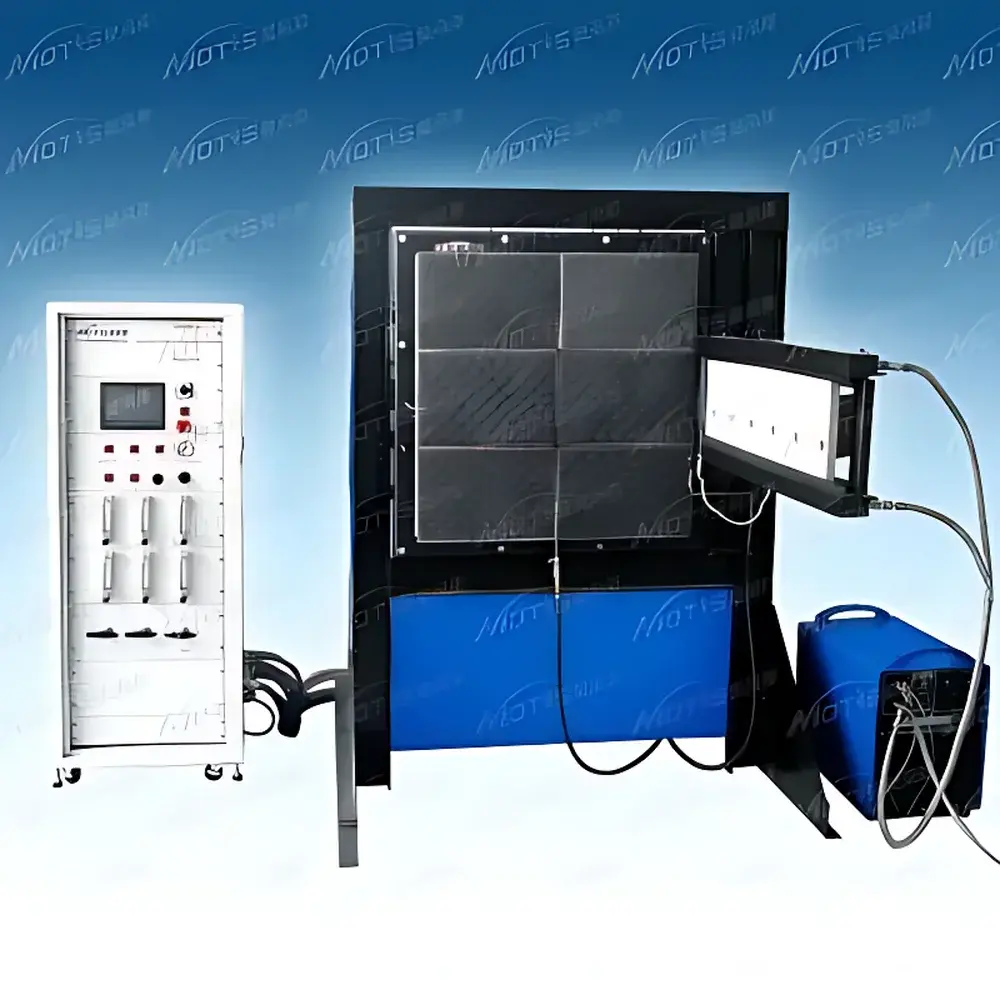
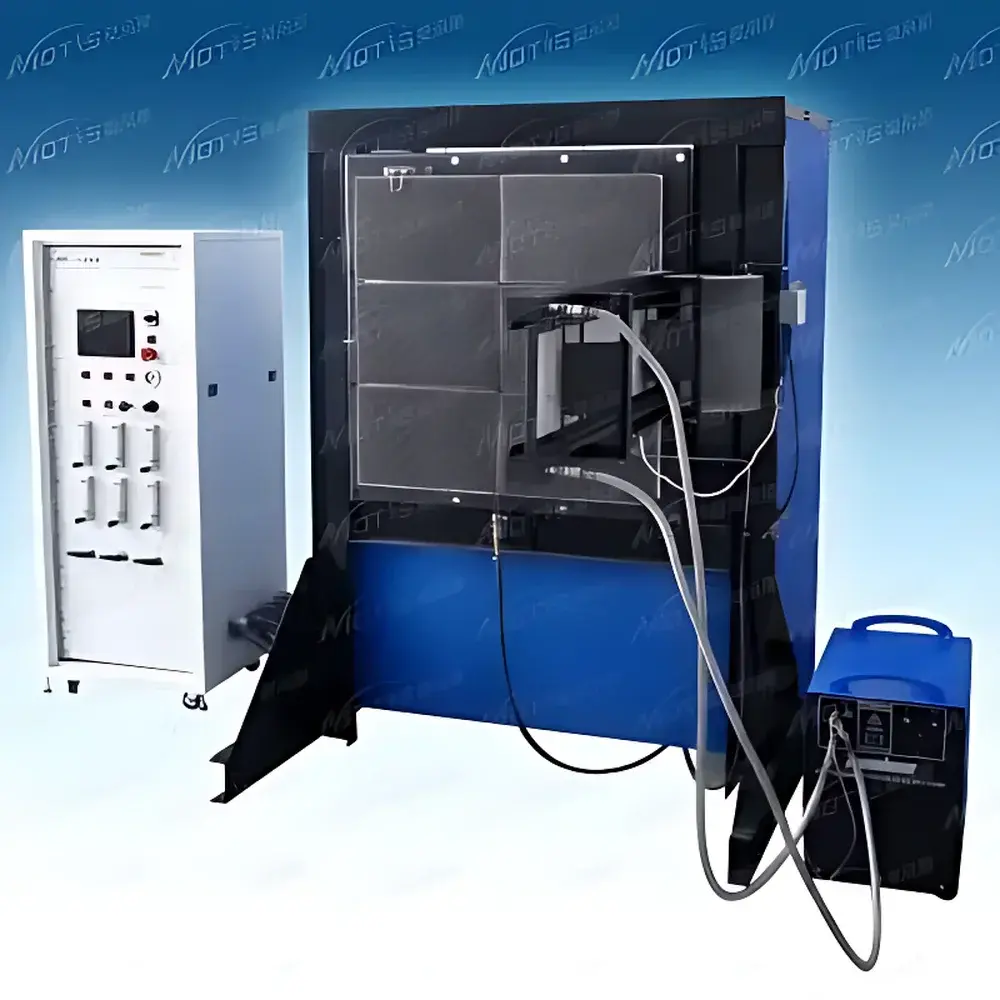
MOTIS PSS Surface Flame Spread Test Apparatus
| Brand | MOTIS |
|---|---|
| Model | PSS |
| Origin | Shanghai, China |
| Compliance | BS 476-7, BS 6853 |
| Radiant Panel Size | 850 mm × 850 mm |
| Ignition Source | Electric spark igniter |
| Specimen Holder | Water-cooled vertical mount with calibrated scale |
| Heat Flux Sensor | NIST-traceable water-cooled calorimeter |
| Control System | PLC-based HMI with digital heat flux display |
| Safety Interlock | Automatic gas shutoff upon radiant panel flameout |
Overview
The MOTIS PSS Surface Flame Spread Test Apparatus is a precision-engineered combustion test system designed to evaluate the lateral flame propagation behavior of building and transportation interior materials under controlled radiant heating conditions. It operates in strict accordance with BS 476-7:1997 “Fire tests on building materials and structures — Method of test to determine the classification of the surface spread of flame of products” and supports compliance verification for BS 6853:1999 “Fire behaviour requirements for materials used in railway vehicles”. The apparatus employs a large-area ceramic radiant panel to impose a defined, spatially uniform thermal flux gradient across the vertically mounted specimen surface. A standardized pilot flame initiates combustion at the bottom edge, and the resulting flame front progression is optically monitored and quantified against calibrated distance markers. Critical output parameters include the Critical Radiant Flux (CRF) — the minimum incident heat flux (kW/m²) at which flame spread ceases — and the maximum lateral flame extension length, both essential for assigning BS 476-7 Class 1 through Class 4 ratings. This method is widely accepted for assessing wall linings, ceiling finishes, floor coverings, and interior trim materials used in rail, marine, and architectural applications where regulatory fire performance thresholds are strictly enforced.
Key Features
- 850 mm × 850 mm high-emissivity ceramic radiant panel with reinforced structural support frame, ensuring thermal stability and uniform flux distribution across the full test area
- Vertically oriented, water-cooled specimen holder with engraved metric scale for direct visual measurement of flame front travel distance up to 1.5 m
- Integrated water-cooling circuit for continuous thermal management of the specimen support structure, preventing deformation or thermal degradation during prolonged exposure
- Electric spark ignition system meeting BS 476-7 timing and positioning specifications; eliminates manual flame application variability
- Redundant safety architecture including automatic gas cutoff upon radiant panel flameout detection via integrated high-temperature sensors
- NIST-traceable, water-cooled heat flux sensor mounted at specimen plane level, enabling real-time digital readout and calibration traceability per ISO/IEC 17025 requirements
- PLC-controlled pneumatic manifold with independent digital mass flow meters for precise stoichiometric regulation of propane/air mixture to the radiant panel burner
- Industrial-grade HMI interface displaying live heat flux values, elapsed time, gas pressure, coolant temperature, and system status flags
Sample Compatibility & Compliance
The PSS accommodates rigid and semi-rigid flat specimens measuring 450 mm (H) × 225 mm (W) × up to 50 mm (D), per BS 476-7 dimensional tolerances. Compatible substrates include polymers, composites, laminates, coated metals, mineral wool boards, and textile-reinforced panels. All test procedures adhere to the procedural rigor defined in BS 476-7 Annex A, including pre-conditioning at 23 °C ± 2 °C and 50 % ± 5 % RH for ≥48 h, mounting orientation verification, and ambient draft control (<0.2 m/s). The system meets the physical and metrological requirements for GLP-compliant testing laboratories and supports audit readiness for UKAS-accredited fire testing facilities. Data outputs satisfy reporting requirements for CE marking under EU Construction Products Regulation (CPR) and UKCA marking for domestic rail procurement under RSSB standards.
Software & Data Management
While the PSS operates via deterministic PLC logic without proprietary software dependency, its HMI logs timestamped heat flux readings, ignition event markers, and system alarms to internal non-volatile memory. Exportable CSV files (via USB port) contain raw sensor data synchronized to second-level resolution, enabling post-test CRF interpolation using BS 476-7 Annex B methodology. Audit trails comply with ALCOA+ principles: attributable, legible, contemporaneous, original, accurate, complete, consistent, enduring, and available. Optional integration with LIMS platforms is supported via Modbus TCP protocol for automated result ingestion into enterprise quality databases. All calibration records — including NIST certificate numbers for the heat flux sensor and annual radiant panel emissivity verification — are retained in the instrument’s electronic logbook.
Applications
This apparatus serves as a primary evaluation tool for manufacturers and third-party testing labs validating fire performance claims for interior materials in regulated transport sectors. Key use cases include qualification testing of seat upholstery fabrics per EN 45545-2, assessment of ceiling panel assemblies for high-speed train refurbishment programs, verification of acoustic insulation claddings against UK Rail Group Standard RIS-2510-RST, and pre-certification screening of façade substructure components under BS 8414-1. Its reproducible radiant heating profile also supports comparative research on intumescent coating efficacy, flame-retardant additive optimization, and aging effects on polymer char formation kinetics.
FAQ
What standards does the PSS apparatus directly support?
BS 476-7:1997 and BS 6853:1999 are fully implemented; supplementary alignment with ASTM E1321 (Lateral Ignition and Flame Spread Test) and ISO 5657 is achievable via procedural adaptation.
Is operator training required prior to commissioning?
Yes — MOTIS provides certified on-site installation verification and a two-day technical workshop covering hazard analysis, calibration protocol execution, emergency shutdown drills, and interpretation of CRF calculation per BS 476-7 Clause 9.
Does the system require dedicated exhaust ducting?
Absolutely — a minimum 1.2 m³/s fume extraction system with acid-resistant lining and spark arrestor is mandatory to handle combustion byproducts and maintain chamber negative pressure per BS 476-7 Section 6.2.
Can test data be exported for regulatory submission?
Yes — all raw heat flux traces, annotated ignition timestamps, and final CRF determinations export as CSV with embedded metadata compliant with UKAS ILAC-P14 documentation requirements.
What maintenance intervals are recommended?
Radiant panel emissivity verification every 12 months; heat flux sensor recalibration annually or after 200 test cycles; water-cooling loop antifreeze replacement biannually; full safety interlock functional check before each test series.



