
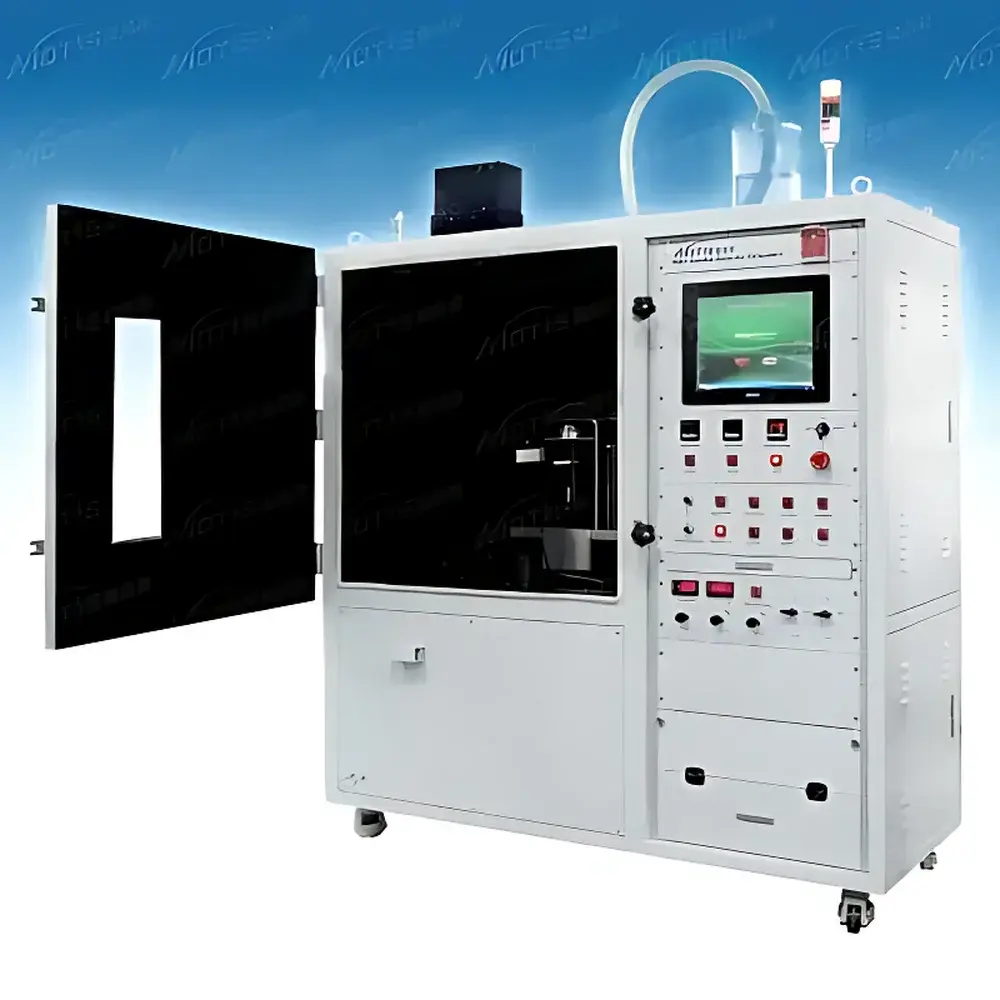
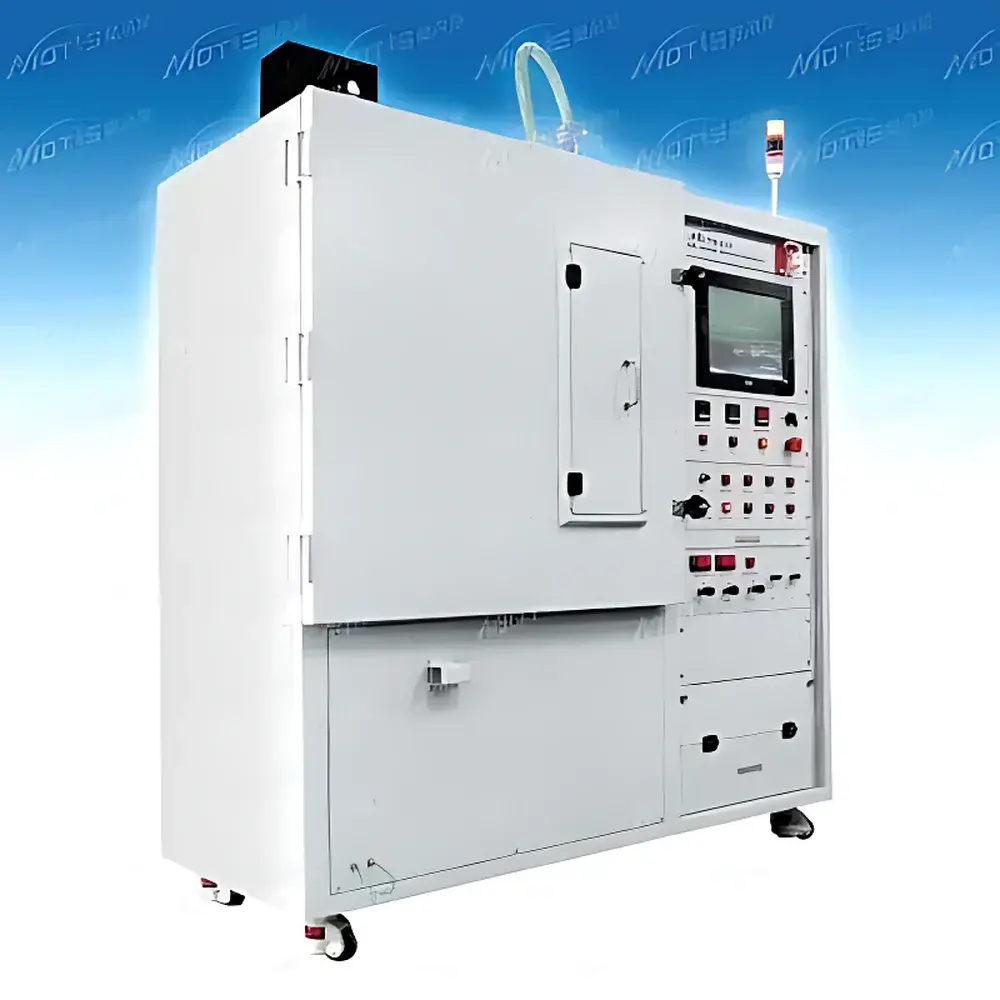
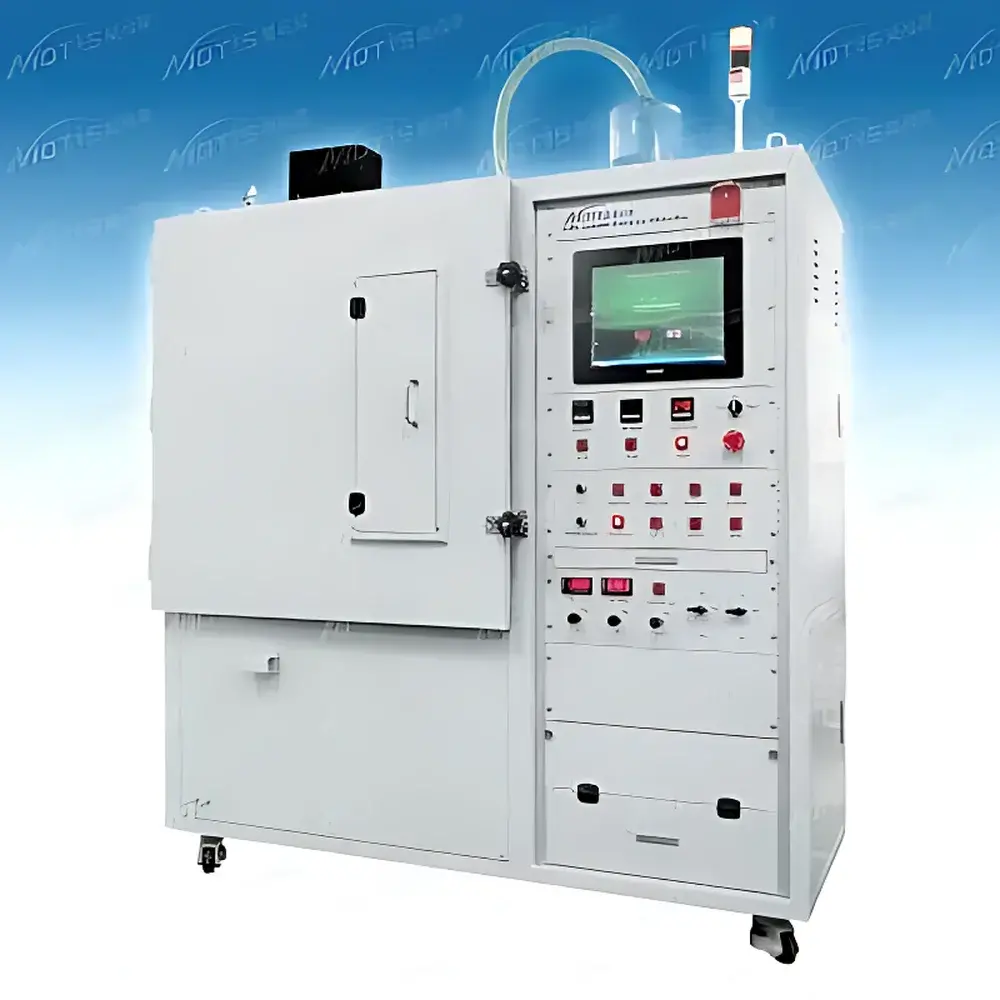
MOTIS SDB Smoke Density Chamber
| Brand | MOTIS |
|---|---|
| Origin | Shanghai, China |
| Model | SDB |
| Compliance Standards | ASTM E662, ISO 5659-2, NES 711 |
| Chamber Internal Dimensions | 914 × 914 × 610 mm |
| Optical System | Side-window photomultiplier tube (PMT), S-4 spectral response, transmittance resolution ≤ 0.0001% |
| Radiation Sources | ASTM E662 radiant heater (25 kW/m²), ISO 5659-2 conical heater (50 kW/m²) |
| Combustion Options | ASTM E662 flame burner, ISO 5659-2 flame burner, NES 711 flame burner + mixing fan |
| Temperature Control | External auxiliary heating jacket for chamber thermal stabilization |
| Safety Features | Explosion-resistant aluminum foil lining, pressure-relief port with calibrated volume bottle, dual pneumatic actuators (top/bottom), Teflon-coated interior walls |
| Data Acquisition | Integrated touchscreen PC with dedicated software, GLP-compliant audit trail, built-in thermal printer |
| Optional Modules | Dräger gas detection tubes (toxicity screening), FTIR coupling interface (smoke gas speciation), water-cooled Medtherm heat flux meter (NIST-traceable), wind-cooled copper calorimeter, integrated balance (0–5000 g, ±0.01 g) |
Overview
The MOTIS SDB Smoke Density Chamber is a fully integrated, standards-compliant optical smoke measurement system engineered for precise quantification of specific optical density (Ds) during material combustion under controlled thermal exposure. It operates on the fundamental principle of the Beer–Lambert Law, measuring real-time attenuation of collimated visible light (via a calibrated tungsten-halogen source and side-window photomultiplier tube) as smoke particles accumulate within a defined test volume. This physical basis enables traceable, repeatable determination of smoke obscuration—critical for fire safety assessment of polymeric composites, rail vehicle interior materials, marine non-metallic components, aerospace wiring insulation, and cable jacketing. The chamber meets the stringent geometric, radiometric, and procedural requirements of ASTM E662 (Standard Test Method for Specific Optical Density of Smoke Generated by Solid Materials), ISO 5659-2 (Plastics — Smoke Generation — Part 2: Determination of Optical Density by a Single-Chamber Test), and NES 711 (Naval Engineering Standard for Smoke Density Testing). Its design prioritizes metrological integrity, operational safety, and cross-standard interoperability—making it suitable for accredited laboratories conducting third-party certification, R&D validation, or regulatory compliance testing.
Key Features
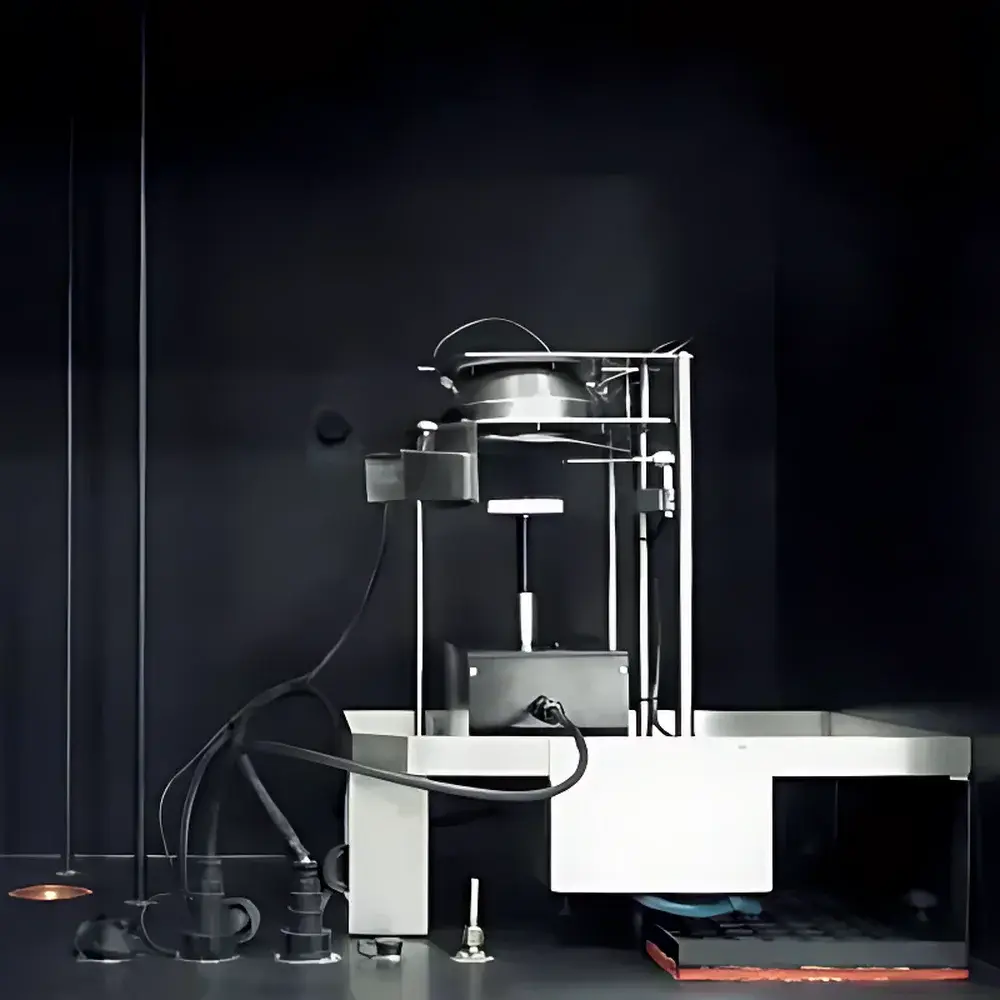
- Optically optimized 914 × 914 × 610 mm test chamber with Teflon-coated interior surfaces to resist acidic and corrosive combustion byproducts, ensuring long-term dimensional stability and optical clarity.
- Dual-mode radiant exposure capability: switchable ASTM E662 radiant panel (25 kW/m²) and ISO 5659-2 conical heater (50 kW/m²), both connected via aviation-grade quick-disconnect interfaces for rapid reconfiguration between test protocols.
- Multi-source ignition support: independently configurable ASTM E662 flame burner, ISO 5659-2 flame burner, and NES 711 flame burner with integrated mixing fan for uniform smoke dispersion.
- High-fidelity optical train: collimated 2856 K tungsten-halogen light source; side-window S-4 spectral response photomultiplier tube with dynamic range spanning 0.0001% to 100% transmittance; motorized neutral density filter wheel (Clear/Filter/Dark) enabling automatic gain adjustment across smoke density gradients.
- Integrated thermal management: external auxiliary heating jacket for accelerated chamber temperature equilibration; optional water-cooled Medtherm heat flux meter (NIST-traceable calibration certificate included); wind-cooled copper calorimeter with rear-surface temperature regulation.
- Enhanced safety architecture: explosion-resistant aluminum foil lining; top-mounted pressure-relief port linked to a calibrated volume bottle for passive overpressure mitigation; dual-position pneumatic actuators for automated optical window access and sample handling.
Sample Compatibility & Compliance
The SDB chamber accommodates flat, rigid, or semi-rigid specimens up to 100 mm × 100 mm × 50 mm in dimension, conforming to specimen geometry specifications in ASTM E662, ISO 5659-2, and NES 711. It supports both radiant-only and combined radiant/flame exposure modes, permitting evaluation of materials under flaming and non-flaming combustion conditions. All hardware configurations—including radiation sources, burners, and optical components—are validated against the dimensional tolerances, alignment criteria, and calibration procedures mandated by each referenced standard. The system is designed for use in laboratories operating under ISO/IEC 17025 accreditation frameworks and supports full traceability through NIST-certified heat flux meters, factory-calibrated PMT response curves, and documented uncertainty budgets per component. Optional Dräger gas detection tube integration enables preliminary toxic gas screening aligned with FAA AC 20-135 and EASA AMC 20-21 guidance; FTIR coupling provides pathway for quantitative analysis of CO, CO₂, HCN, HCl, and other pyrolysis gases per ISO 19702.
Software & Data Management
The SDB is controlled via an embedded industrial touchscreen PC running proprietary Windows-based test software compliant with 21 CFR Part 11 requirements for electronic records and signatures. Software modules include real-time optical density (Ds) calculation per ASTM E662 Annex A1, time-resolved smoke development curves (Ds vs. time), peak Ds reporting, and integrated MOD (Modified Optical Density) computation for weight-loss-corrected smoke yield. All raw sensor data—including PMT voltage, thermocouple readings, mass loss (via integrated 0.01 g precision balance), and heat flux—are timestamped and stored in encrypted binary format with SHA-256 hash verification. Audit trails record operator logins, parameter changes, calibration events, and report generation. Export options include CSV, PDF, and XML formats compatible with LIMS integration. Built-in thermal printer produces tamper-evident reports containing test ID, standard reference, operator signature, instrument serial number, and calibration validity dates.
Applications
- Fire safety qualification of interior materials for rolling stock (EN 45545-2, BS 6853), ships (IMO FTP Code), and aircraft (SAE AS4683, FAR 25.853).
- Regulatory submission testing for UL 94 V-0/V-1/V-2, IEC 60695-2-40, and GB/T 8323 series standards.
- R&D of low-smoke halogen-free flame-retardant polymers, intumescent coatings, and nanocomposite additives.
- Comparative smoke toxicity screening using Dräger tubes (e.g., CO, HCN, HCl) prior to full-scale FTIR or GC-MS analysis.
- Thermal degradation kinetics studies via synchronized mass loss (TGA mode) and smoke evolution profiling.
FAQ
What standards does the SDB chamber officially support?
ASTM E662, ISO 5659-2, and NES 711 are fully implemented with hardware and software validation. Additional configurations may support GB/T 8323, EN 50399, and DIN 53436 upon request.
Is the optical system calibrated traceable to NIST?
Yes—the photomultiplier tube’s spectral responsivity and linearity are factory-characterized; the optional Medtherm heat flux meter includes a NIST-traceable calibration certificate.
Can the chamber be upgraded for FTIR coupling?
Yes—standard FTIR interface ports (vacuum-tight optical feedthroughs and purge gas connections) are pre-installed for seamless integration with commercial FTIR spectrometers.
Does the system meet GLP/GMP data integrity requirements?
Yes—software enforces role-based access control, electronic signatures, full audit trail logging, and immutable data archiving compliant with FDA 21 CFR Part 11 and EU Annex 11.
What maintenance is required for long-term optical accuracy?
Biannual verification of PMT dark current, lamp intensity drift, and window transmittance using supplied ND2 filter and reference standards is recommended; Teflon coating inspection should occur after every 50 test cycles.



