
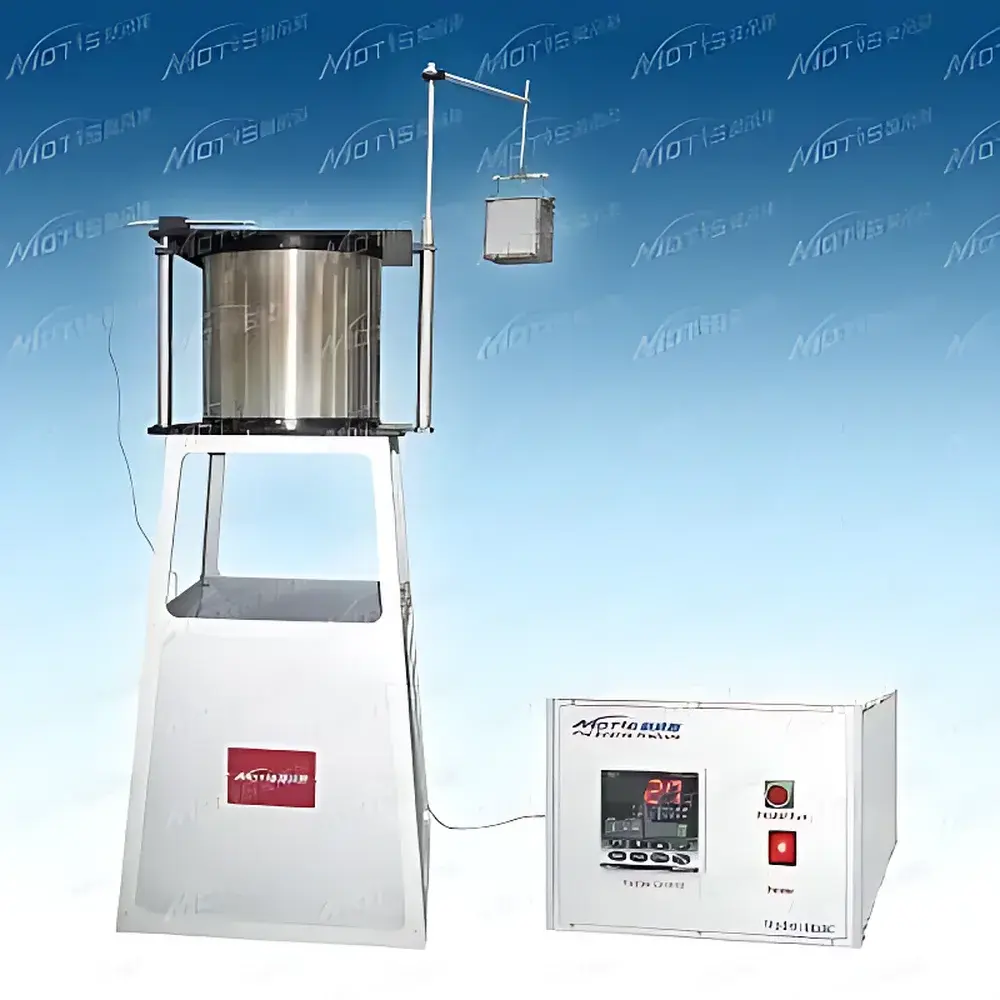
MOTIS GCF Hot Surface Ignition Test Furnace
| Brand | MOTIS |
|---|---|
| Origin | Shanghai, China |
| Manufacturer Type | Authorized Distributor |
| Country of Origin | China |
| Model | GCF |
| Pricing | Available Upon Request |
| Temperature Control | Programmable controller with standard temperature ramp profile (e.g., BS 8414 Annex A) |
| Test Duration | Up to 24 h continuous monitoring and control |
| Compliance | BS 8414-1:2015, BS 8414-2:2015 (aligned with draft GB/T 39173 under development) |
| Data Acquisition | Real-time display of furnace interior and specimen surface temperatures |
| Thermocouple Configuration | Integrated internal furnace thermocouples + dedicated specimen surface thermocouples |
| Specimen Handling | Freely accessible test chamber with standardized mounting interface for façade system assemblies |
Overview
The MOTIS GCF Hot Surface Ignition Test Furnace is a purpose-built, full-scale fire testing apparatus engineered to evaluate the flame spread resistance and thermal integrity of external thermal insulation composite systems (ETICS) under controlled window ignition conditions. It operates on the principle of radiant and convective heat exposure, replicating the thermal flux profile generated by a compartment fire venting through an opening—specifically simulating the “window corner fire” scenario defined in BS 8414. The furnace delivers a time-dependent temperature rise within its insulated combustion chamber, following the standardized heating curve specified in BS 8414 Annex A (0–30 min: 20°C to 600°C; 30–60 min: linear increase to 900°C; 60–120 min: plateau at 900°C), enabling reproducible assessment of system-level fire performance. Unlike small-scale bench tests, the GCF furnace accommodates full-height façade mock-ups (typically 2.4 m × 2.0 m or larger), allowing evaluation of real-world construction interfaces, fixings, cavity barriers, and material interactions during sustained thermal exposure.
Key Features
- Programmable digital temperature controller with pre-loaded BS 8414-compliant heating profiles and user-defined ramp/soak sequences
- Robust refractory-lined combustion chamber rated for continuous operation up to 1000°C, with optimized gas burner configuration for uniform thermal distribution
- Integrated dual thermocouple array: six Class 1 mineral-insulated (MI) thermocouples positioned per BS 8414-1:2015 Clause 7.3.2 for furnace gas temperature monitoring, plus two additional surface-mounted thermocouples for direct measurement of specimen substrate and insulation layer temperatures
- Real-time data acquisition system logging temperature values at 1-second intervals, synchronized with timestamped video recording capability (optional)
- Front-access hinged door with ceramic fiber gasket seal and mechanical interlock for safe specimen loading/unloading under ambient conditions
- Compliance-ready architecture supporting audit trails, calibration logs, and operator authentication—designed to align with GLP and ISO/IEC 17025 documentation requirements
Sample Compatibility & Compliance
The GCF furnace accepts full-scale ETICS assemblies—including render-coated expanded polystyrene (EPS), mineral wool, polyisocyanurate (PIR), and phenolic foam systems—mounted on representative structural substrates (e.g., concrete, aerated autoclaved concrete, or steel framing). Specimens are installed in accordance with BS 8414 test configuration requirements, including standardized cavity depth, fixing pattern, and perimeter detailing. The system meets the physical and operational specifications outlined in BS 8414-1:2015 (for non-loadbearing external cladding systems) and BS 8414-2:2015 (for loadbearing systems), and is aligned with the technical framework of the draft Chinese national standard GB/T 39173–2020 “Test method for fire performance of external thermal insulation systems using hot surface ignition.” All thermocouples comply with IEC 60584-2 tolerance class 1, and temperature control accuracy is maintained within ±5°C across the operational range.
Software & Data Management
The embedded control software provides intuitive graphical interface for test setup, real-time curve visualization, and post-test analysis. It records all thermocouple channels simultaneously, exports data in CSV format compatible with Excel and MATLAB, and supports automatic generation of test reports compliant with BS 8414 reporting clauses (e.g., temperature deviation tables, flame spread height measurements, and insulation damage classification per BR 135 criteria). Audit trail functionality logs user actions, parameter changes, and calibration events—meeting traceability requirements under ISO/IEC 17025:2017 Clause 7.7 and supporting FDA 21 CFR Part 11 readiness when deployed in regulated R&D environments.
Applications
- Fire safety certification of ETICS for building code compliance (e.g., UK Building Regulations Approved Document B, EN 15804 EPD verification)
- Comparative evaluation of insulation material behavior under realistic fire exposure—assessing charring depth, delamination onset, and melt drip characteristics
- Validation of fire barrier effectiveness at floor slabs, window reveals, and vertical joints
- Supporting BRE Global’s BR 135 Appendix D assessments and European Technical Assessment (ETA) submissions
- Research into fire dynamics of novel bio-based or low-smoke insulation composites
FAQ
What standards does the GCF furnace specifically support?
BS 8414-1:2015 and BS 8414-2:2015 are fully implemented; alignment with draft GB/T 39173–2020 is verified via thermal profile fidelity and instrumentation layout.
Can the furnace be used for non-ETICS applications, such as curtain wall or rainscreen testing?
Yes—provided specimen geometry and mounting meet BS 8414 dimensional constraints and thermal exposure protocols; custom test protocols may require validation per ISO/IEC 17025.
Is third-party calibration documentation included with delivery?
Each unit ships with a factory calibration certificate for all thermocouples and controller sensors, traceable to NIM (China National Institute of Metrology) standards.
What electrical and gas utility requirements apply?
Standard configuration requires 380 VAC ±10%, 3-phase, 50 Hz power supply and natural gas (or LPG) feed with pressure regulation to 25–35 mbar; detailed utility specs provided in installation manual.
How is data integrity ensured during extended 24-hour tests?
Redundant SD card logging + optional network backup ensures uninterrupted acquisition; power-fail recovery resumes logging from last known state without data gap.
Related Products



