
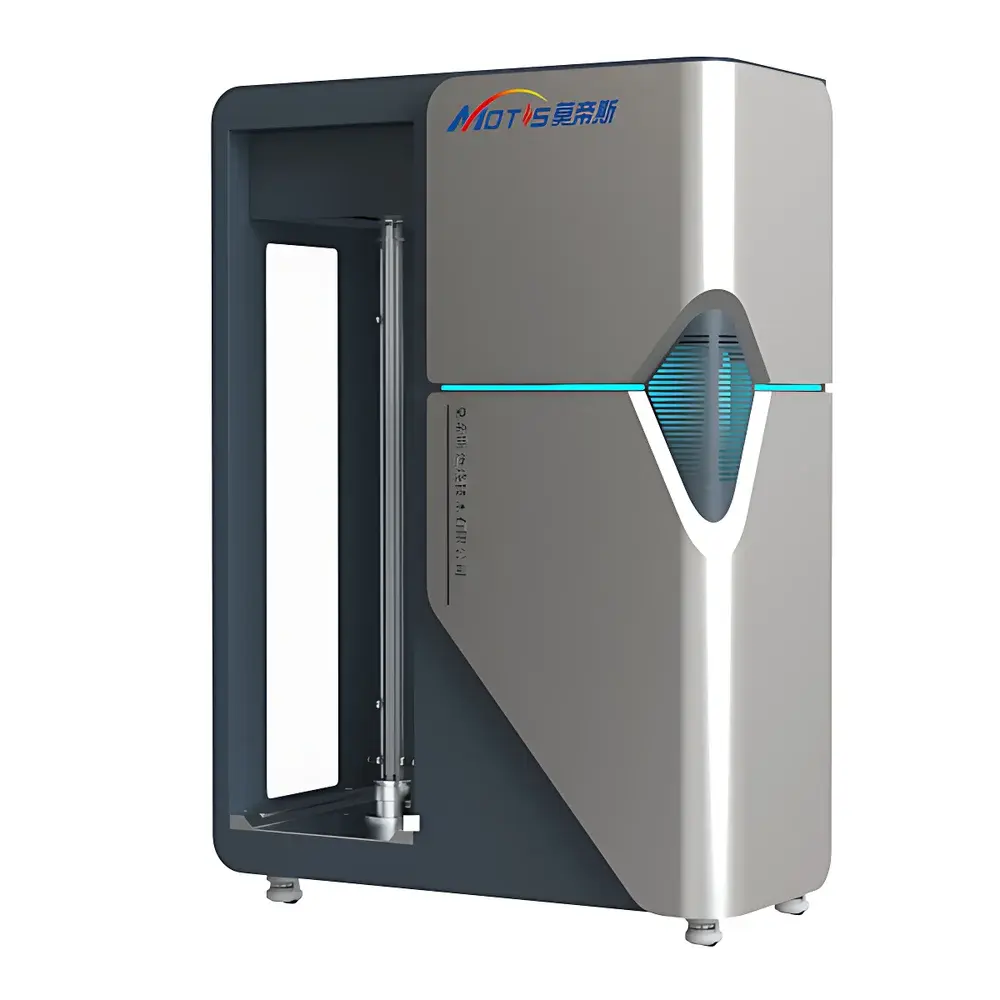
MOTIS EFS-20 Flame Propagation Velocity Test System for Battery Thermal Runaway Analysis
| Brand | MOTIS |
|---|---|
| Origin | Jiangsu, China |
| Manufacturer Type | Authorized Distributor |
| Country of Origin | China |
| Model | EFS-20 |
| Pricing | Available Upon Request |
| Pressure Sensor Range | −0.1–1 MPa, Accuracy ≥ 0.05% FS |
| Safety Relief Valve Set Point | 0.5 MPa |
| Solenoid Valve Rating | ≥ 3 MPa, Response Time ≤ 10 ms |
| Vacuum Pump | Pumping Speed ≥ 2 L/s, Ultimate Vacuum ≤ 1.0 kPa, Inlet OD: 10 mm |
| Ignition System | Dual Electrodes, Transformer Output 13–15 kV |
| Exhaust Scrubbing Unit | Acid Gas Neutralization & Particulate Adsorption |
| Observation Module | Angled Optical Port with Adjustable LED Illumination |
| Control Hardware | Advantech Industrial PC |
| Software | Dedicated Flame Kinematics Acquisition & Post-Processing Suite |
Overview
The MOTIS EFS-20 Flame Propagation Velocity Test System is an engineered platform designed to quantify flame front dynamics during controlled combustion events—specifically targeting thermal runaway propagation in lithium-ion battery cells and modules. It operates on the principle of laminar or quasi-laminar premixed flame propagation within a standardized vertical quartz tube under precisely regulated gas composition, pressure, and ignition conditions. The system enables high-fidelity temporal and spatial resolution of flame geometry evolution—including flame front area, base cross-sectional area, and axial propagation velocity—as critical inputs for fire modeling, hazard classification (e.g., UN GHS Category 1–4), and safety protocol development per IEC 62619, UL 1642, and GB/T 36276. Unlike generic combustibility testers, the EFS-20 integrates synchronized high-speed imaging (≥10,000 fps recommended), real-time pressure monitoring, and traceable gas mixing to support reproducible, ISO/IEC 17025-aligned test execution in R&D laboratories and third-party certification facilities.
Key Features
- Optically transparent 1200 mm quartz combustion tube (ID ≤ 40 mm, pressure-rated ≥ 0.1 MPa) enabling unobstructed side-view imaging and minimizing wall quenching effects
- Calibrated 10 L gas mixing vessel with dual-stage pressure regulation, integrated ±5% volumetric accuracy verification, and redundant safety architecture including 0.5 MPa relief valve and 3 MPa-rated fast-response solenoid valves (≤10 ms actuation)
- High-stability vacuum subsystem (≥2 L/s pumping speed, ≤1.0 kPa ultimate vacuum) ensuring consistent initial atmosphere evacuation prior to gas filling
- Dual-electrode ignition system powered by 13–15 kV transformer, delivering reliable spark initiation at defined axial positions within the tube
- Integrated exhaust treatment module featuring sequential acid gas scrubbing (NaOH solution) and activated carbon adsorption to comply with local VOC and HCl emission limits
- Angled optical port with collimated LED illumination and anti-reflection coating minimizes glare and supports repeatable high-speed video acquisition under variable ambient lighting
- Advantech industrial-grade control PC preloaded with proprietary software for automated sequence control, sensor synchronization, and flame boundary detection via edge-enhanced thresholding algorithms
Sample Compatibility & Compliance
The EFS-20 accommodates gaseous mixtures representative of off-gas profiles from thermally stressed Li-ion batteries—including H₂, CO, CH₄, C₂H₄, HF, and electrolyte vapor surrogates—delivered at stoichiometric or fuel-rich ratios. It supports testing per ASTM E2079 (Standard Test Method for Determining the Burning Rate of Solid Materials Using a Vertical Tube Apparatus), modified for gaseous fuels, and aligns with functional requirements outlined in NFPA 855 (Standard for the Installation of Stationary Energy Storage Systems) Annex D. All pressure instrumentation meets EN 837-1 accuracy class requirements; gas handling components conform to ISO 15848-1 for fugitive emissions control. The system architecture supports audit-ready data logging compliant with FDA 21 CFR Part 11 when configured with electronic signatures and immutable event logs.
Software & Data Management
The embedded test software provides fully scriptable test sequences—including automated vacuum purge, gas fill, pressure stabilization, ignition trigger, and high-speed camera activation—with timestamped synchronization across all analog and digital channels (pressure, temperature, valve status, frame triggers). Raw image sequences are stored in lossless TIFF format with embedded EXIF metadata (exposure time, gain, lens focus position). Post-acquisition tools include semi-automated flame contour extraction, pixel-to-mm calibration using reference scale bars, and derivation of dL/dt (propagation velocity), Afront(t), and Abase(t) curves. Export formats include CSV (time-series metrics), PDF reports with annotated frames, and MATLAB-compatible .mat files for advanced statistical analysis. Audit trails record user login, parameter changes, and calibration events with tamper-evident hashing.
Applications
- Quantifying flame spread kinetics in battery vent gas compositions to inform cell-to-cell propagation models
- Evaluating flame inhibition efficacy of novel electrolyte additives or flame-retardant separators
- Generating input parameters for CFD fire simulations (e.g., FDS, ANSYS Fluent) used in ESS cabinet design
- Supporting UN Manual of Tests and Criteria, Part III, subsection 38.3.2.3 (thermal runaway propagation testing)
- Comparative assessment of gas-phase flammability between NMC, LFP, and solid-state battery chemistries
- Validation of computational chemistry predictions (e.g., laminar flame speed SL) against empirical measurements
FAQ
What gas mixtures can be tested in the EFS-20?
The system is validated for binary and ternary mixtures containing H₂, CO, CH₄, C₂H₄, and synthetic air or N₂ diluent. Custom calibration certificates are provided for each certified mixture composition.
Is the quartz tube replaceable, and what is its typical service life?
Yes—the tube is field-replaceable as a modular component. Under standard operation (≤50 tests/month, no thermal shock), expected service life exceeds 500 cycles; replacement kits include metrology-certified dimensional verification reports.
Does the software support automated pass/fail evaluation against regulatory thresholds?
Yes—users may define custom acceptance criteria (e.g., “max flame velocity ≤ 0.8 m/s at 100 kPa”) and enable auto-flagging of non-conforming runs with annotated deviation reports.
Can the system be integrated into a larger battery abuse test chamber network?
Yes—via Modbus TCP or OPC UA interfaces, enabling coordinated triggering with external calorimeters, gas analyzers (FTIR/GC-MS), or environmental chambers for multi-parameter thermal runaway studies.
What maintenance intervals are recommended for pressure sensors and vacuum pump oil?
Pressure sensors require annual recalibration traceable to NIST standards; vacuum pump oil must be replaced every 500 operating hours or biannually—whichever occurs first—using ISO VG 68 synthetic lubricant.




