
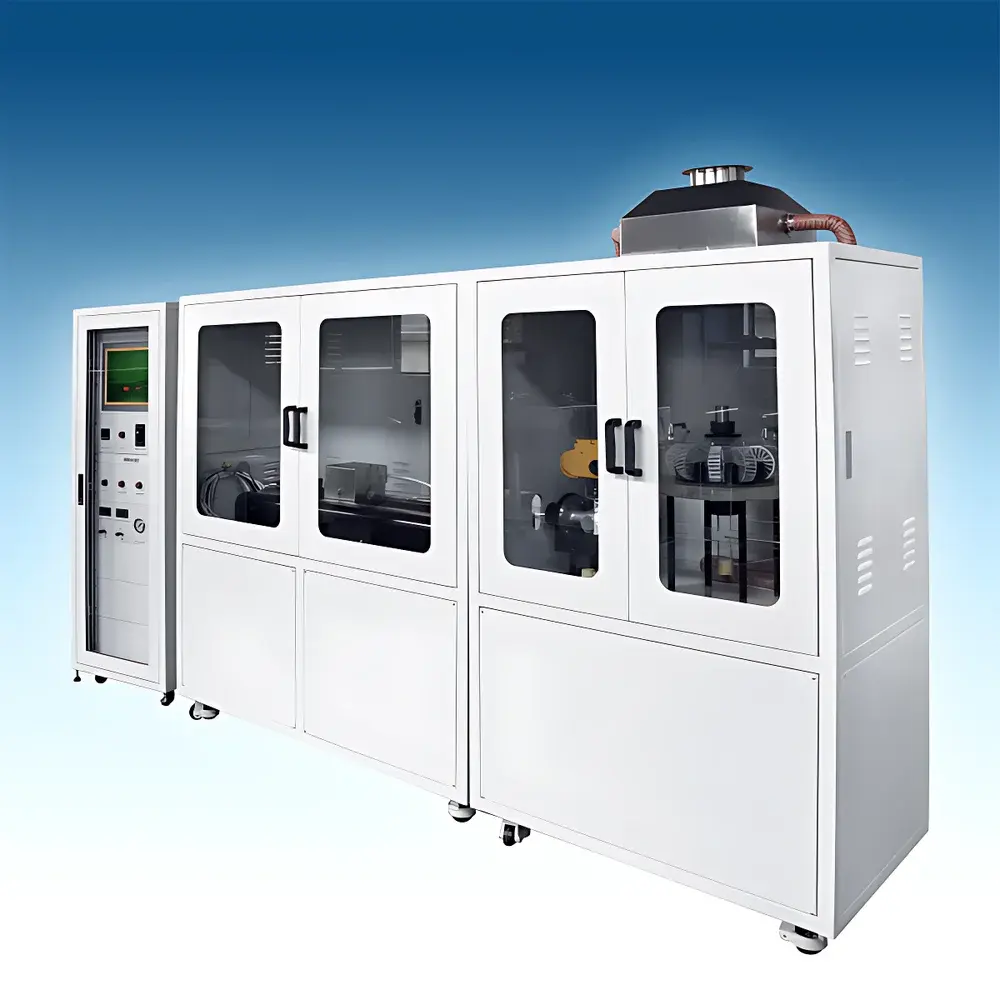
MOTIS MTT Smoke Toxicity Test Apparatus (Mouse Cage Method)
| Brand | MOTIS |
|---|---|
| Origin | Jiangsu, China |
| Manufacturer Type | Authorized Distributor |
| Regional Classification | Domestic (China) |
| Model | MTT |
| Price Range | USD 14,000 – 28,000 |
| Application Field | Construction Materials |
| Compliance Standard | GB/T 20285 “Hazard Classification of Smoke Toxicity from Materials” |
Overview
The MOTIS MTT Smoke Toxicity Test Apparatus (Mouse Cage Method) is a standardized, regulatory-grade combustion toxicology testing system engineered for quantitative assessment of acute inhalation toxicity from smoke generated during thermal decomposition of solid materials. It operates on the principle of controlled pyrolysis under defined heating kinetics—specifically, constant-velocity scanning of a rectangular specimen through a stabilized annular furnace—followed by continuous dilution and delivery of evolved smoke into an exposure chamber housing live test subjects (Mus musculus). This methodology directly implements the requirements of GB/T 20285, China’s national standard for hazard classification of smoke toxicity, which correlates observed physiological endpoints (e.g., time to onset of convulsions, respiratory arrest, or mortality) with material classification (e.g., Class A–C). The apparatus integrates precision thermal control, laminar gas dynamics, and real-time physiological monitoring infrastructure to ensure high reproducibility across inter-laboratory studies and compliance-driven certification workflows.
Key Features
- Annular furnace assembly with 47 ± 1 mm inner diameter and 100 ± 1 mm axial length, capable of stable operation from ambient to ≥1100 °C; furnace tube constructed from high-purity alumina ceramic with embedded NiCr-NiSi heating elements.
- Precision furnace translation system driven by Panasonic servo motor and PLC controller, delivering linear displacement at 10.0 ± 0.1 mm/min over ≥600 mm travel range—ensuring consistent thermal ramp rate and specimen residence time.
- Quartz reaction train comprising a 1100 ± 100 mm long, 36 ± 1 mm ID quartz tube (wall thickness 2 ± 0.5 mm) and a 400 mm × 32 ± 1 mm quartz boat—designed for inert, low-adsorption smoke transport and minimal catalytic interference.
- Dual-mass-flow control architecture: carrier gas (0–10 L/min, resolution ≤0.1 L/min) and dilution air (0–5 L/min, resolution ≤0.1 L/min), both digitally regulated via calibrated thermal mass flow meters with integrated drying and particulate filtration.
- Mouse exposure module featuring a 9.2 L transparent acrylic染毒箱 (toxicant exposure chamber) and ten independently suspended aluminum rotating cages (60 ± 10 g each), enabling unrestricted rotational motion without mechanical constraint—critical for objective behavioral endpoint detection.
- Omega K-type thermocouple (1 mm OD) with 1Cr18Ni9Ti sensing tip, factory-calibrated and software-integrated for traceable furnace temperature profiling and dynamic validation per GB/T 20285 Annex B.
- Omron PID temperature controller achieving ±1 °C setpoint accuracy in static mode and ±2.5 °C during active translation—validated against reference thermocouples at multiple axial positions.
- Industrial-grade Advantech data acquisition module (not proprietary or single-board solutions), compliant with IEC 61000-4 EMC standards and supporting 16-bit analog input resolution for synchronized logging of temperature, flow, cage rotation speed, and time-stamped event markers.
Sample Compatibility & Compliance
The MTT apparatus accepts flat, dimensionally stable specimens up to 200 mm × 20 mm × 10 mm (L × W × H), including rigid polymers, coated composites, insulation foams, and mineral-based building panels. Specimen mass is recorded pre-test to normalize smoke yield calculations. All hardware and procedural protocols align with GB/T 20285’s mandatory clauses for furnace calibration, airflow verification, animal welfare conditions (including acclimatization, post-exposure recovery protocols, and humane endpoints), and data reporting format. While GB/T 20285 remains the primary normative reference, the system’s modular architecture supports adaptation to ISO 5659-2 (cone calorimeter smoke density) correlation studies and ASTM E1678 (toxic potency evaluation) when paired with supplementary analytical instrumentation (e.g., FTIR gas analyzers). No modifications are required for GLP-compliant audit trails: all raw sensor data, operator inputs, and system events are timestamped, non-erasable, and exportable in CSV/ASCII format.
Software & Data Management
The standard MOTIS TestSuite v3.2 software provides real-time visualization of furnace temperature profiles, dual mass flow rates, and individual cage angular velocity curves (when optional photoelectric rotation monitoring is installed). Calibration routines include multi-point furnace mapping and automatic thermocouple drift compensation. All test sessions generate encrypted .mttlog files containing metadata (operator ID, sample ID, ambient RH/T, calibration certificate IDs), raw time-series data (10 Hz sampling), and annotated behavioral event tags (e.g., “first tremor”, “respiratory pause >3s”). Audit logs comply with ALCOA+ principles: attributable, legible, contemporaneous, original, accurate, complete, consistent, enduring, and available. Export modules support direct integration with LIMS platforms via OPC UA or RESTful API (optional license).
Applications
This apparatus is routinely deployed in third-party fire safety laboratories, national building material inspection centers (e.g., CNAS-accredited institutions), and R&D departments of flame-retardant additive manufacturers. Primary use cases include: classification of ceiling tiles, PVC wall coverings, cable jacketing compounds, and structural sandwich panels per GB/T 20285 hazard tiers; comparative screening of halogen-free vs. brominated flame retardants; validation of smoke suppression efficacy in intumescent coatings; and generation of toxicological datasets for computational fire modeling (e.g., CFAST input parameterization). It also serves as a reference platform for method transfer studies between Chinese and international regulatory frameworks where murine bioassay endpoints remain relevant.
FAQ
Does the MTT system meet international regulatory requirements beyond GB/T 20285?
While designed primarily for GB/T 20285 compliance, its core measurement architecture—controlled pyrolysis, defined dilution ratios, and standardized exposure geometry—is technically compatible with OECD TG 403 and EPA OPPTS 870.1300 protocols. However, formal recognition under EU REACH or US CPSC mandates requires additional validation per local GLP guidelines.
Can the system accommodate alternative test species or exposure durations?
The mechanical and airflow design is optimized for Mus musculus (20–25 g, 6–8 weeks old) under the 30-minute exposure duration specified in GB/T 20285. Modification for other species or extended exposures would require revalidation of flow uniformity, CO₂ buildup, and thermal loading—and is not supported under warranty.
Is remote monitoring or automated reporting available?
Yes. With optional Ethernet-enabled Advantech DAQ and licensed TestSuite Remote Server, users can monitor live parameters and receive SMS/email alerts on thermal deviation or flow fault. Automated PDF report generation—including pass/fail determination per GB/T 20285 Table 1—is configurable per client template.
What maintenance intervals are recommended for critical subsystems?
Quartz tube inspection every 50 tests; furnace thermocouple recalibration annually or after 200 h of operation above 800 °C; mass flow meter verification quarterly using NIST-traceable dry calibrators; and full system performance qualification per GB/T 20285 Annex C every 12 months.
Are consumables such as quartz boats or thermocouples supplied by MOTIS?
Yes. MOTIS provides certified replacement quartz boats (ASTM F2691-compliant purity), Omega-certified K-type thermocouples with calibration certificates, and OEM-filter cartridges for the air purification train—all with documented lot traceability and shelf-life labeling.



