
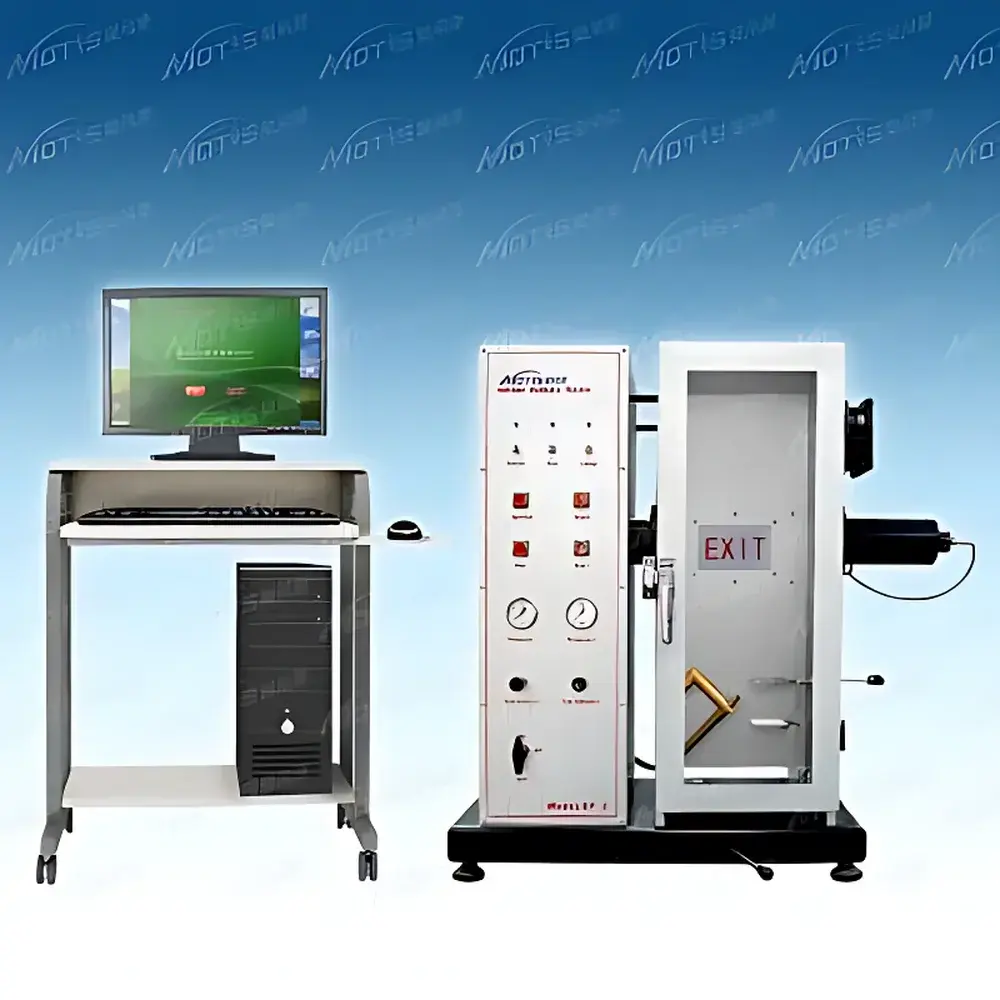
MOTIS XP-2 Smoke Density Chamber for Building Materials
| Brand | MOTIS |
|---|---|
| Origin | Shanghai, China |
| Model | XP-2 |
| Compliance | ASTM D2843 |
| Chamber Coating | PTFE (Teflon®) Interior |
| Light Source | Calibrated Incandescent Lamp |
| Detector | Cosine-Corrected Silicon Photodiode with Visible-Spectrum Filter (380–780 nm) |
| Primary Burner Pressure | 256 kPa |
| Auxiliary Burner | Integrated for Dripping Combustion Control |
| Data Acquisition | 15-s Interval Transmittance Logging |
| Output | SDR (Smoke Density Rating) Calculation & Multi-Sample Comparative Analysis |
| Software | Windows-Based, CFR Part 11 Compliant Audit Trail Optional |
| Chamber Viewing Window | Optical-Grade Quartz with EXIT Marking (White-on-Red) |
Overview
The MOTIS XP-2 Smoke Density Chamber is a precision-engineered instrument designed to quantify smoke generation from building materials under controlled flaming combustion conditions, in strict accordance with ASTM D2843 – “Standard Test Method for Smoke Density of Materials Burning Under Controlled Conditions.” The system operates on the fundamental photometric principle derived from the Beer–Lambert law: incident light attenuation through smoke-laden air is measured as optical transmittance (%T), and the resulting Smoke Density Rating (SDR) is calculated as SDR = −log10(%T/100). This dimensionless index reflects cumulative smoke obscuration over time and serves as a critical parameter in fire safety engineering, regulatory compliance assessments, and material classification per ISO 5659-2, GB/T 8627, and UL 723. Unlike legacy systems, the XP-2 integrates modern photodetection architecture—including cosine-corrected silicon photodiodes and spectrally selective filtering—ensuring high fidelity to human visual response (CIE 1931 standard observer) while eliminating ultraviolet and infrared interference.
Key Features
- PTFE-coated dual-chamber interior: Chemically inert fluoropolymer lining resists aggressive acidic condensates (e.g., HCl, HF, SOx) generated during halogenated polymer combustion, extending service life and maintaining optical calibration stability.
- Optically optimized illumination path: 2800 K incandescent source paired with CIE photopic-filtered silicon photodiode ensures metrological traceability to luminous transmittance standards (NIST-traceable calibration available).
- Dual-burner combustion system: Primary burner delivers precisely regulated 256 kPa flame impingement; auxiliary burner activates automatically upon detection of molten drip to ensure complete combustion of falling residues—critical for accurate SDR assessment of thermoplastic materials.
- Real-time transmittance logging: Acquires %T values at 15-second intervals throughout the 10-minute test duration; software computes instantaneous SDR and integrates area-under-curve for total smoke yield quantification.
- Multi-sample comparative analysis: Simultaneous import and overlay of up to three independent test runs enables statistical evaluation of batch consistency, aging effects, or formulation variants against pass/fail thresholds defined in building codes.
- Compliance-ready reporting engine: Generates audit-trail-enabled PDF reports with embedded metadata (operator ID, timestamp, environmental conditions, calibration status), supporting GLP/GMP and FDA 21 CFR Part 11 requirements when configured with electronic signature modules.
Sample Compatibility & Compliance
The XP-2 accommodates standard ASTM D2843 specimens (25.4 mm × 25.4 mm × thickness ≤ 25.4 mm), including rigid boards, foams, coated fabrics, cable jacketing, and composite panels. Specimen mounting fixtures ensure reproducible orientation and thermal exposure geometry. The chamber meets dimensional and airflow specifications outlined in ASTM D2843 Annex A1 and ISO 5659-2 Clause 6. All optical and thermal subsystems undergo quarterly verification using NIST-traceable neutral density filters and reference smoke generators. System validation documentation supports third-party accreditation (e.g., ILAC-MRA, CNAS) and regulatory submissions to authorities including NFPA, FM Global, and EU Notified Bodies under CPR (EU Regulation 305/2011).
Software & Data Management
The XP-2 Control Suite is a native Windows application developed in accordance with IEC 62304 Class B software safety standards. It features role-based access control, configurable test templates, automated SDR curve fitting (exponential decay model), and export to CSV, XML, and PDF formats. Raw transmittance data are stored with full metadata (including ambient temperature/humidity logs from integrated sensors). Optional 21 CFR Part 11 mode provides electronic signatures, audit trails with immutable timestamps, and user activity logging—fully compliant with pharmaceutical and aerospace QA environments requiring ALCOA+ data integrity principles.
Applications
- Fire performance qualification of insulation, ceiling tiles, wall coverings, and flooring per ASTM E84 / UL 723 classification.
- Development and screening of low-smoke halogen-free (LSHF) cables and wire coatings.
- Regulatory testing for CE marking under Construction Products Regulation (CPR) Annex ZA.
- Comparative analysis of flame-retardant additive efficacy in polymeric matrices.
- Quality assurance in manufacturing of railway interior materials (EN 45545-2 R22/R23 compliance).
- Research into smoke toxicity correlation studies (paired with FTIR or GC-MS gas analysis systems).
FAQ
What standards does the XP-2 fully support?
ASTM D2843, ISO 5659-2, GB/T 8627, and EN 60695-2-30 for radiant panel smoke density measurement.
Is PTFE coating mandatory for long-term accuracy?
Yes—uncoated stainless steel chambers degrade rapidly due to acidic corrosion from chlorinated/brominated smoke species; PTFE lining ensures ≥10-year optical stability under routine use.
Can the XP-2 be integrated into a LIMS environment?
Yes—via OPC UA or HL7-compliant API interface; raw data streams include transmittance arrays, SDR time-series, and diagnostic flags.
Does the system require annual recalibration by the manufacturer?
No—users may perform daily verification with supplied ND filters; full calibration is recommended every 12 months by an accredited lab (certificate provided).
How is dripping behavior managed during testing?
The auxiliary burner activates automatically upon thermal sensor detection of droplet formation, applying targeted flame to prevent incomplete combustion and underestimation of SDR.



