
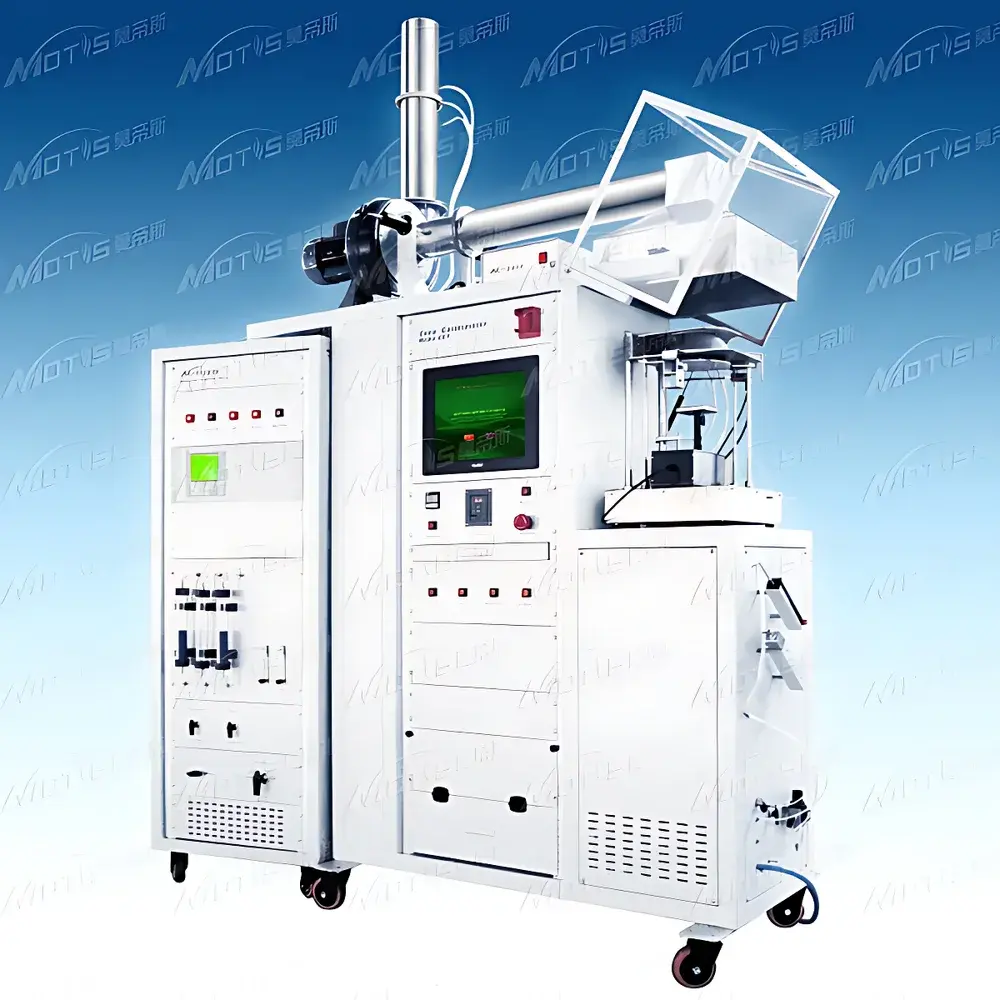
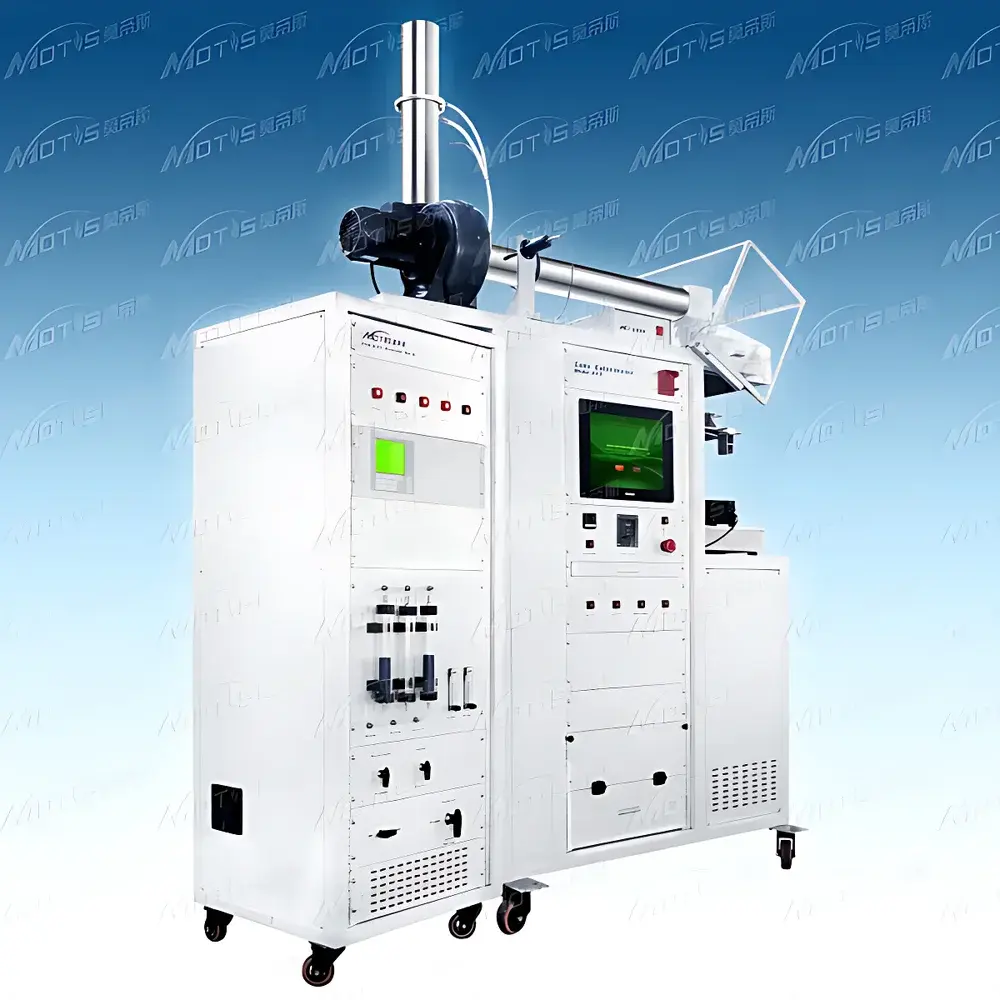
MOTIS C-CT Cone Calorimeter
| Brand | MOTIS |
|---|---|
| Origin | Jiangsu, China |
| Manufacturer Type | Authorized Distributor |
| Country of Origin | China |
| Model | C-CT |
| Price | USD 55,000 (FOB) |
| Standards Compliance | ISO 5660-1 & -2, ASTM E1354, GB/T 16172, BS 476-15 |
| Heat Flux Range | 0–100 kW/m² |
| Sample Capacity | 100 mm × 100 mm × 50 mm |
| Mass Measurement | 0–2000 g, ±0.1 g |
| Oxygen Analyzer | Paramagnetic, 0–25% O₂, T₉₀ < 1.5 s, drift < 0.5%/month |
| CO/CO₂ Analyzers | NDIR, CO: 0–1%, CO₂: 0–10% |
| Smoke Measurement | He-Ne laser (0.5 mW), dual photodiode detection |
| Exhaust Flow Control | 0–50 g/s, ±0.1 g/s |
| Cone Heater Power | 5000 W |
| Thermocouple | 1.6 mm sheathed, grounded junction, installed 100 mm above orifice plate |
| Heat Flux Sensor | Water-cooled Gardon gauge, 0–100 kW/m², ±3% accuracy, NIST-traceable calibration |
| C-factor Calibration | Brass burner with square aperture, automated C-value calculation per ISO 5660 |
| Data Acquisition | Synchronized multi-channel sampling (O₂, CO, CO₂, pressure, temperature, mass, smoke) |
| Software | Windows-based, CFR Part 11-compliant audit trail, Excel export, real-time sensor diagnostics, automatic delay compensation, C-factor logging |
Overview
The MOTIS C-CT Cone Calorimeter is a precision-engineered bench-scale fire testing instrument designed for quantitative assessment of material combustion behavior under controlled radiant heat exposure. It operates on the oxygen consumption calorimetry principle—first established by Babrauskas at NIST in 1982—which correlates the mass of oxygen consumed during combustion to the heat released, based on the empirically validated enthalpy of combustion of oxygen (13.1 MJ/kg ±5%). This thermodynamic foundation ensures high reproducibility and strong correlation with large-scale fire test data. Unlike small-flame screening methods (e.g., UL 94, LOI), the cone calorimeter delivers absolute, physics-based metrics—including heat release rate (HRR), total heat release (THR), effective heat of combustion (EHC), time to ignition (TTI), mass loss rate (MLR), and specific optical density (SOD)—under well-defined, standardized convective-radiative heating conditions. Its design conforms rigorously to ISO 5660-1 (heat release rate), ISO 5660-2 (smoke and toxicity), ASTM E1354, GB/T 16172, and BS 476-15, making it suitable for regulatory submissions, product development, and fundamental fire science research in academic, industrial, and certification laboratories.
Key Features
- Modular cabinet architecture: Separable test unit and 19-inch analysis rack enable flexible integration with larger-scale heat release rate (HRR) systems or standalone operation.
- Integrated control interface: Embedded 17-inch industrial touchscreen PC running real-time Windows OS with deterministic I/O timing for synchronized multi-sensor acquisition.
- High-stability conical heater: 5000 W rated power, PID-controlled radiant output adjustable from 0 to 100 kW/m²; cone orientation supports both horizontal and vertical sample configurations.
- Precision irradiance uniformity: ≤±2% deviation across central 50 mm × 50 mm sample area, verified via NIST-traceable Gardon heat flux sensor (0–100 kW/m², water-cooled, ±3% accuracy).
- Comprehensive gas analysis suite: Paramagnetic O₂ analyzer (0–25%, T₉₀ < 1.5 s, zero drift < 0.5%/month); dual NDIR analyzers for CO (0–1%) and CO₂ (0–10%); integrated delay-time compensation algorithms.
- Laser-based smoke measurement: 0.5 mW He-Ne source with dual photodiode detection system for specific extinction area (SEA) quantification; compliant with ISO 5660-2 optical path geometry.
- Robust exhaust metrology: Critical flow orifice (57 mm ±1 mm) positioned 350 mm upstream of fan inlet; mass flow range 0–50 g/s with ±0.1 g/s resolution; calibrated using traceable pressure transducers.
- Automated C-factor calibration: Integrated brass burner with square aperture enables ISO 5660-compliant C-value determination at user-selectable power levels (1, 3, or 5 kW); software computes mean C-factor and logs historical calibration records.
- Self-contained cooling: Factory-supplied portable chiller eliminates dependency on municipal water supply for Gardon gauge operation.
Sample Compatibility & Compliance
The C-CT accommodates specimens up to 100 mm × 100 mm × 50 mm in dimension and 2000 g in mass, supporting rigid, semi-rigid, and layered composites—including polymers, foams, textiles, wood-based panels, and intumescent coatings. All structural components comply with ISO 5660 mechanical tolerances, including ring sampler placement (685 mm below hood), thermocouple positioning (100 mm above orifice plate), and laser beam alignment per Clause 6.3.2 of ISO 5660-2. The system meets GLP and GMP documentation requirements through built-in audit trails, electronic signatures, and 21 CFR Part 11–compliant software architecture. Calibration certificates for all primary sensors—including the Gardon gauge, paramagnetic O₂ cell, and NDIR modules—are provided with NIST traceability and uncertainty statements. Routine verification follows ASTM E1354 Annex A1 and ISO 5660-1 Clause 9 procedures.
Software & Data Management
The proprietary FireTest Suite v4.2 provides full lifecycle test management: sensor configuration, multi-point calibration (single/dual point for O₂, CO, CO₂, pressure, smoke, and mass), real-time diagnostic dashboards, and automated C-factor trending. The software implements ISO 5660-mandated time-lag correction between gas concentration and mass flow signals, ensuring accurate HRR derivation. All raw and processed data—including HRR, THR, TTI, MLR, EHC, SEA, CO yield, and CO₂ yield—are stored in encrypted binary format with metadata tagging (operator ID, calibration status, ambient conditions). Reports export natively to Excel (.xlsx) with embedded plots, tabular summaries, and customizable templates aligned with ASTM and ISO reporting conventions. Audit logs record every user action, parameter change, and calibration event with timestamp, IP address, and role-based access control.
Applications
The C-CT serves as a foundational tool in fire safety engineering across sectors: polymer formulation labs use HRR and EHC to quantify flame-retardant efficacy; building product manufacturers validate compliance with EN 13501-1 and ASTM E84/E119; aerospace OEMs assess cabin material flammability per FAR 25.853; and battery researchers characterize thermal runaway propagation in Li-ion cells. Its capacity to resolve transient combustion dynamics makes it indispensable for developing predictive fire models (e.g., CFD input parameters), evaluating intumescence kinetics, and benchmarking novel flame-retardant chemistries against industry reference materials (e.g., PMMA, PVC, pine wood). When coupled with optional FTIR or GC-MS add-ons, it further supports toxic gas speciation studies required under ISO 13344 and NFPA 921.
FAQ
What standards does the MOTIS C-CT fully support?
ISO 5660-1 & -2, ASTM E1354, GB/T 16172, and BS 476-15 — with hardware and software validation documentation provided.
Is the C-factor calibration automated?
Yes. The software controls gas flow to the calibration burner at defined power setpoints (1 kW, 3 kW, 5 kW), calculates instantaneous and mean C-values per ISO 5660, and maintains a searchable calibration history log.
How is data synchronization ensured across sensors?
Hardware-timed acquisition with programmable trigger delays compensates for individual sensor response lags (e.g., O₂ analyzer T₉₀, gas transport time in sampling lines), enabling mathematically rigorous HRR computation.
Can the system operate without external cooling water?
Yes. The included portable chiller provides closed-loop water circulation for the Gardon gauge, eliminating plumbing requirements and ensuring stable thermal boundary conditions.
What level of traceability is provided for calibration?
All primary sensors ship with NIST-traceable calibration certificates, including expanded uncertainties at multiple points across their operational ranges, per ISO/IEC 17025 requirements.



