
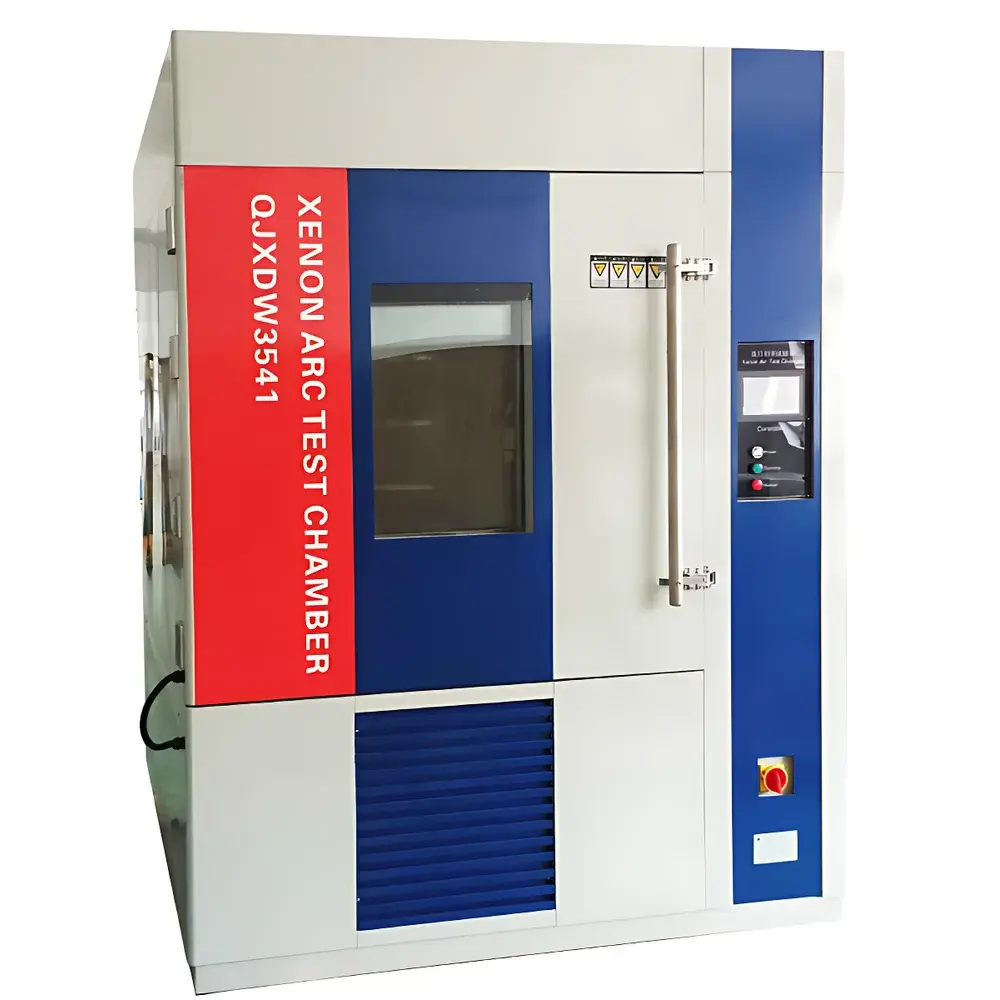
QJXDW3541 Xenon Arc Weathering Test Chamber
| Origin | Shanghai, China |
|---|---|
| Manufacturer Type | Authorized Distributor |
| Origin Category | Domestic (PRC) |
| Model | QJXDW3541 |
| Price | USD 13,800 (FOB Shanghai) |
| Xenon Lamp Power | 4.5 kW (water-cooled) |
| Temperature Range | RT+10°C to 80°C ±1°C |
| Humidity Range | Not applicable (condensation-based humidity simulation only) |
| Spectral Range | 290–800 nm |
| Irradiance at 340 nm | 0.35–1.50 W/m² (adjustable) |
| Sample Rotation Speed | 5 rpm |
| Chamber Interior Dimensions | 500 × 500 × 600 mm (W×D×H) |
| Sample Holder Radius (inner/outer) | 100 / 220 mm |
| Center-to-Holder Distance | 165 mm |
| Holder Height | 420 mm |
| Rainfall Duration | 0–9999 min (programmable) |
| Rainfall Cycle Interval | 0–240 min (programmable) |
| Lamp Lifetime | ~2000 h |
Overview
The QJXDW3541 Xenon Arc Weathering Test Chamber is an engineered environmental simulation system designed to accelerate material degradation under controlled, reproducible conditions that replicate key outdoor weathering stressors—primarily solar radiation, thermal cycling, and moisture exposure (via condensation and simulated rainfall). It employs a water-cooled 4.5 kW xenon arc lamp as its broadband UV–visible light source, delivering a spectral output closely aligned with terrestrial sunlight (290–800 nm), including critical UV-B and UV-A bands responsible for photochemical degradation in polymers, coatings, and composites. Unlike UV fluorescent or metal halide systems, xenon arc technology provides full-spectrum fidelity essential for evaluating color shift, gloss loss, chalking, cracking, and mechanical property decay per international standards such as ISO 4892-2, ASTM G155, and SAE J2527. The chamber integrates precise irradiance control, programmable temperature profiles, and dynamic moisture delivery to emulate diurnal cycles—including dark/cool condensation phases mimicking dew formation and wet/dry transitions simulating natural rain events.
Key Features
- Water-cooled 4.5 kW xenon lamp with spectral output traceable to CIE daylight standard (D65), ensuring high-fidelity solar simulation across 290–800 nm
- Digital irradiance monitoring and closed-loop feedback control at selectable wavelengths (e.g., 340 nm or 420 nm), enabling compliance with ISO 4892-2 irradiance setpoints
- Precise temperature regulation from RT+10°C to 80°C ±1°C using PID-controlled heating and forced-air circulation; uniformity maintained at ≤2°C across sample plane
- Programmable condensation and spray cycles: rainfall duration (0–9999 min) and interval (0–240 min) independently adjustable to match regional climatic profiles
- Rotating sample holder (5 rpm) with dual-radius configuration (inner 100 mm / outer 220 mm) and fixed center distance (165 mm), ensuring consistent irradiance distribution and thermal exposure across all specimens
- Modular stainless-steel interior (500 × 500 × 600 mm) optimized for airflow dynamics and lamp alignment; accommodates standard specimen racks per ASTM D7869 and ISO 11341
- Real-time display of irradiance integral (J/m²), elapsed test time, and chamber environmental parameters with data logging capability
Sample Compatibility & Compliance
The QJXDW3541 supports flat-panel and three-dimensional specimens up to 420 mm in height, including automotive safety glass, coated metal substrates, architectural cladding (e.g., aluminum composite panels), thermoplastic elastomers, and aerospace-grade composites. Its operational envelope satisfies method requirements for ISO 4892-2 (Plastics — Methods of exposure to laboratory light sources — Part 2: Xenon-arc lamps), ASTM G155 (Standard Practice for Operating Xenon Arc Light Apparatus for Exposure of Non-Metallic Materials), and SAE J2527 (Surface Vehicle Recommended Practice for Accelerated Exposure of Automotive Exterior Materials Using a Controlled Irradiance Xenon Arc Apparatus). While the system itself does not carry CE or UL certification, its architecture aligns with IEC 60068-2-5 and IEC 60068-2-14 for environmental testing equipment. All firmware and user interfaces comply with GLP-relevant audit trail principles for traceability of test parameters and runtime logs.
Software & Data Management
The chamber operates via an embedded industrial controller with touchscreen HMI, supporting multi-step program creation (up to 99 segments) for complex exposure sequences—e.g., 102 min light + 18 min dark condensation, repeated over 1,000 cycles. Irradiance integration values are stored internally with timestamps and can be exported via USB to CSV format for post-test analysis in MATLAB, Excel, or LIMS platforms. Optional RS-485 or Ethernet interface enables integration into centralized lab automation networks. Data integrity safeguards include password-protected parameter modification, session-level event logging (start/stop, alarm triggers, lamp replacement records), and non-volatile memory retention during power interruption. Firmware updates are performed offline to maintain validation status in regulated environments.
Applications
- Accelerated weathering qualification of automotive interior and exterior trim components against OEM specifications (e.g., Ford CETP, GMW14124)
- UV stability benchmarking of architectural coatings and façade systems per AAMA 2604 and ISO 11998
- Photochemical degradation kinetics studies for polymer additives (HALS, UV absorbers) in R&D laboratories
- Correlation development between accelerated test results and real-world field exposure data for predictive service life modeling
- Quality assurance testing of photovoltaic module encapsulants and backsheets per IEC 61215-2 MQT03
- Evaluation of optical clarity retention in polycarbonate glazing and LED lens materials
FAQ
What spectral irradiance calibration options are available?
The system includes factory-calibrated irradiance sensors traceable to NIM (China National Institute of Metrology); optional third-party recalibration services are available annually.
Is the chamber compatible with ASTM G155 Cycle 1 (Daylight Filter) and Cycle 4 (Window Glass Filter)?
Yes—interchangeable optical filters (supplied separately) enable compliance with both filter configurations; spectral irradiance profiles are verified pre-installation.
How is lamp aging compensated during long-duration tests?
The closed-loop irradiance control continuously adjusts lamp power to maintain setpoint intensity; integrated lamp hour counter triggers maintenance alerts at 1,800 h.
Can the unit operate unattended for 30-day continuous cycles?
Yes—robust thermal management, redundant safety interlocks (overtemperature, low coolant flow), and auto-recovery after brief power loss support extended autonomous operation.
What consumables require scheduled replacement?
Xenon lamps (~2000 h), air filters (quarterly), and rain nozzles (annually under continuous spray mode); all part numbers and cross-references are documented in the maintenance manual.



