
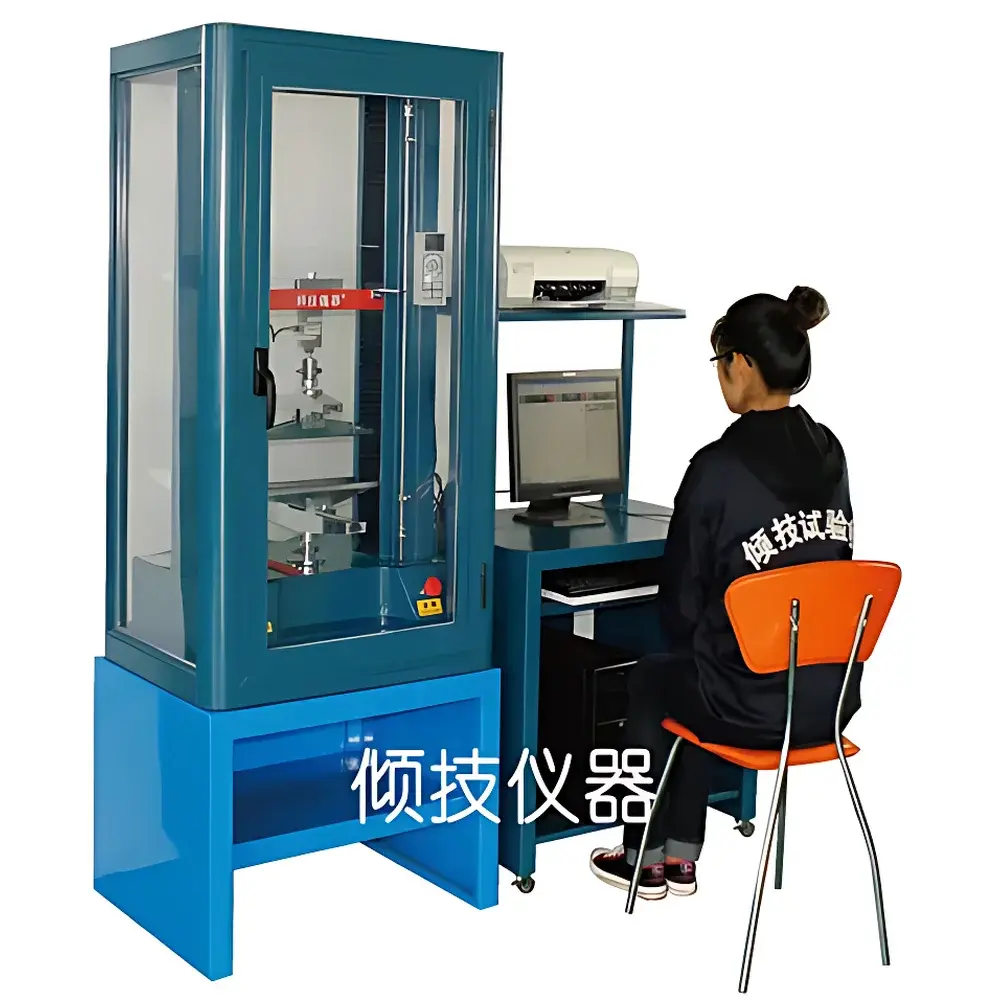
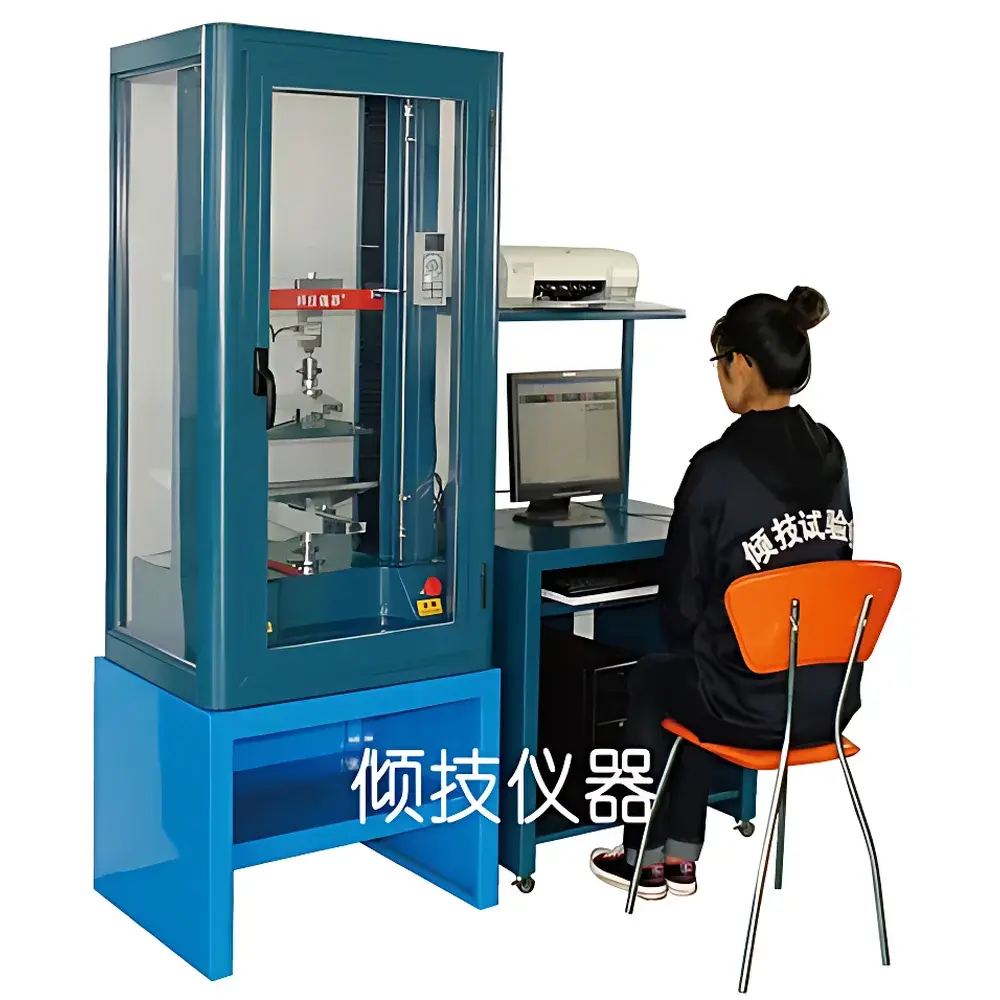
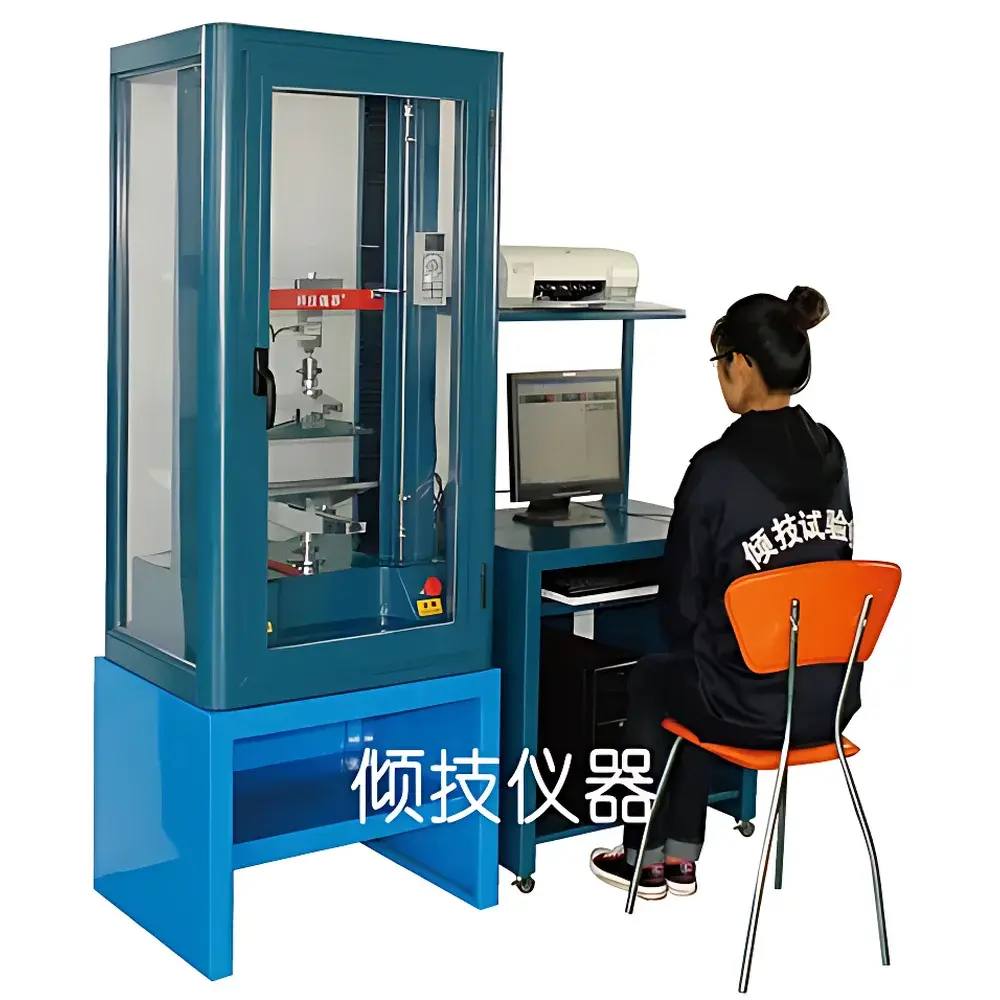
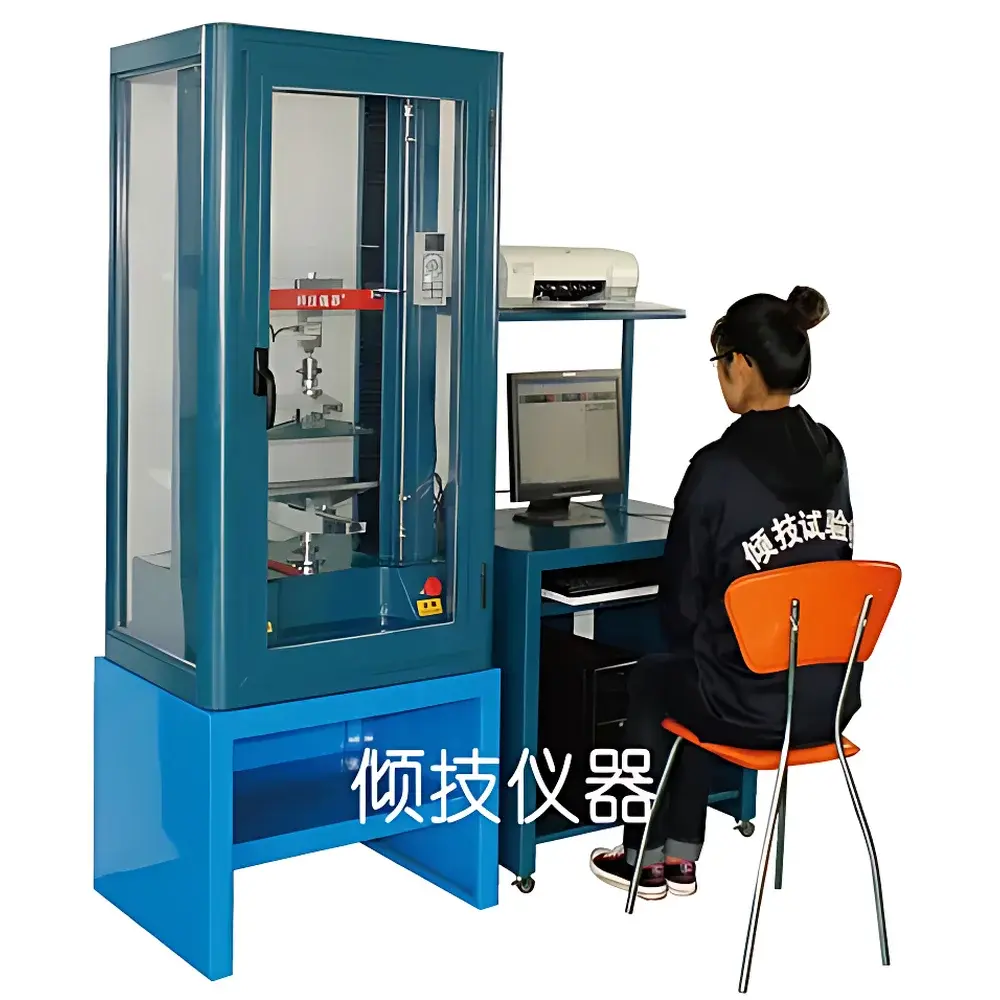
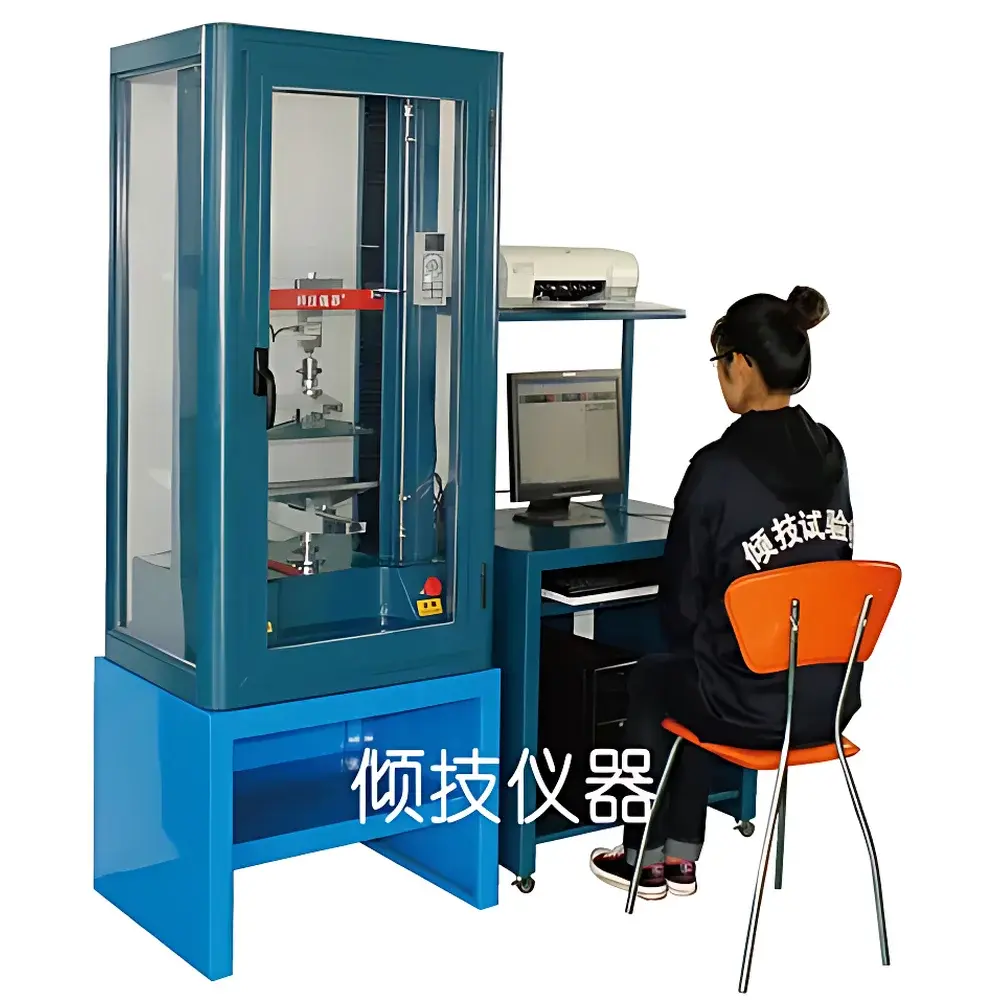
Qinji QJ211S ROR Dual-Ring Testing System for Optical Glass and Display Panel Mechanical Characterization
| Origin | Shanghai, China |
|---|---|
| Manufacturer Type | Authorized Distributor |
| Origin Category | Domestic (PRC) |
| Model | QJ211S |
| Load Capacity | 20 kN |
| Force Accuracy | Class 0.5 |
| Effective Force Range | 0.02–100% of full scale |
| Force Resolution | 500,000 counts (single-range, no auto-ranging) |
| Effective Test Width | 460 mm |
| Effective Vertical Travel (excluding fixtures) | 1500 mm |
| Test Speed Range | 0.001–1000 mm/min (programmable) |
| Speed Accuracy | ±0.5% of indicated value |
| Displacement Accuracy | ≤0.2% of indicated value |
| Strain/Deformation Accuracy | ≤0.2% of indicated value |
| Noise Level | ≤76 dB(A) |
| Continuous Operational Duty Cycle | ≥2000 h |
| Critical Component Service Life | ≥8000 h |
| Motor Power | 0.75 kW |
| Dimensions (W×D×H) | ≈670×600×2220 mm |
| Net Weight | ≈195 kg |
Overview
The Qinji QJ211S ROR Dual-Ring Testing System is an electromechanical universal testing platform engineered for high-precision mechanical evaluation of brittle and laminated optical substrates used in flat-panel display manufacturing. Designed around the ASTM C1499 (Standard Test Method for Monotonic Tensile Strength of Advanced Ceramics at Ambient Temperature) and ISO 178 (Plastics — Determination of Flexural Properties) compliant dual-ring loading configuration, it enables standardized three-point bending, four-point bending, static compression, yellow-spot (stress-induced birefringence) assessment, and shear testing on rigid transparent materials—including chemically strengthened glass, sapphire wafers, fused silica lenses, touch panel cover glass, and laminated LCD assemblies. Its rigid C-frame architecture, low-vibration drive system, and closed-loop load-cell feedback ensure repeatability within ±0.5% force accuracy across the full 20 kN range—critical for qualification of cover glass batches under IPC-J-STD-020 or JEDEC JESD22-A111 reliability protocols.
Key Features
- High-resolution force measurement with 500,000-count analog-to-digital conversion, maintaining constant resolution across the entire 0.02–100% load range—eliminating range-switching artifacts during dynamic ramp-hold-relax cycles.
- Dual-speed crosshead actuation (fast jog + precise fine control) with electronic travel limit protection and programmable return-to-start functionality for unattended batch testing.
- Modular fixture interface supporting ISO/ASTM-compliant bending jigs, compression platens, tensile grips, peel fixtures, and custom shear adapters—enabling full mechanical property mapping per ASTM D3039, D695, D790, and D1876.
- Low-noise (<76 dB(A)) operation certified for integration into cleanroom-adjacent QA laboratories without acoustic interference to adjacent metrology stations.
- Robust structural design validated for ≥2000 hours of continuous duty cycle and ≥8000 hours of critical component service life—meeting OEM production line uptime requirements.
Sample Compatibility & Compliance
The QJ211S accommodates specimens up to 460 mm wide and 1500 mm tall (excluding fixtures), making it suitable for full-size display modules, cut-to-size cover glass blanks (e.g., Gorilla Glass Gen 6, Dragon Trail), and optical lens subassemblies. It supports mechanical characterization under ambient conditions per ISO 291 (standard atmosphere) and complies with GLP documentation requirements via audit-trail-enabled software. All test methods align with IEC 60068-2-78 (damp heat), MIL-STD-810G Method 516.6 (shock), and USP for medical-grade glass packaging validation when paired with appropriate environmental chambers.
Software & Data Management
Controlled via PC-based Qinji TestSuite™ v4.x software, the system delivers real-time force-displacement-strain synchronization with timestamped data export in CSV, XML, and PDF report formats. Software features include method templates preconfigured for ASTM C1161 (flexural strength of advanced ceramics), automated pass/fail thresholding against AQL sampling plans, and 21 CFR Part 11-compliant user access control, electronic signatures, and immutable audit trails. Raw data files are stored with embedded calibration metadata and firmware revision logs—ensuring traceability for FDA, ISO 13485, or IATF 16949 audits.
Applications
- Flexural strength verification of smartphone cover glass prior to tempering and coating processes.
- Static compression testing of OLED module stacks to assess interlayer delamination thresholds.
- Yellow-spot stress mapping on AR-coated optical lenses using controlled ring-load indentation.
- Peel strength quantification of OCA (optically clear adhesive) bonds between touch sensor layers and cover glass.
- Shear resistance evaluation of laser-welded glass-metal hybrid housings for wearable electronics.
FAQ
Is the QJ211S compatible with third-party environmental chambers?
Yes—standardized RS-485 and analog I/O ports support bidirectional communication with thermal/humidity chambers meeting ASTM E145 Class II specifications.
Does the system meet ISO/IEC 17025 calibration traceability requirements?
All load cells are factory-calibrated against NIST-traceable standards; calibration certificates include uncertainty budgets and as-found/as-left data.
Can test methods be exported for cross-laboratory validation?
Method files (.qtm format) include full parameter definitions, fixture IDs, and compliance references—enabling seamless replication across global R&D sites.
What maintenance intervals are recommended for GLP-compliant operation?
Biannual verification of force and displacement accuracy per ISO 7500-1; annual mechanical inspection of guide rails, belt tension, and motor encoder alignment.
Are custom fixtures available for non-standard substrate geometries?
Qinji’s engineering team provides CAD-supported fixture design services with lead times under 12 weeks for prototypes and 6 weeks for production runs.






