
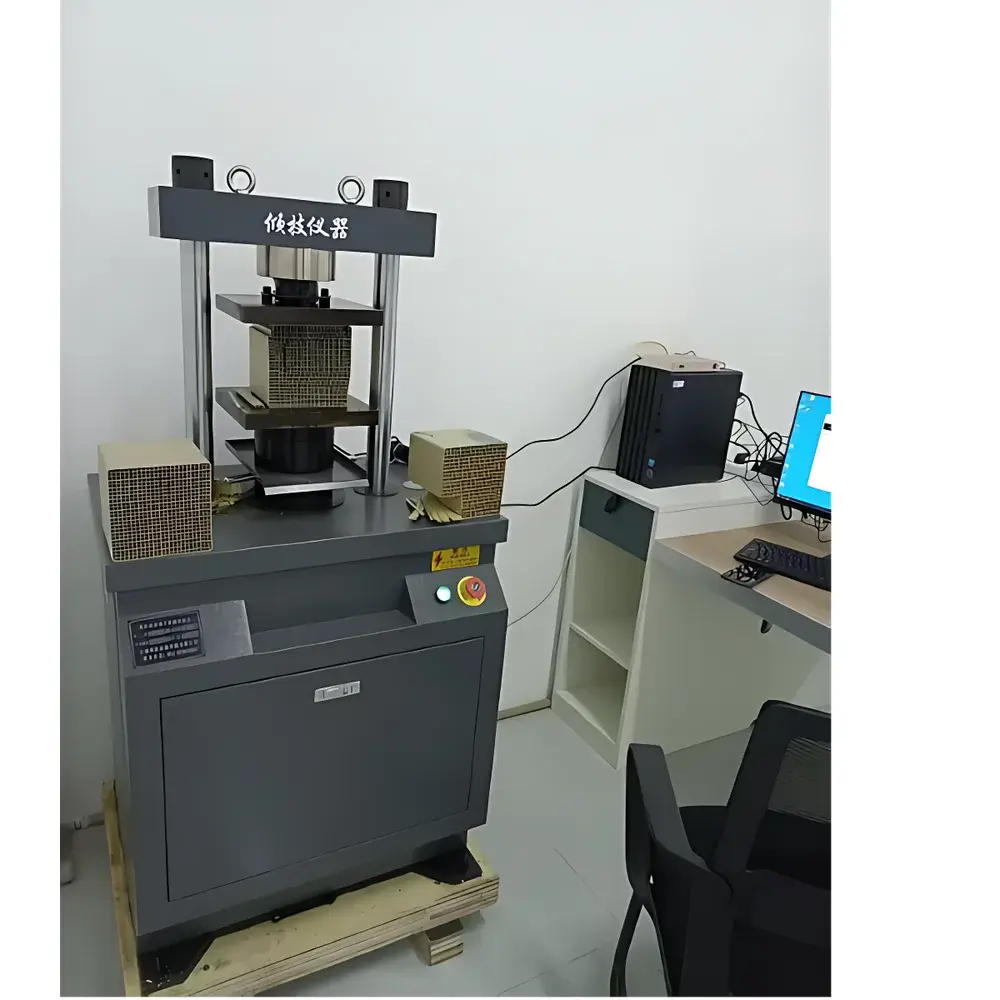
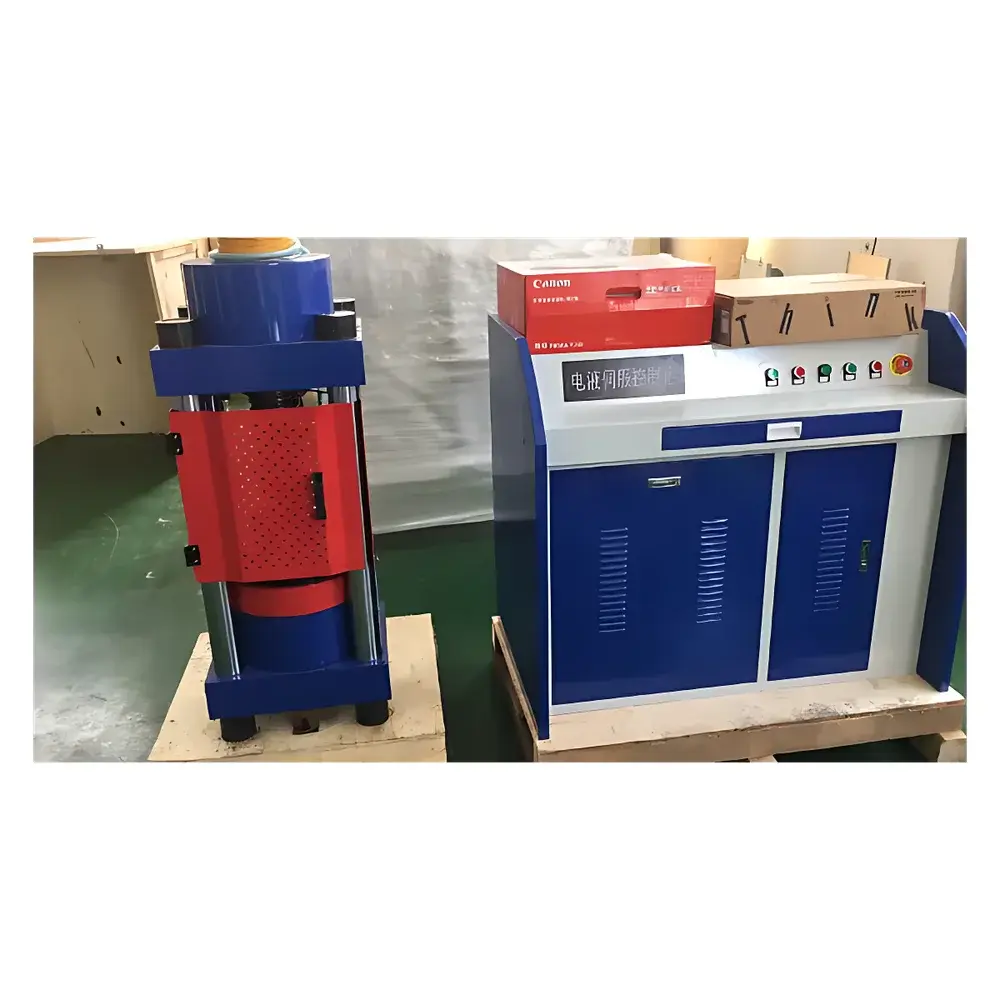
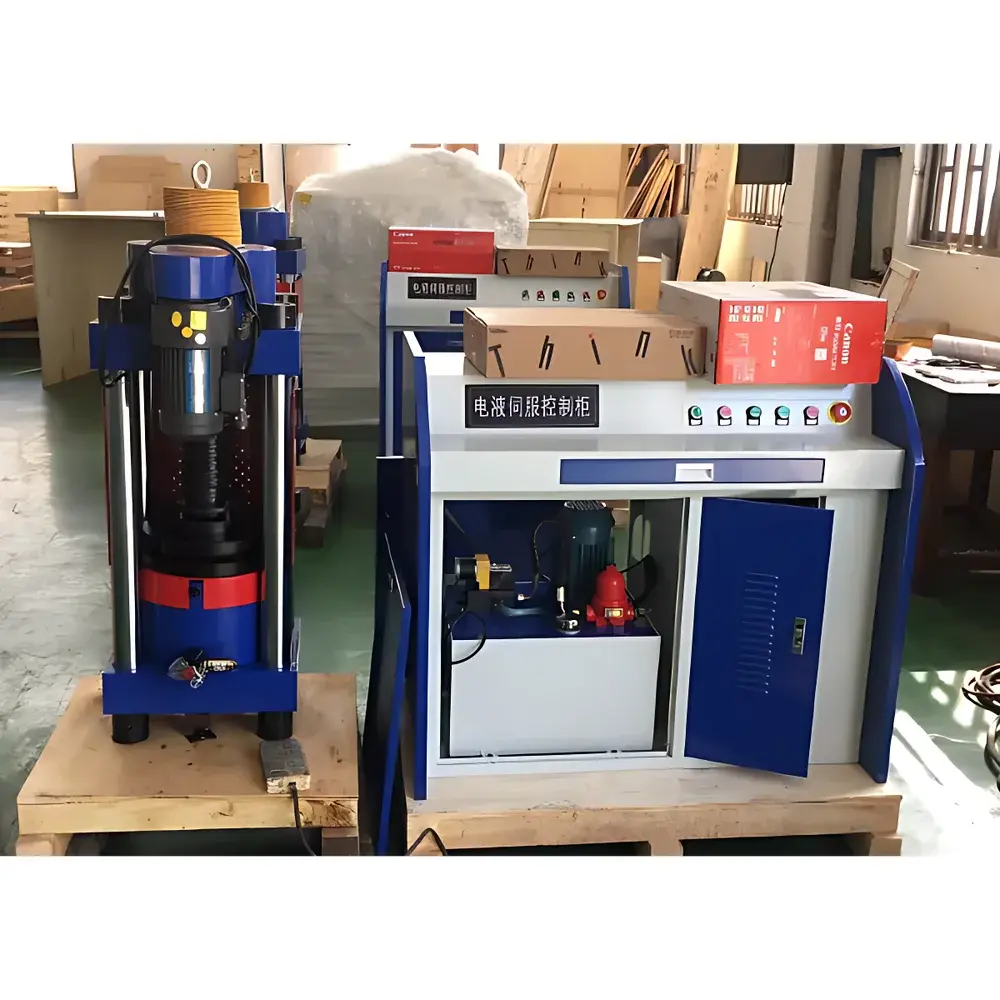
Qinji QJYL872A Microcomputer-Controlled Compression Testing Machine for Denitrification Catalysts
| Brand | Qinji |
|---|---|
| Origin | Shanghai, China |
| Model | QJYL872A |
| Max. Test Load | 3000 kN |
| Load Application Rate | 0–2.4 kN/s ±200 N/s |
| Platen Spacing | 260 mm |
| Platen Dimensions | 250 × 250 mm |
| Accuracy Class | Class I (per ISO 7500-1 & GB/T 3159) |
| Force Measurement Range | 10–3000 kN |
| Crosshead Speed | 1–15 mm/s (adjustable) |
| Motor Power | 0.75 / 1.1 / 2.2 kW |
| Net Weight | 1000–1500 kg |
| Overall Dimensions | Approx. 520×450×1350 mm or 700×540×1800 mm |
Overview
The Qinji QJYL872A Microcomputer-Controlled Compression Testing Machine is a high-capacity, servo-driven mechanical testing system engineered for precise and repeatable compressive strength evaluation of denitrification catalysts, cementitious materials, refractory bricks, natural stone, and other quasi-brittle construction-grade specimens. Designed in accordance with the fundamental principles of uniaxial compression testing per ISO 3187, ASTM C109/C348, and GB/T 17671–1999, the system employs closed-loop hydraulic or electromechanical actuation—depending on configured motor power option—to deliver controlled, rate-dependent load application with real-time feedback from calibrated load cells and displacement transducers. Its rigid four-column frame architecture ensures minimal deflection under maximum rated load (3000 kN), supporting long-term dimensional stability and measurement integrity required for regulatory-compliant quality control in catalyst manufacturing and building materials certification laboratories.
Key Features
- Class I accuracy force measurement (per ISO 7500-1 and GB/T 3159), validated across 10–3000 kN range with ≤±1.0% indication error
- Programmable loading profiles: constant rate of force (kN/s), constant rate of displacement (mm/s), or stress-controlled ramping—fully configurable via embedded controller and PC software
- Dual-mode operation: standalone mode using integrated controller with LCD interface; synchronized PC mode for advanced test sequencing, data logging, and report generation
- Robust platens (250 × 250 mm, hardened steel, parallelism tolerance ≤0.02 mm/m) optimized for uniform stress distribution across irregular catalyst monoliths and standard mortar prisms
- Adjustable platen spacing (260 mm clear opening) accommodates standard 40×40×160 mm cement beams (per ISO 679), 50×50×50 mm catalyst pellets, and full-size ceramic honeycomb substrates up to 200 mm tall
- Overload protection, emergency stop circuitry, and automatic unloading sequence compliant with EN 61000-6-2 (EMC) and GB/T 2611–2007 general safety requirements
Sample Compatibility & Compliance
The QJYL872A is routinely deployed in catalyst production QA/QC labs for evaluating crush strength of V₂O₅-WO₃/TiO₂ honeycomb monoliths and extruded pellet forms, as well as in cement testing centers validating conformity to GB/T 17671–1999 (equivalent to ISO 679) and GB/T 3074.1–2008 (carbon electrode flexural strength). It supports standardized fixtures for three-point bending (cement beams), direct compression (catalyst blocks), and confined compression (ceramic tile or fired clay brick per GB/T 4100–2015). All test protocols are traceable to national metrological standards; force calibration certificates are issued annually per JJG 139–2014 (Chinese verification regulation for compression testing machines), with optional UKAS-accredited calibration available upon request.
Software & Data Management
The system integrates with Qinji’s proprietary TestMaster v4.x software suite, compatible with Windows 10/11 (64-bit). The software provides ISO/IEC 17025-aligned audit trails—including user login logs, parameter change history, raw channel data timestamps, and electronic signatures—meeting GLP and GMP documentation requirements. Raw data exports to CSV, Excel, and XML formats; stress–strain curves are auto-generated with tangent modulus, proportional limit, and peak compressive strength annotations. Optional FDA 21 CFR Part 11 compliance package includes role-based access control, biometric or token-based authentication, and immutable electronic records with digital signature validation.
Applications
- Crush strength assessment of SCR (Selective Catalytic Reduction) catalyst monoliths per IEC 60068-2-21 and internal OEM specifications
- Compressive strength testing of Portland cement mortars and concretes (ASTM C109, ISO 679, GB/T 17671)
- Flexural strength determination of carbon electrodes and graphite components (GB/T 3074.1–2008)
- Mechanical qualification of refractory ceramics, fired clay bricks, and natural dimension stone (ASTM C67, C170, GB/T 4100)
- Research-grade load–displacement characterization of porous ceramic filters and metal foam substrates
FAQ
What standards does the QJYL872A comply with for cement testing?
It fully satisfies the loading rate requirements of GB/T 17671–1999 (ISO 679) and GB/T 3074.1–2008, including the specified 2400 ± 200 N/s ramp for 40×40×160 mm mortar specimens.
Can the machine perform both compression and flexural tests?
Yes—when equipped with the optional three-point bending fixture, it executes standardized flexural strength tests on cement beams and carbon electrodes per GB/T 3074.1 and ASTM C78.
Is third-party calibration and certification available?
Yes. Factory calibration is performed against national primary standards; optional UKAS or CNAS-accredited calibration with uncertainty reporting is available at time of delivery or during annual maintenance.
What maintenance intervals are recommended?
Preventive maintenance—including load cell verification, lubrication of guide columns, and encoder alignment check—is advised every 12 months or after 5,000 test cycles, whichever occurs first.
Does the system support integration with LIMS or MES platforms?
Via OPC UA or TCP/IP API, raw test data and summary results can be exported directly to laboratory information management systems (LIMS) or manufacturing execution systems (MES) without manual intervention.



