
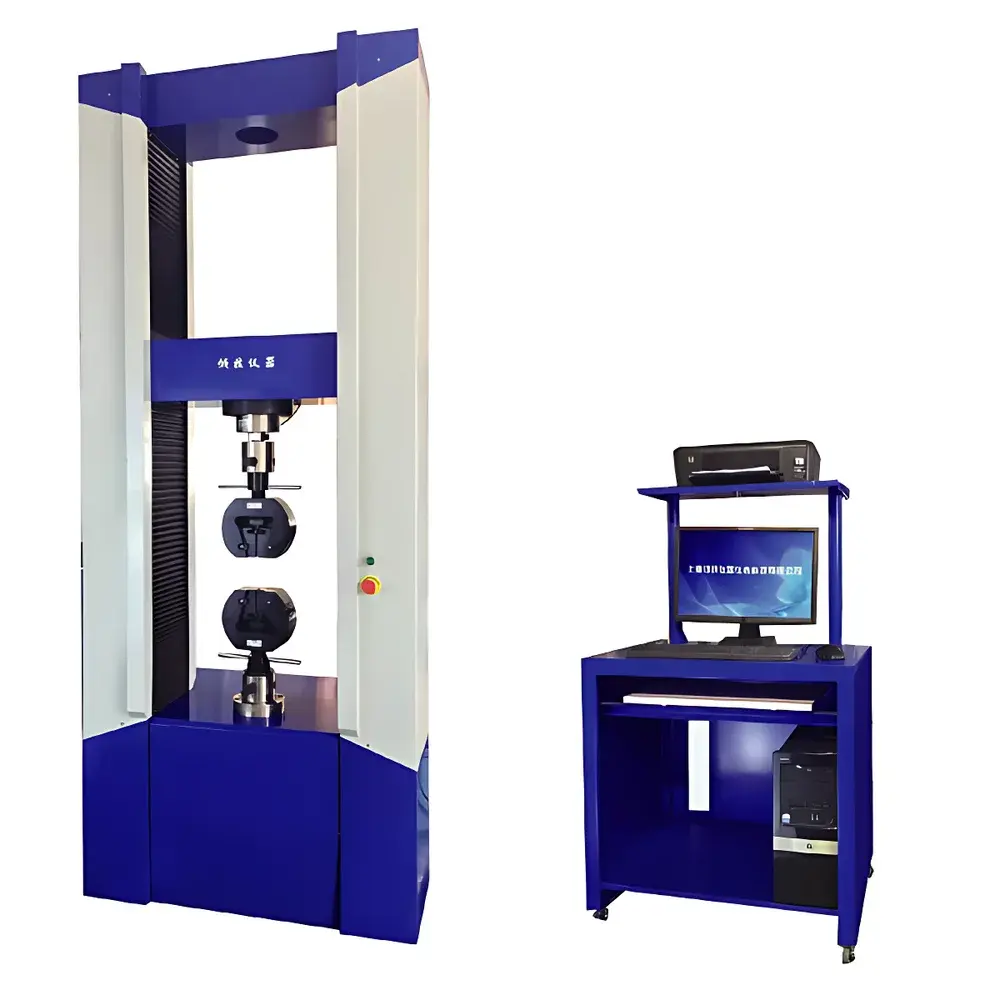
QJ212C Universal Testing Machine for Wood Mechanical Property Evaluation
| Origin | Shanghai, China |
|---|---|
| Manufacturer Type | Authorized Distributor |
| Origin Category | Domestic (PRC) |
| Model | QJ212C |
| Instrument Type | Electromechanical Universal Testing Machine |
| Load Capacity Options | 10–500 kN |
| Effective Test Width | 500 mm |
| Max. Tensile Travel | 600 / 800 mm (configurable) |
| Test Speed Range | 0.001–1000 mm/min |
| Speed Accuracy | ±1% of indicated value |
| Load Resolution | ±1/250,000 full scale (constant across entire range) |
| Displacement & Strain Measurement Accuracy | ±0.5% of indicated value |
| Safety Features | Electronic travel limit protection, overload shutdown (>110% FS), manual/auto return, dual-speed crosshead control |
| Power Supply | 1.5 kW |
| Dimensions (W×D×H) | 960 × 650 × 2000 mm |
| Weight | 1200 kg |
| Compliance | ISO 6892-1, ASTM D143, ASTM D1437, ASTM D2555, ISO 3133, EN 338, GB/T 1931–2009, GB/T 1936.1–2009 |
Overview
The QJ212C Universal Testing Machine is an electromechanical force-testing platform engineered for precise mechanical characterization of solid wood, engineered timber products (e.g., LVL, CLT, glulam), and wood-based composites. It operates on the principle of controlled uniaxial loading—applying calibrated tensile, compressive, flexural, shear, cleavage, or fatigue forces to standardized specimens in accordance with internationally recognized test protocols. Designed for laboratories engaged in timber grading, structural product certification, R&D of bio-based construction materials, and quality assurance within wood processing facilities, the system delivers traceable, repeatable mechanical data essential for compliance with building codes and material specifications. Its modular load frame architecture supports interchangeable fixtures—including four-point bending jigs, compression platens, shear blocks, and cleavage grips—enabling seamless transition between test modes without recalibration.
Key Features
- High-fidelity load measurement with constant-resolution transduction: ±1/250,000 full-scale resolution maintained across the entire 10–500 kN range, eliminating range-switching artifacts and ensuring metrological consistency from low-stiffness veneer testing to high-load structural beam evaluation.
- Programmable crosshead motion: Continuous speed control from 0.001 to 1000 mm/min with ≤±1% speed accuracy, enabling quasi-static creep tests and dynamic stiffness assessments within a single platform.
- Dual-mode positioning: Independent fast/slow motorized crosshead adjustment with jog capability facilitates rapid specimen setup and fine alignment—critical for brittle wood specimens where misalignment induces premature failure.
- Integrated safety architecture: Redundant electronic travel limits, hardware-based overload cutoff (triggered at 110% of selected capacity), and automatic post-test return minimize operator intervention and safeguard both personnel and instrumentation.
- Rigid C-frame construction: 1200 kg mass and optimized 960 × 650 × 2000 mm footprint ensure minimal frame deflection (<0.02% of applied load) during high-force compression tests on dense hardwoods or laminated members.
Sample Compatibility & Compliance
The QJ212C accommodates standard and custom wood specimens per ISO 3133 (density and moisture content preconditioning), ASTM D143 (small clear specimens), ASTM D2555 (full-size structural members), and EN 338 (strength classes for structural timber). Specimen widths up to 500 mm fit within the effective test zone; tensile lengths are configurable to 600 mm or 800 mm to meet minimum gauge length requirements for modulus-of-elasticity determination. All test sequences—including ramp-to-break, load-controlled hold, and displacement-controlled cyclic protocols—generate audit-ready output compliant with GLP documentation standards. The system supports direct export of raw force-displacement datasets in CSV and XML formats, facilitating third-party validation against ISO/IEC 17025-accredited calibration reports.
Software & Data Management
Control and analysis are executed via Windows-based proprietary software featuring real-time dual-axis plotting (force vs. displacement, stress vs. strain), synchronized video capture integration (optional), and parametric test method libraries preloaded with ASTM D143, ISO 6892-1, and GB/T 1936.1 templates. Users may freely annotate, trim, overlay, and rescale curves; all modifications are logged with timestamps and user IDs to satisfy FDA 21 CFR Part 11 electronic record integrity requirements. Data export includes metadata headers specifying environmental conditions (temperature/humidity per ISO 291), specimen ID, test standard, calibration certificate ID, and operator credentials—ensuring full traceability for certification bodies such as APA – The Engineered Wood Association or CE-marking notified bodies.
Applications
- Mechanical property mapping of tropical hardwoods and plantation-grown softwoods under varying moisture content (8–20% MC).
- Modulus of rupture (MOR) and modulus of elasticity (MOE) determination for structural glued-laminated timber (glulam) per EN 14080.
- Compression strength parallel/perpendicular to grain for cross-laminated timber (CLT) panels in accordance with ANSI/APA PRG 320.
- Shear strength evaluation of finger-jointed lumber using ASTM D5652 protocols.
- Cyclic fatigue behavior of bamboo scrimber and hemp-lignin composites under simulated service loading.
- Quality conformance testing for FSC®-certified timber suppliers requiring documented mechanical verification per chain-of-custody audits.
FAQ
What international standards does the QJ212C support out-of-the-box?
Preconfigured test methods include ASTM D143, D2555, D1437; ISO 3133, 6892-1, 13968; EN 338, 14080; and GB/T 1931–2009, GB/T 1936.1–2009.
Is the system suitable for testing green wood or high-moisture-content specimens?
Yes—provided specimens are conditioned per ISO 291 and mounted with moisture-resistant grips; optional environmental chamber integration supports testing at controlled RH (30–90%) and temperature (10–40°C).
How is calibration traceability maintained?
Each unit ships with a NIST-traceable load cell calibration certificate; annual recalibration services include uncertainty budgeting per ISO/IEC 17025 and certificate versioning linked to firmware revision history.
Can the machine perform ASTM D1437 block shear tests on adhesives used in plywood?
Yes—using the dedicated shear fixture kit (QJ-SF-03), which applies uniform double-shear loading to bonded wood blocks per ASTM D1437 Section 7.2.
Does the software support multi-user role-based access control?
Yes—administrator, technician, and reviewer roles enforce differential permissions for method editing, test execution, and report approval, satisfying ALCOA+ data integrity principles.



