
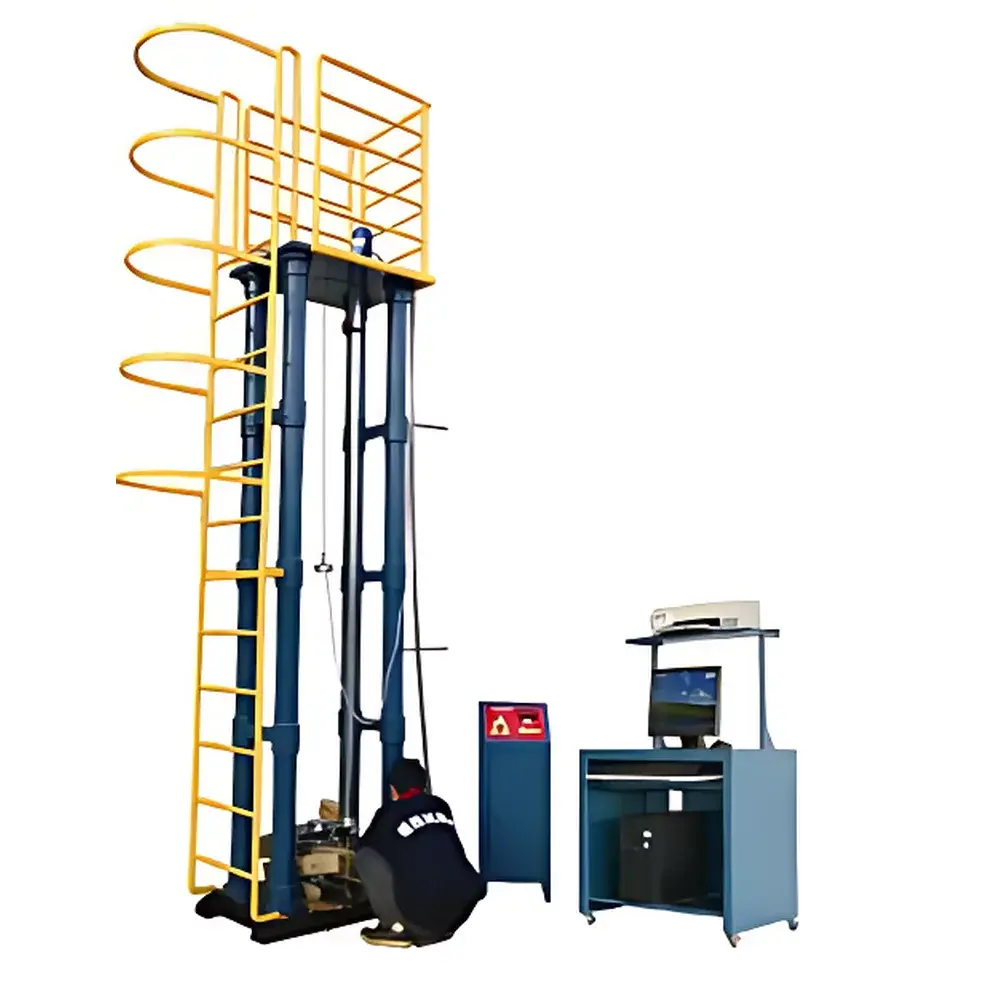
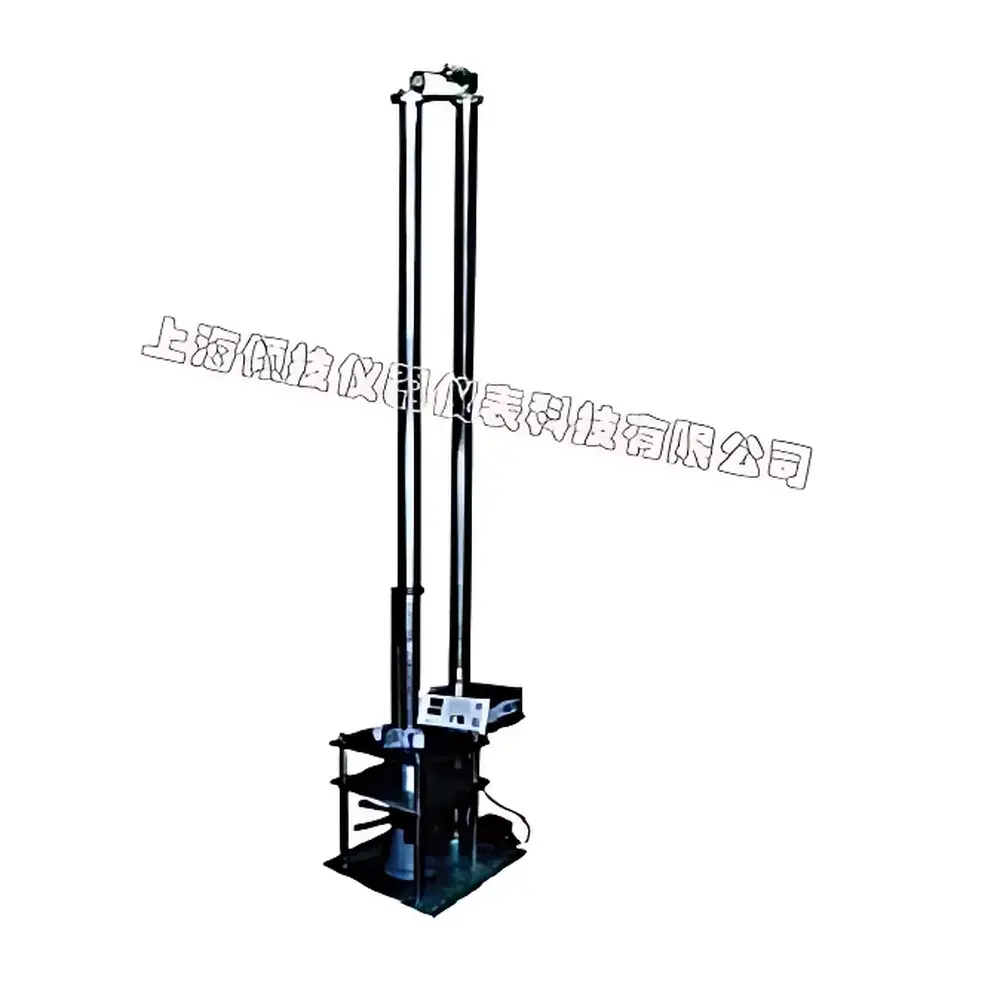
Qinji QJLC Dynamic Impact Strength Tester
| Brand | Qinji |
|---|---|
| Origin | Shanghai, China |
| Model | QJLC |
| Instrument Type | Customizable Pendulum-Type Impact Testing Machine |
| Impact Energy | Customizable |
| Impact Velocity | Customizable |
| Pendulum Torque (Impact Constant) | Customizable |
| Load Cell Range | Customizable |
| Maximum Lifting Height | Customizable |
| Accuracy Class | Class 1 (per ISO 148-1 & ASTM E23) |
| Force Measurement Range | 20–500 kN |
| Full-Scale Load Cell Capacity | 500 kN |
| Measurement Accuracy | ±1% of reading |
| Drop Height Adjustment Range | 0–10,000 mm |
| Drop Height Resolution | 0.1 mm |
| Standard Weights | 2, 3, 4, 5, 10, 20, 50, and 100 kg (45# steel, ±1% tolerance) |
| Control & Data System | QJLC17.7.Ttest Real-Time Impact Curve Acquisition & Analysis Software |
Overview
The Qinji QJLC Dynamic Impact Strength Tester is a precision-engineered pendulum-type impact testing system designed for quantitative evaluation of dynamic mechanical response under high-strain-rate loading conditions. Based on the fundamental principles of conservation of energy and angular momentum in a calibrated pendulum system, the instrument delivers repeatable, traceable impact energy delivery to test specimens—enabling measurement of absorbed energy, peak impact force, deformation displacement, and time-resolved force–displacement–energy profiles. Unlike conventional Charpy or Izod testers with fixed energy ratings, the QJLC platform supports fully configurable impact parameters—including pendulum mass, drop height, impact velocity, and moment arm—allowing users to simulate application-specific loading scenarios for brittle, ductile, and composite materials. Its architecture complies with core metrological requirements defined in ISO 148-1 (Metallic materials — Charpy pendulum impact test), ASTM E23 (Standard Test Methods for Notched Bar Impact Testing of Metallic Materials), and ISO 8256 (Plastics — Determination of tensile-impact strength), while supporting method development beyond standardized protocols.
Key Features
- Modular pendulum assembly with interchangeable hammers and customizable moment arms for precise impact constant adjustment
- High-resolution electromechanical lifting mechanism enabling 0.1 mm repeatability in drop height positioning across 0–10,000 mm range
- Integrated 500 kN load cell (Class 1 accuracy per ISO 376) with real-time digital signal conditioning and anti-aliasing filtering
- Dual-sensor synchronization: simultaneous acquisition of force, displacement (via LVDT or optical encoder), and time-stamped energy dissipation
- Real-time curve rendering and post-test parametric extraction—including peak force, maximum deflection, energy absorption up to yield, total fracture energy, and loading/unloading stiffness
- Ruggedized frame with vibration-damping base and safety interlock system compliant with EN ISO 13857 and OSHA 1910.212
Sample Compatibility & Compliance
The QJLC accommodates specimens ranging from small-scale ceramic tiles (10 × 10 × 2 mm) to structural steel plates (up to 100 × 50 × 25 mm), including notched and unnotched configurations. It supports standardized geometries per ASTM E23, ISO 148, ISO 8256, and GB/T 229. The system enables full traceability through NIST-traceable load cell calibration certificates and documented uncertainty budgets. All software operations comply with ALCOA+ data integrity principles; audit trails, electronic signatures, and user-access controls are implemented in accordance with FDA 21 CFR Part 11 requirements for regulated environments. Routine verification follows ISO/IEC 17025 guidelines for testing laboratories.
Software & Data Management
The proprietary QJLC17.7.Ttest software provides a deterministic real-time acquisition engine sampling at up to 1 MHz (user-selectable), ensuring no loss of transient events during microsecond-scale impact events. Data is stored in HDF5 format with embedded metadata—including test parameters, calibration history, operator ID, timestamp, and environmental conditions. Built-in analysis modules support comparative curve overlay, derivative-based event detection (e.g., crack initiation time), hysteresis loop quantification, and export to CSV, MATLAB (.mat), or Universal File Format (UFF) for third-party FEA correlation. All raw datasets retain full bit-depth fidelity without compression or interpolation.
Applications
- Quantitative comparison of fracture toughness across diamond-coated cutting tools, tungsten carbide inserts, and polycrystalline diamond compacts (PCD)
- Evaluation of thermal shock resistance in refractory ceramics and graphite electrodes used in metallurgical furnaces
- Dynamic property mapping of fiber-reinforced polymer laminates under ballistic-relevant strain rates
- Validation of weld zone integrity in high-strength structural steels per AWS D1.1 and EN ISO 15614
- Development and qualification of impact-absorbing composites for aerospace interior panels (SAE AMS 3809, FAR 25.853)
- Material screening for additive manufacturing feedstocks where layer adhesion and interfacial strength govern impact performance
FAQ
What standards does the QJLC system support out-of-the-box?
It natively implements test methods aligned with ISO 148-1, ASTM E23, ISO 8256, and GB/T 229, with configurable parameter templates for each.
Can the system be integrated into an existing LIMS or MES environment?
Yes—via RESTful API and OPC UA server interface, supporting structured data exchange with LabWare LIMS, Thermo Fisher SampleManager, and Siemens Opcenter.
Is on-site installation and IQ/OQ validation assistance available?
Qinji provides factory-authorized commissioning, including Installation Qualification (IQ), Operational Qualification (OQ), and documentation aligned with ISO/IEC 17025 and GMP Annex 11.
What maintenance intervals are recommended for long-term accuracy retention?
Annual recalibration of the load cell and height positioning system is advised; biannual verification of hammer alignment and bearing preload is included in the preventive maintenance plan.
Does the software support multi-user role-based access control?
Yes—administrators, analysts, reviewers, and auditors can be assigned granular permissions for data viewing, editing, deletion, and electronic signing.



