
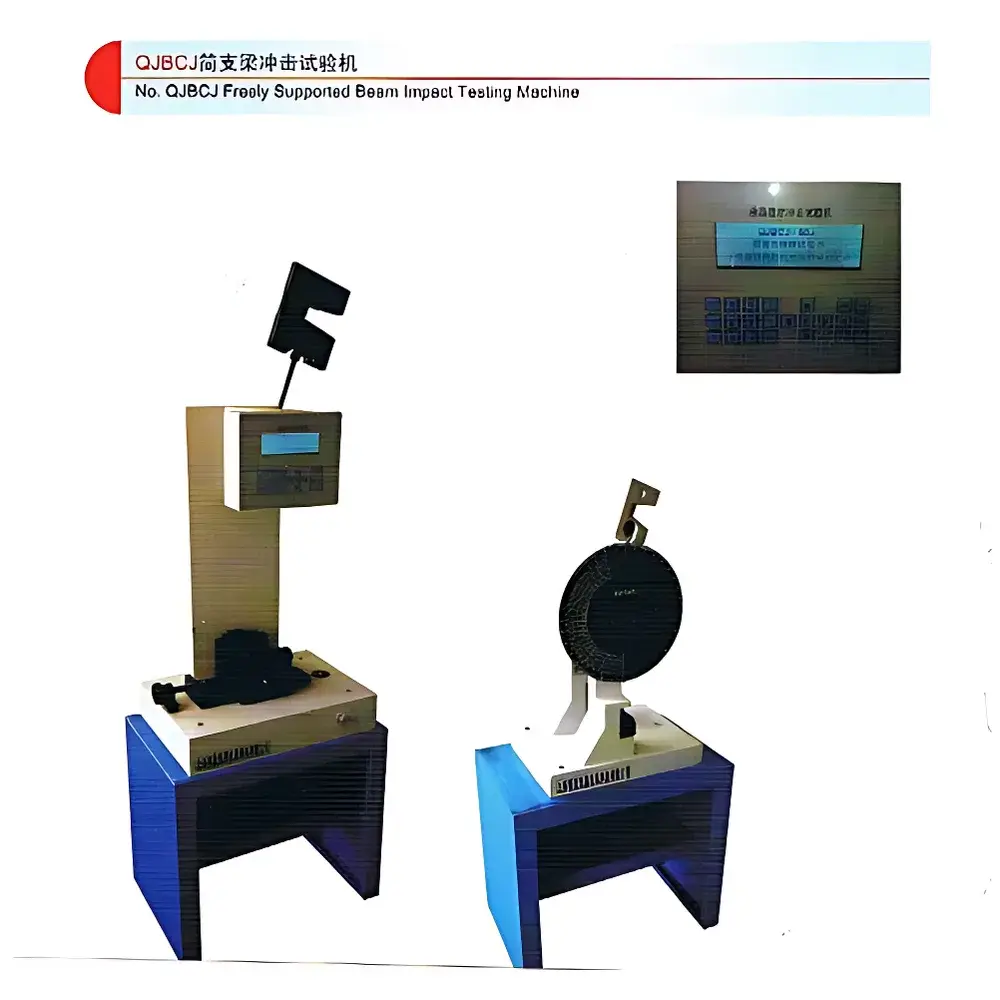
Qingji QJBCJ Simply-Supported Beam Impact Testing Machine
| Brand | Qingji |
|---|---|
| Origin | Shanghai, China |
| Model | QJBCJ |
| Impact Energies | 5 J, 7.5 J, 15 J, 25 J, 50 J |
| Impact Velocity | 2.9 m/s |
| Pendulum Pivot-to-Specimen Center Distance | 230 mm |
| Pendulum Hammer Radius (Impact Constant) | 230 mm |
| Specimen Support Span Options | 40 mm, 60 mm, 70 mm, 95 mm |
| Notch Knife Edge Angle | 30° |
| Notch Knife Edge Radius | 2 mm |
| Anvil Radius | 1 mm |
| Maximum Lifting Height | 230 mm |
| Dimensions (L×W×H) | 280 mm × 250 mm × 500 mm |
| Net Weight | 50 kg |
| Compliance | GB/T 1043, ISO 179-1, ISO 9854-1, DIN 8078, DIN 53453 |
Overview
The Qingji QJBCJ Simply-Supported Beam Impact Testing Machine is a precision mechanical testing instrument engineered for the quantitative determination of impact resistance and notch sensitivity in rigid non-metallic materials. It operates on the classical pendulum impact principle—specifically the simply-supported beam configuration—where a calibrated pendulum strikes a horizontally supported, notched specimen at a defined velocity, and the energy absorbed during fracture is calculated from the pendulum’s residual swing height. This method delivers reproducible Charpy-type impact values essential for comparative material qualification, quality control, and regulatory compliance in polymer, composite, ceramic, and electrical insulating material development. Designed in strict accordance with international standard test protocols—including GB/T 1043, ISO 179-1 (2019), ISO 9854-1, DIN 8078, and DIN 53453—the system ensures metrological traceability and inter-laboratory comparability. Its robust cast-iron base, hardened steel anvil and striker assembly, and geometrically precise specimen supports minimize parasitic energy loss and angular deviation, thereby enhancing measurement fidelity across the full 5–50 J energy range.
Key Features
- Modular pendulum system with five selectable nominal impact energies (5 J, 7.5 J, 15 J, 25 J, 50 J), each validated via certified calibration weights and angular displacement verification.
- Precision-machined support span adjustment mechanism accommodating standardized spans of 40 mm, 60 mm, 70 mm, and 95 mm—enabling direct alignment with ISO 179-1 Annex A and GB/T 1043 specimen geometry requirements.
- Hardened steel impact knife edge (30° included angle, 2 mm tip radius) and anvil (1 mm radius) manufactured to ±0.02 mm dimensional tolerance per ISO 179-2 specifications.
- Optically referenced pendulum release mechanism ensuring consistent 160° pre-lift angle and eliminating manual release variability.
- Stable monolithic frame with vibration-damping base footprint (280 × 250 mm), minimizing environmental influence on low-energy impact measurements.
- Integrated scale and digital angle encoder for direct readout of energy absorption, supporting both analog verification and digital data logging interfaces.
Sample Compatibility & Compliance
The QJBCJ accommodates rectangular bars (typically 80 mm × 10 mm × 4 mm or 120 mm × 15 mm × 10 mm) with standardized machined notches per ISO 179-1 Type A or Type B geometries. It is routinely employed for thermoplastics (e.g., ABS, PC, PP), fiber-reinforced composites (glass/CFRP), rigid PVC, phenolic laminates, engineering ceramics, and cast stone. All mechanical dimensions—including pivot-to-specimen center distance (230 mm), support span tolerances (±0.2 mm), and striker alignment—conform to the geometric constraints defined in ISO 179-2:2020 for apparatus validation. The system supports full audit readiness for GLP-compliant laboratories and meets the mechanical verification criteria outlined in ASTM E23 Annex A1 for pendulum impact testers.
Software & Data Management
While the base QJBCJ model operates as a standalone mechanical tester, optional digital upgrade kits provide RS-232 or USB connectivity for integration with Qingji’s IMPACT-View™ software suite. This platform enables automated energy calculation, statistical reporting (mean, SD, CV%), pass/fail thresholding against specification limits, and export to CSV or PDF formats compliant with ISO/IEC 17025 documentation requirements. Audit trails record operator ID, test date/time, specimen ID, energy selection, and calibration status—supporting adherence to FDA 21 CFR Part 11 principles where electronic records are mandated.
Applications
- Quality assurance of injection-molded plastic components in automotive and consumer electronics supply chains.
- Comparative evaluation of toughening agent efficacy (e.g., rubber modifiers in polypropylene blends).
- Batch-release testing of glass-fiber reinforced nylon for aerospace structural housings.
- Regulatory submission testing for medical device polymer housings under ISO 10993-1 biocompatibility frameworks.
- Teaching laboratory implementation for undergraduate materials science curricula emphasizing fracture mechanics fundamentals.
- Third-party certification testing per IEC 60695-1-30 for electrically insulated enclosure materials.
FAQ
What standards does the QJBCJ comply with?
It satisfies the mechanical and procedural requirements of GB/T 1043, ISO 179-1:2019, ISO 9854-1, DIN 8078, and DIN 53453.
Can the machine test specimens with different notch types?
Yes—it accepts both Type A (2 mm deep, 0.25 mm root radius) and Type B (2 mm deep, 1 mm root radius) notches per ISO 179-1, provided specimens are prepared using certified milling fixtures.
Is calibration certification included with delivery?
Each unit ships with a factory verification report documenting pendulum moment of inertia, energy linearity across all ranges, and support span accuracy—traceable to national metrology institutes.
What maintenance is required for long-term accuracy?
Annual verification of pivot bearing friction, knife edge wear (via profilometry), and support span repeatability is recommended; Qingji provides certified replacement anvils and strikers with NIST-traceable dimensional certificates.
Does the system support GLP/GMP documentation workflows?
When equipped with IMPACT-View™ and optional electronic signature modules, it supports full ALCOA+ data integrity principles including attributable, legible, contemporaneous, original, and accurate records.



