
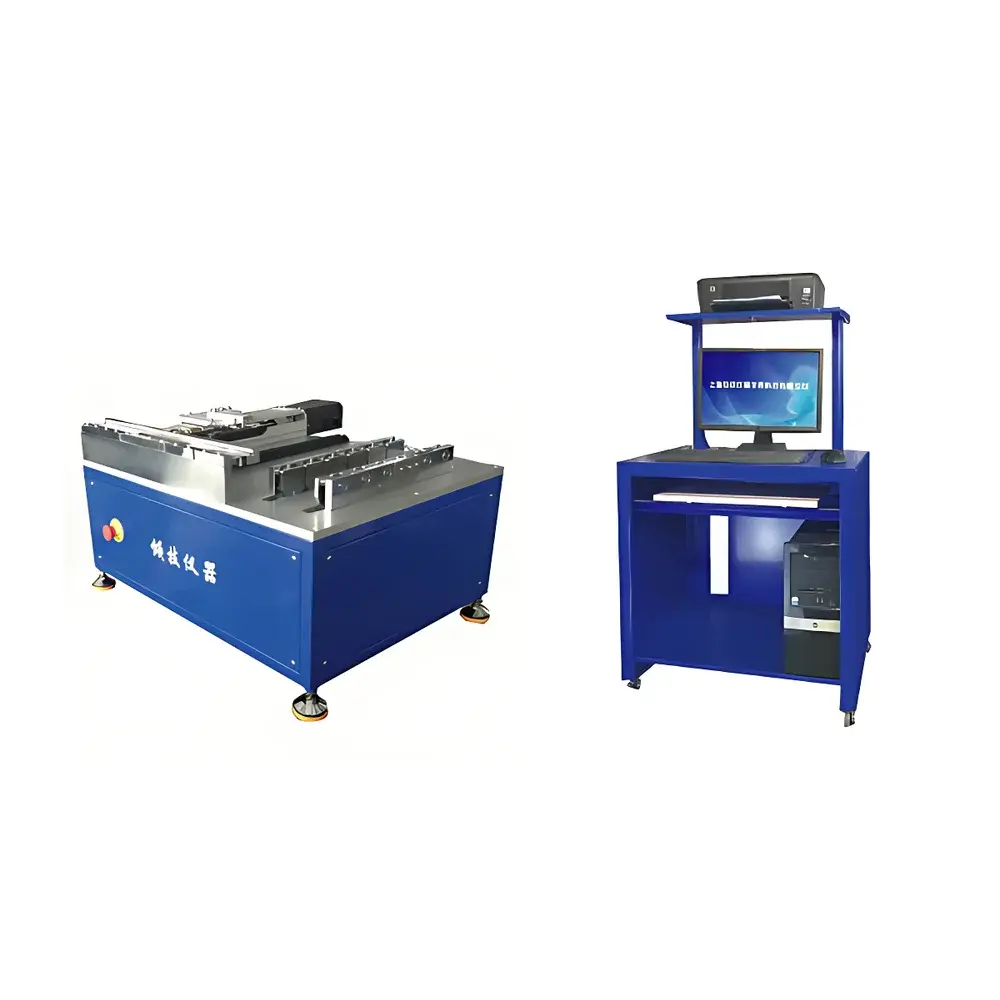
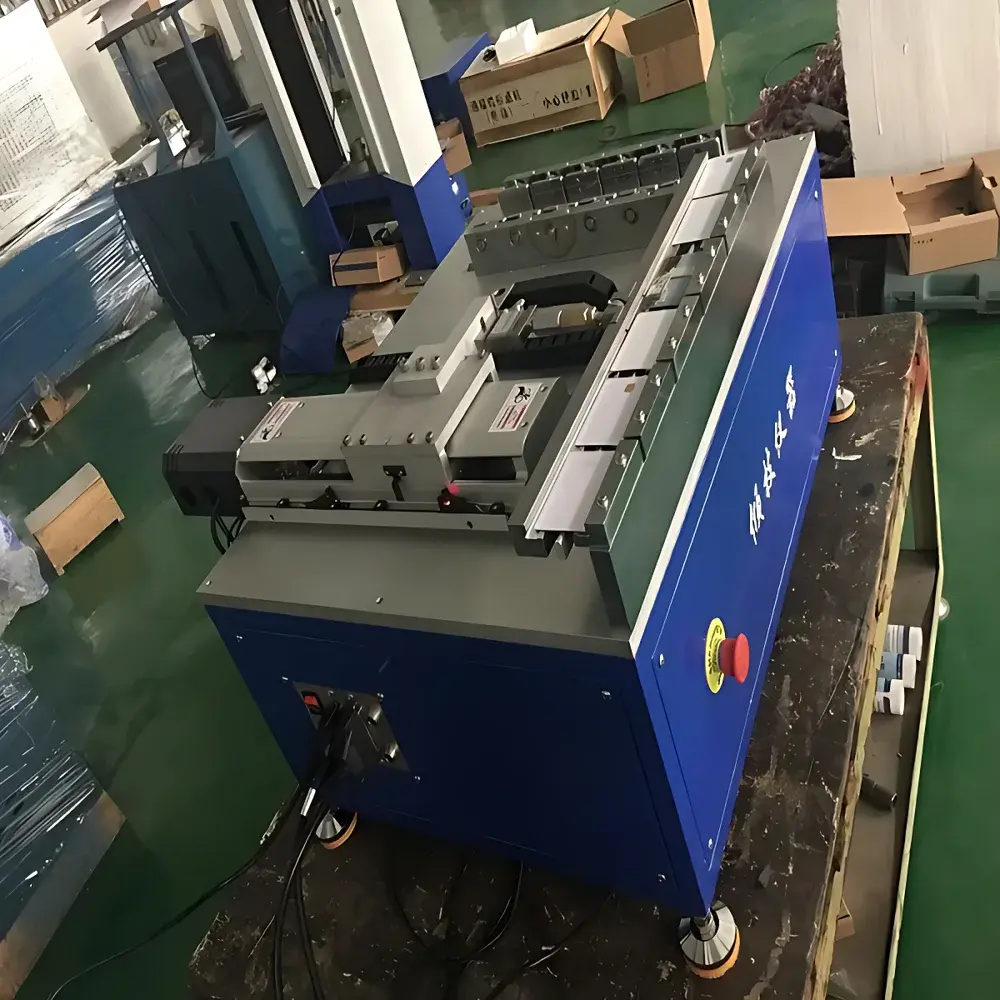
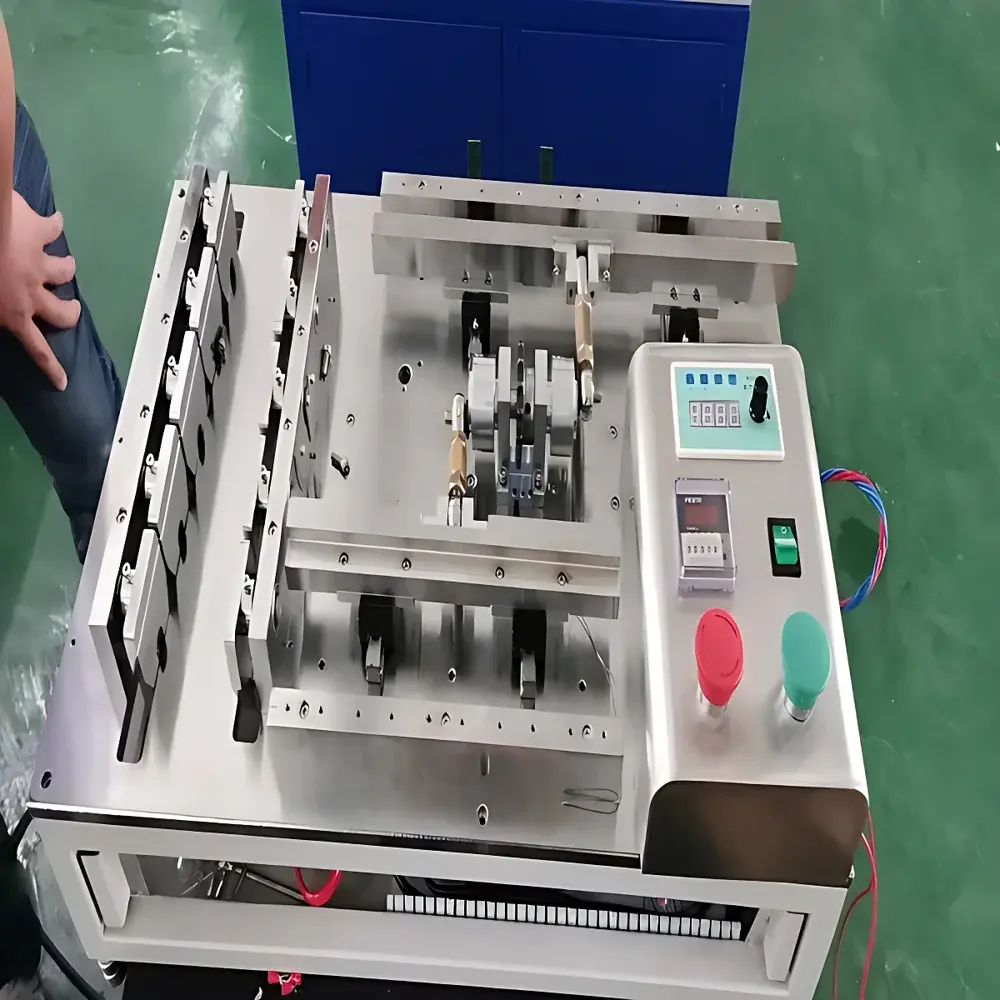
Qinji QJICWQ IC Card Bending and Torsion Testing Machine
| Brand | Qinji |
|---|---|
| Origin | Shanghai, China |
| Model | QJICWQ |
| Maximum Bending/Torsion Angle | ±15° (±1° accuracy) |
| Torque Measurement Range | Equivalent to 29 rpm bending speed |
| Angular Resolution | 0.1° (derived from ±1° angular tolerance specification) |
| Cycle Count Range | 1–9999 cycles |
| Motor Power | 35 W |
| Dimensions (L×W×H) | 670 × 380 × 220 mm |
| Weight | 70 kg |
| Input Voltage | AC 220 V ±5% |
Overview
The Qinji QJICWQ IC Card Bending and Torsion Testing Machine is a dedicated mechanical endurance tester engineered for standardized evaluation of flexible smart cards—including contactless transit cards, EMV-compliant payment cards, and ISO/IEC 7810-compliant ID cards—under controlled cyclic flexural and torsional stress. It operates on the principle of programmable angular displacement actuation, applying precise bidirectional bending deformation at a fixed rotational speed (29 rpm) to simulate real-world mechanical fatigue encountered during card insertion, pocket friction, or repeated flexing in daily use. Designed in alignment with ISO/IEC 10373-6 (Test Methods for Identification Cards – Physical Characteristics), ISO/IEC 16649-1 (Integrated Circuit(s) Cards – Part 1: Physical Characteristics), and GB/T 17554.1 (Chinese national standard equivalent), this instrument delivers repeatable, traceable mechanical stress profiles essential for quality assurance, R&D validation, and pre-certification testing.
Key Features
- Precisely calibrated bidirectional angular actuation system delivering ±15° bending/torsion with ±1° positional accuracy—ensuring compliance with angular tolerance requirements defined in ISO/IEC 16649-1 and GB/T 17554.1.
- Programmable cycle counter (1–9999 cycles) with non-volatile memory retention, enabling unattended long-duration fatigue testing and statistical durability analysis.
- Low-inertia 35 W brushless DC motor drive optimized for stable low-speed operation (29 rpm), minimizing thermal drift and mechanical resonance during repetitive motion.
- Rigid aluminum-alloy frame and precision-machined fixture base provide structural stability and dimensional repeatability across multiple test sessions.
- Integrated safety interlock and emergency stop circuit compliant with IEC 61000-6-2 (immunity) and IEC 61000-6-3 (emission) standards for laboratory environments.
- Front-panel digital display with intuitive parameter entry (angle, speed, cycles) and real-time status feedback—no external PC required for basic operation.
Sample Compatibility & Compliance
The QJICWQ accommodates standard ISO/IEC 7810 ID-1 format cards (85.6 × 53.98 × 0.76 mm), including laminated PVC, PET, polycarbonate, and composite substrate cards with embedded antennas or chips. Fixture geometry ensures uniform moment arm application without edge slippage or localized stress concentration. Test methodology supports verification against ISO/IEC 10373-6 Clause 7.2 (Bending Resistance) and Clause 7.3 (Torsion Resistance), as well as GB/T 17554.1 Annex A. Data generated meets evidentiary requirements for internal QA documentation, third-party certification submissions (e.g., EMVCo, Common Criteria), and GLP-aligned lab records when paired with manual log entries.
Software & Data Management
While the QJICWQ operates as a standalone unit, its digital interface supports optional RS-232 serial output (available via accessory module) for integration into custom LabVIEW or Python-based data acquisition systems. Users may export cycle count, completion status, and timestamped pass/fail flags for traceability. Though the base model does not include FDA 21 CFR Part 11-compliant electronic signatures or audit trail functionality, it is fully compatible with external LIMS platforms that enforce electronic record integrity policies. All firmware updates are delivered via secure USB flash drive following manufacturer validation protocols.
Applications
- Pre-production validation of card substrate flexibility and lamination bond strength in smart card manufacturing facilities.
- Comparative fatigue analysis of alternative core materials (e.g., PETG vs. polycarbonate) under identical bending amplitude and frequency conditions.
- Quality control screening in contract card personalization centers prior to mass issuance.
- Academic research on micro-crack propagation in embedded antenna traces subjected to cyclic mechanical strain.
- Supporting technical documentation for conformity assessments required by transport authorities (e.g., ITSO, CIPURSE, Calypso) mandating minimum mechanical lifetime thresholds.
FAQ
Does the QJICWQ comply with ISO/IEC 16649-1?
Yes—the ±15° ±1° bidirectional bending capability and programmable cycle control directly satisfy Clause 6.2 (Mechanical Endurance Requirements) and Annex B (Test Procedure) of ISO/IEC 16649-1.
Can the machine test dual-interface (contact + contactless) cards?
Yes—fixture design avoids electrical interference; no RF shielding is required since mechanical stress testing does not involve signal transmission.
Is calibration certification included with shipment?
A factory calibration report (traceable to CNAS-accredited reference standards) is provided; annual recalibration is recommended per ISO/IEC 17025 guidelines.
What maintenance is required?
Biannual lubrication of rotary bearings and visual inspection of clamping jaws; no scheduled replacement parts are specified within the first 5 years of typical lab usage.
Is technical support available outside China?
Yes—remote diagnostics and English-language engineering documentation are provided; on-site service is available via authorized regional partners in APAC, EMEA, and North America.



