
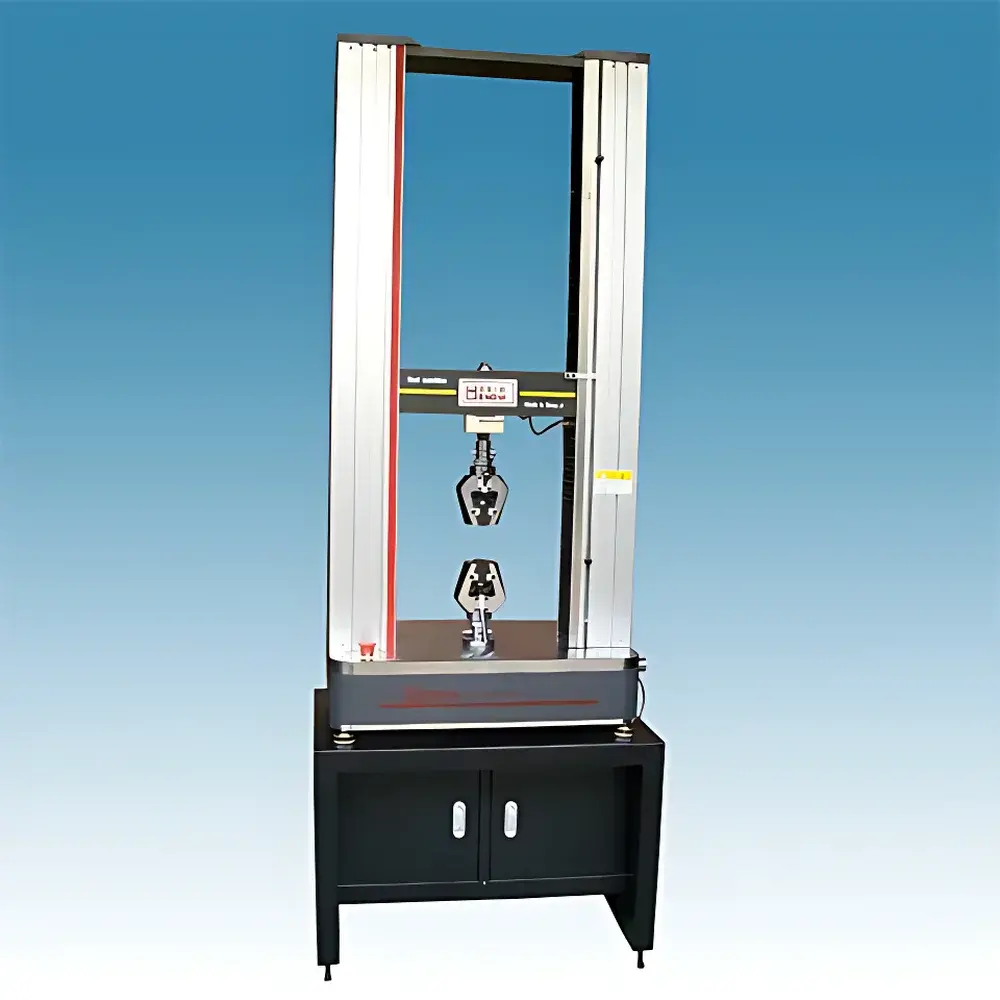
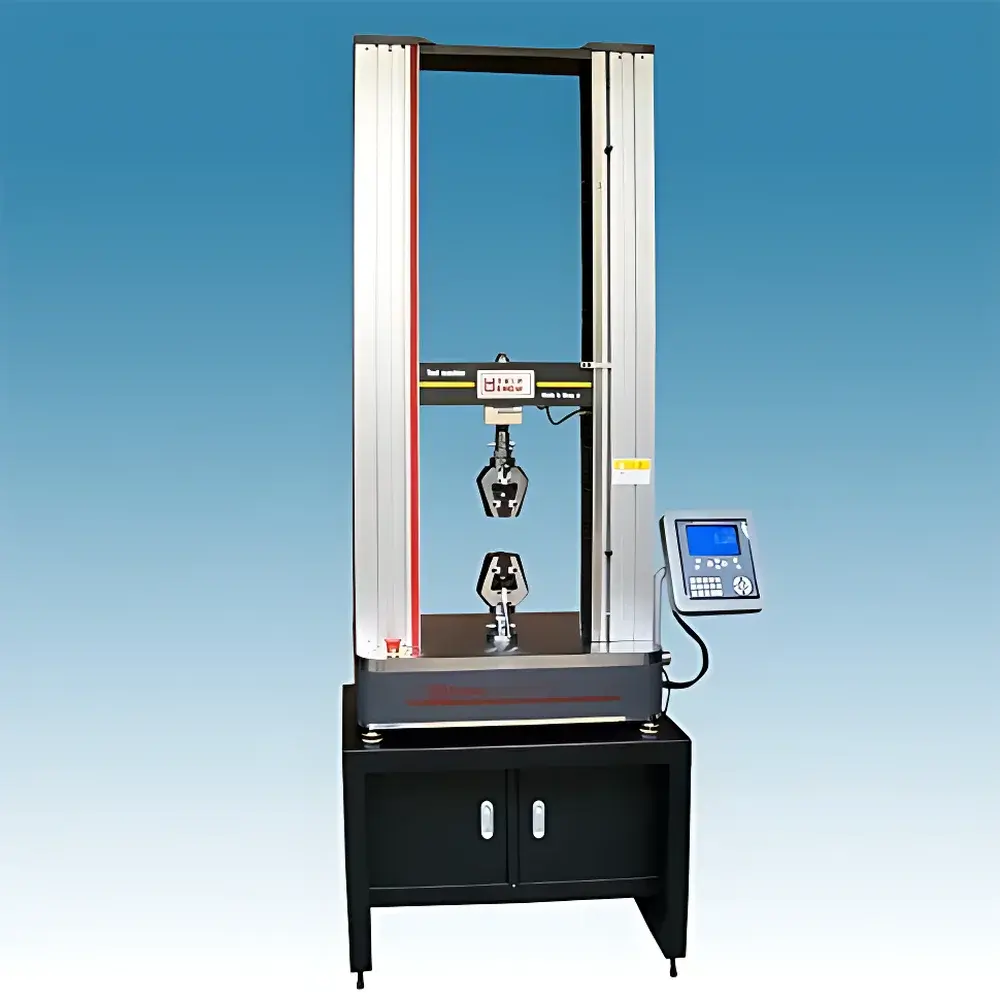
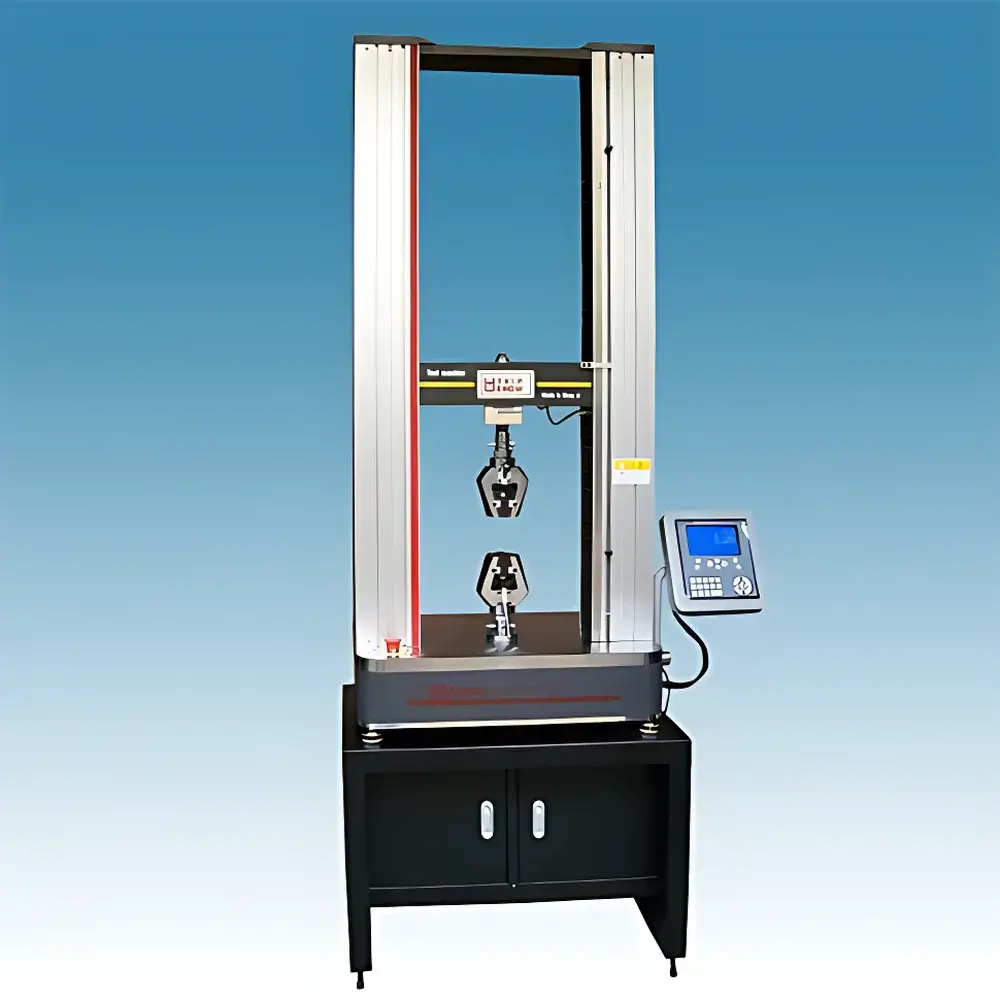
Hengyi HY-3080TC Dual-Column Universal Testing Machine for Flexural Strength Testing of Porous Ceramics
| Brand | Hengyi |
|---|---|
| Origin | Shanghai, China |
| Manufacturer Type | Direct Manufacturer |
| Product Category | Domestic |
| Model | HY-3080TC |
| Instrument Type | Electromechanical Universal Testing Machine |
| Load Capacity Options | 1 N to 30 kN (multi-range configurable) |
| Accuracy Class | ≤0.5% of full scale |
| Effective Test Width | 380 mm (expandable) |
| Effective Stroke | 800 mm (extendable) |
| Speed Range | 0.001–500 mm/min |
| Speed Accuracy | ±0.5% of indicated value |
| Force Resolution | ±500,000 counts (full-scale, no range switching) |
| Displacement & Strain Measurement Accuracy | ±0.5% of indicated value |
| Control Modes | Stress, strain, displacement, and load control |
| Safety Features | Electronic limit protection, overload cutoff (110% FS), auto-diagnostic system |
| Power Supply | 220 V AC, 750 W |
| Dimensions (W×D×H) | 700 × 420 × 1510 mm |
| Weight | 180 kg |
Overview
The Hengyi HY-3080TC is a dual-column electromechanical universal testing machine engineered for high-precision static mechanical characterization of brittle and quasi-brittle materials—specifically optimized for flexural strength evaluation of porous ceramics per ASTM C1161, ISO 14704, and GB/T 6569 standards. Its rigid龙门 (portal) frame architecture ensures minimal deflection under load, critical for maintaining alignment integrity during three-point and four-point bending tests where specimen geometry and support span tolerance directly influence fracture stress calculation accuracy. Unlike hydraulic systems, the HY-3080TC employs a closed-loop servo-controlled drive train with Panasonic AC servo motor and precision preloaded ball screws, delivering consistent velocity fidelity across its full 0.001–500 mm/min range—essential for controlled crack propagation studies and compliance with ISO 527-1 strain-rate requirements in tensile testing of ceramic matrix composites.
Key Features
- High-stiffness dual-column steel frame with optional dual-test-space configuration for simultaneous or sequential axial and transverse loading protocols.
- Panasonic AC servo motor and driver system—maintenance-free, low-noise operation with torque ripple <0.5%, ensuring smooth force ramping during creep or relaxation tests.
- Imported high-accuracy bidirectional load cell (USA-sourced), featuring automatic sensor recognition and thermal drift compensation (<0.02% FS/°C).
- Digital controller supporting SI and imperial units, with multilingual UI (English, German, French, Spanish, Chinese) and both open-loop jog control and closed-loop PID-regulated test profiles.
- Integrated hand-held remote control for rapid setup, emergency stop activation, and manual crosshead positioning without PC dependency.
- Real-time hardware diagnostics continuously monitor drive voltage, current, encoder feedback, and load cell output—triggering immediate fault isolation and safe shutdown upon anomaly detection.
Sample Compatibility & Compliance
The HY-3080TC accommodates a broad spectrum of standardized and non-standard specimens relevant to advanced ceramics R&D and quality assurance. Certified fixtures include ASTM E8/E8M-compliant tensile grips, ISO 12135-compliant compression platens, and three/four-point bending fixtures with adjustable span lengths (25–300 mm) and roller diameters compliant with ISO 14704 Annex A. Validated sample types include sintered alumina, silicon carbide foams, cordierite honeycombs, yttria-stabilized zirconia scaffolds, and bioactive glass-ceramic implants. All mechanical data acquisition meets GLP audit requirements: timestamped raw data files are stored with full metadata (operator ID, calibration certificate ID, environmental conditions), and optional 21 CFR Part 11-compliant software modules provide electronic signatures, audit trails, and role-based access control.
Software & Data Management
The standard Hengyi TestMaster v4.2 software provides real-time force–displacement–strain synchronization at up to 1 kHz sampling rate, with post-processing capabilities including modulus calculation (tangent, secant, chord), yield point identification (0.2% offset method), fracture toughness estimation (KIC via SEPB), and Weibull statistical analysis for strength distribution modeling. Export formats include CSV, XML, PDF reports (with embedded digital signatures), and direct integration with LIMS platforms via OPC UA. Optional add-ons include automated report generation per ISO/IEC 17025 templates, cloud backup with AES-256 encryption, and MATLAB®/Python API for custom algorithm deployment.
Applications
- Flexural strength and modulus determination of porous structural ceramics used in filtration membranes, catalyst supports, and thermal barrier coatings.
- Mechanical screening of additive-manufactured ceramic lattices under monotonic and cyclic bending loads.
- Interfacial adhesion assessment of ceramic–metal brazed joints using peel and shear fixtures.
- Compression testing of lightweight ceramic insulation boards per ASTM C165 and EN 14303.
- Tensile property mapping of thin-film ceramic coatings on metallic substrates using micro-grip assemblies.
- Quality control of dental zirconia blanks per ISO 6872 and ISO 13356, including biaxial flexure (piston-on-three-ball) adaptation.
FAQ
What international standards does the HY-3080TC support for porous ceramic flexural testing?
ASTM C1161 (room-temperature), ISO 14704 (ambient and elevated temperature), and GB/T 6569 (Chinese national standard) — all implemented via preconfigured test methods with automatic parameter validation.
Can the system perform cyclic fatigue testing on ceramic specimens?
Yes — with optional waveform generator module, it supports sinusoidal, triangular, and trapezoidal load/displacement waveforms from 0.01 Hz to 5 Hz, with phase-synchronized strain measurement for S–N curve generation.
Is third-party calibration certification included?
Each unit ships with a factory calibration certificate traceable to CNAS-accredited metrology labs; optional Shanghai Institute of Measurement and Testing Technology (SIMT) certification is available upon request.
How is data integrity ensured for regulatory submissions?
Raw test data is written directly to non-volatile memory with immutable timestamps; audit logs record every user action, parameter change, and calibration event — fully compliant with FDA 21 CFR Part 11 and EU Annex 11 requirements.
What is the lead time for custom fixture design?
Standard bending fixtures ship with the base system; application-specific tooling (e.g., high-temperature furnace integration, vacuum chamber mounting) typically requires 4–6 weeks from drawing approval.



