
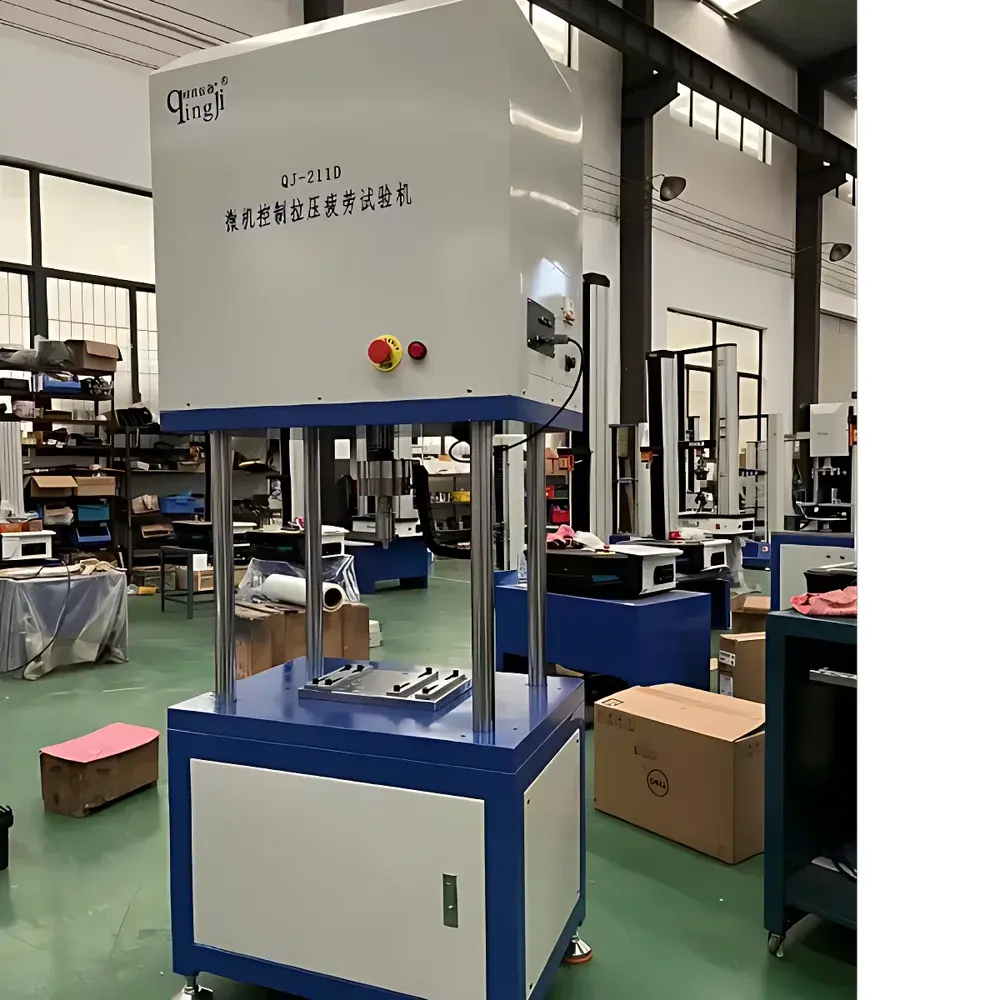
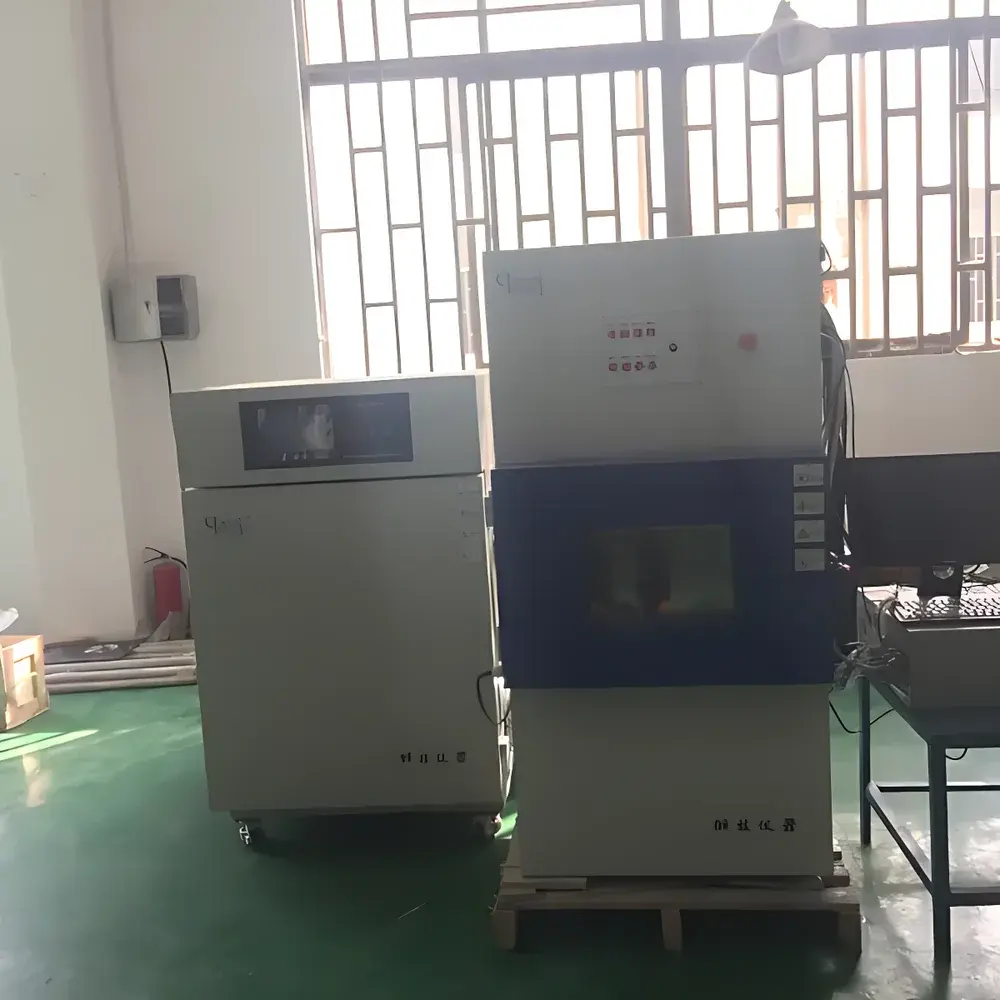
Qinji QJWE543L Tensile Fatigue Testing Machine
| Brand | Qinji |
|---|---|
| Origin | Shanghai, China |
| Model | QJWE543L |
| Maximum Test Load | 30 kN |
| Frequency Range | 0.001–1000 Hz (customizable) |
| Actuator Stroke | ±50 mm (customizable) |
| Load Accuracy | ±1% of reading (2–100% FS) |
| Dynamic Load Ripple | ≤2% |
| Closed-Loop Control Bandwidth | 10 kHz |
| Control Modes | Force, Displacement, and Strain |
| Waveform Options | Sine, Triangle, Square, Sawtooth, Half-Sine, Half-Triangle, Random, and External Input |
| Host Weight | 1200 kg or 6600 kg (depending on configuration) |
| Compliance | ISO 12107, ASTM E466, ASTM E606, ISO 1099 |
Overview
The Qinji QJWE543L Tensile Fatigue Testing Machine is a high-performance electro-hydraulic servo fatigue system engineered for precise, repeatable evaluation of material and component endurance under cyclic uniaxial tensile-compressive loading. Operating on the principle of controlled servo-hydraulic actuation, the system applies programmable dynamic loads to specimens while maintaining strict fidelity to user-defined waveforms and boundary conditions. Its architecture supports both high-cycle fatigue (HCF) and low-cycle fatigue (LCF) regimes, enabling rigorous assessment of crack initiation, propagation kinetics, and life prediction in metallic alloys, composites, polymers, and structural weldments. Designed for integration into R&D laboratories, quality control environments, and certification testing facilities, the QJWE543L meets foundational requirements for mechanical integrity validation in aerospace, automotive, energy, and biomedical device development.
Key Features
- Robust dual-load-frame design available in two configurations—compact (1200 kg) and heavy-duty (6600 kg)—to accommodate varying specimen dimensions, test rigidity demands, and facility floor-loading constraints.
- Full-digital hydraulic servo controller with 10 kHz closed-loop update rate, supporting seamless switching among force, displacement, and strain control modes without signal discontinuity or phase lag.
- Wide operational frequency range from 0.001 Hz to 1000 Hz, with 0.001 Hz frequency resolution, enabling quasi-static creep-fatigue coupling studies as well as ultrasonic-assisted fatigue investigations.
- High-fidelity waveform generation including sine, triangle, square, sawtooth, half-cycle variants, and arbitrary user-defined profiles imported via CSV or real-time analog input.
- Load measurement accuracy of ±1% across 2–100% of full scale (30 kN), verified per ISO 7500-1 Class 1 criteria; dynamic load ripple maintained at ≤2% RMS under steady-state cycling.
- Modular extensometer and clip-on strain gauge interfaces compliant with ASTM E83 Class B-1 specifications, supporting simultaneous multi-channel data acquisition.
Sample Compatibility & Compliance
The QJWE543L accommodates standardized tensile specimens (e.g., ASTM E8/E647, ISO 6892-1, ISO 1099) as well as custom geometries up to 300 mm gauge length and 50 mm cross-section width. Gripping systems include pneumatic wedge grips, hydraulic self-tightening jaws, and high-temperature furnace-compatible fixtures (optional). The system conforms to international fatigue testing standards including ISO 12107 (fatigue testing — statistical planning and analysis of data), ASTM E466 (conducting force-controlled constant amplitude axial fatigue tests), ASTM E606 (strain-controlled fatigue testing), and ISO 1099 (metallic materials — fatigue testing — axial force-controlled method). When configured with audit-trail-enabled software and electronic signature modules, it supports GLP/GMP-aligned workflows and FDA 21 CFR Part 11 compliance for regulated industries.
Software & Data Management
The system operates under Qinji’s proprietary TestMaster-Fatigue software platform, a Windows-based application featuring real-time plotting, automated test sequencing, event-triggered data logging, and post-test S–N curve generation. All raw channel data—including load, displacement, strain, temperature (with optional sensors), and acoustic emission (when interfaced)—are stored in HDF5 format with embedded metadata (test ID, operator, calibration timestamp, environmental conditions). Software includes built-in tools for rainflow cycle counting (per ASTM E1049), crack growth rate (da/dN) calculation using Paris law fitting, and Weibull-based reliability analysis. Export options include CSV, MATLAB .mat, and universal MDF4 for third-party CAE integration (e.g., nCode DesignLife, FE-SAFE).
Applications
- Characterization of fatigue threshold (ΔKth) and crack growth behavior in turbine disk alloys under variable-amplitude loading.
- Evaluation of solder joint reliability and interfacial delamination in flexible printed circuit boards subjected to thermal-mechanical cycling.
- Validation of additive-manufactured Ti-6Al-4V lattice structures per ASTM F3303, including notch sensitivity and surface roughness effects on fatigue life.
- Accelerated life testing of orthopedic implant fixation screws under physiological loading spectra derived from gait analysis.
- Correlation of microstructural features (grain size, precipitate distribution) with fatigue crack nucleation sites using in-situ SEM-compatible load frames (optional upgrade).
FAQ
What standards does the QJWE543L support for fatigue data reporting?
It supports output formatting aligned with ASTM E739, ISO 12107 Annex C, and SAE JA1161 for tabulated life data, scatter band estimation, and probabilistic life modeling.
Can the system perform push-pull testing with thermal cycling?
Yes—when integrated with a programmable environmental chamber (−70°C to +300°C) and synchronized thermal profiling, it enables thermo-mechanical fatigue (TMF) testing per ASTM E2368.
Is remote monitoring and diagnostic capability available?
The controller includes Ethernet/IP and Modbus TCP interfaces; optional cloud telemetry module enables secure remote access, predictive maintenance alerts, and firmware-over-the-air updates.
How is traceability ensured for calibration and test records?
Each test file embeds digital signatures, hardware serial numbers, sensor calibration certificates (traceable to NIM, China), and time-stamped audit logs meeting ISO/IEC 17025 documentation requirements.
Does the system support closed-loop strain control using video extensometry?
Yes—via optional DIC (Digital Image Correlation) interface compatible with commercial systems such as LaVision STRAINMASTER or Correlated Solutions VIC-2D, enabling non-contact, full-field strain mapping during fatigue cycling.



