
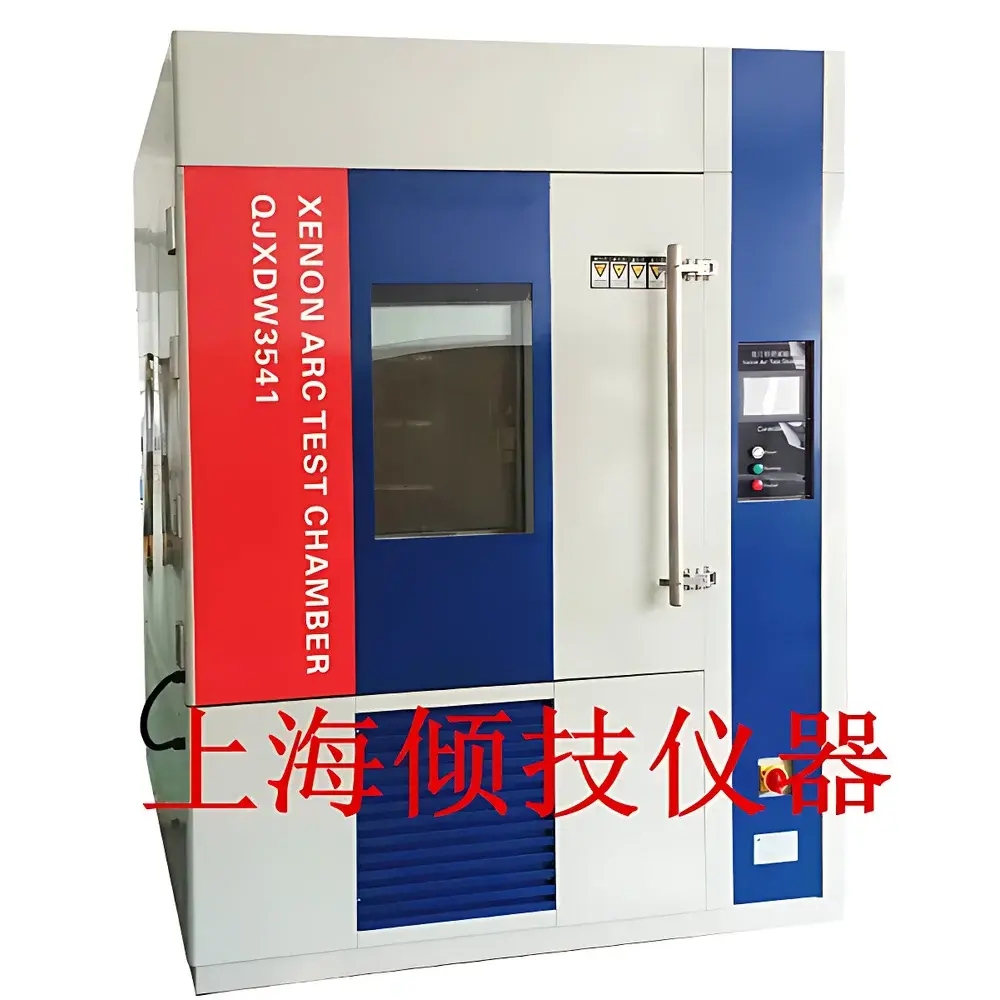
QJXDW Automotive Glass Weathering Test Chamber
| (Origin | Shanghai, China |
|---|---|
| Manufacturer Type | Authorized Distributor |
| Origin Category | Domestic (China-made) |
| Model | QJXDW |
| Price | USD 7,000 approx.) |
Overview
The QJXDW Automotive Glass Weathering Test Chamber is an engineered environmental simulation system designed to accelerate the evaluation of material degradation under controlled, repeatable conditions mimicking real-world outdoor exposure. It operates on the principle of xenon-arc irradiation combined with cyclic thermal and hygrothermal stress—precisely replicating the synergistic effects of solar UV/visible radiation (290–800 nm), elevated temperature (RT+10°C to 80°C), and moisture ingress via condensation and programmed rainfall. This methodology aligns with internationally recognized accelerated weathering standards including ISO 4892-2, ASTM G155, SAE J2527, and ISO 11341, enabling laboratories and R&D centers to generate predictive durability data for automotive glazing systems—including laminated safety glass, tempered glass, and coated or hydrophobic-treated substrates—within days rather than years.
Key Features
- Xenon-arc light source delivering calibrated spectral irradiance (300–800 nm) at 550 W/m², traceable to NIST-referenced radiometric calibration protocols
- Precise dual-mode cooling architecture: 3 kW forced-air cooling for lamp stabilization and 4.5 kW water-cooled heat dissipation, ensuring stable spectral output over extended test cycles
- Intelligent digital PID temperature control with ±1°C accuracy and ≤2°C uniformity across the test chamber volume (500 × 500 × 600 mm internal dimensions)
- Motor-driven rotating sample carousel (5 rpm) with concentric inner/outer radii (100 mm / 220 mm) and fixed center-to-center distance (165 mm), accommodating standard automotive glass specimens up to 420 mm in height
- Programmable wet/dry cycling: rainfall duration (0–9999 min) and interval (0–240 min) independently adjustable to simulate dew formation, rain events, and drying phases
- Real-time monitoring of irradiance intensity and integrated radiant exposure (W·h/m²), displayed digitally with data logging capability
Sample Compatibility & Compliance
The QJXDW chamber accommodates flat and slightly curved automotive glass specimens—typically 300 × 300 mm to 500 × 500 mm—mounted on a standardized planar sample tray or custom fixture. Its design supports testing per OEM specifications (e.g., Ford CETP 00.00-L-467, GMW 14124, VW TL 226) and global regulatory frameworks including ECE R43, UN Regulation No. 43, and ISO 3537. All operational parameters—including irradiance setpoints, temperature ramps, and humidity profiles—are fully configurable to meet GLP-compliant test protocols. The system supports audit-ready documentation when paired with validated software (see below), satisfying requirements for ISO/IEC 17025-accredited laboratories and FDA 21 CFR Part 11–aligned workflows where electronic records are required.
Software & Data Management
While the base unit features standalone digital control, optional PC-based software enables full test sequence programming, real-time parameter visualization, automated data export (CSV/Excel), and long-term trend analysis. The software architecture supports user-defined test profiles, alarm thresholds, and event-triggered notifications. All measurement logs—including irradiance accumulation, chamber temperature history, and rainfall timing—include timestamps and operator ID fields, supporting traceability and compliance with ISO 17025 Clause 7.7 (Results Reporting) and GMP Annex 11 principles. Calibration certificates for the radiometer and temperature sensors are provided with initial commissioning and recommended annually.
Applications
- Evaluation of interlayer yellowing resistance in PVB- and ionomer-laminated windshields under UV/thermal stress
- Assessment of edge seal integrity and delamination onset in insulated glazing units (IGUs) exposed to thermal cycling + moisture
- Validation of anti-fog, hydrophobic, and IR-reflective coatings against photodegradation and adhesion loss
- Comparative lifetime modeling of alternative glass compositions (e.g., alkali-free borosilicates) versus conventional soda-lime substrates
- Supporting root-cause analysis during field failure investigations by correlating lab-induced defects (e.g., micro-cracking, haze development, interfacial debonding) with service history data
FAQ
What standards does the QJXDW chamber comply with?
It is configured to meet core requirements of ISO 4892-2, ASTM G155, SAE J2527, and OEM-specific automotive glazing test specifications.
Is radiometric calibration included with delivery?
Yes—a factory calibration report for the broadband radiometer (300–800 nm) and thermocouple array is supplied; annual recalibration is recommended.
Can the chamber accommodate curved windshield samples?
Standard configuration supports flat or low-curvature specimens; custom fixtures for high-dome windshields are available upon request and dimensional specification.
What maintenance is required for the xenon lamp system?
Lamp replacement is advised every ~2,000 operating hours; air filters, water-cooling lines, and quartz envelope cleaning should be performed per the scheduled maintenance log.
Is remote monitoring supported?
Optional Ethernet-enabled controller modules allow secure web-based access to status, alarms, and real-time sensor values via authenticated login.
Related Products



