
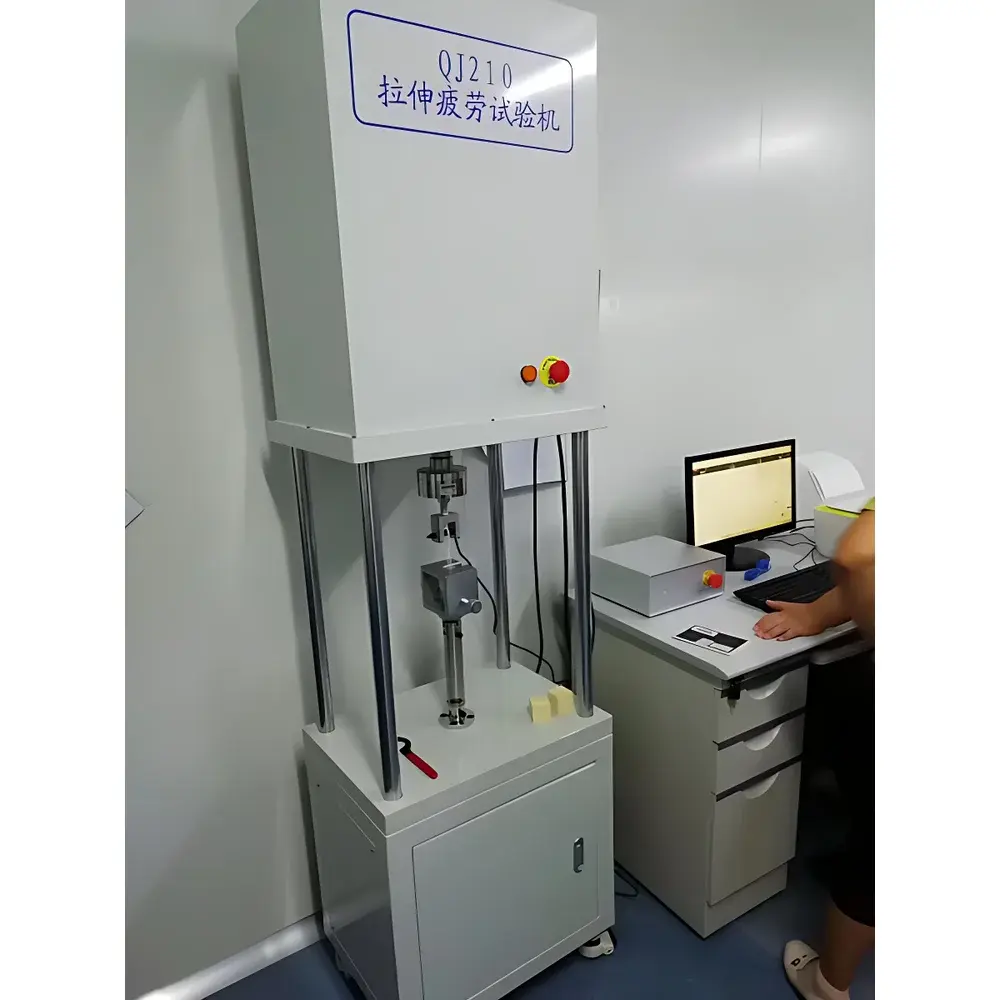
QJPL-10KN Spring Fatigue Testing Machine by Qingji
| Brand | Qingji |
|---|---|
| Origin | Shanghai, China |
| Model | QJPL-10KN |
| Maximum Test Force | 10 kN |
| Frequency Range | 0.001–100 Hz |
| Actuator Stroke | 50 mm (adjustable) |
| Effective Test Width | 60 mm |
| Max Spring Outer Diameter | ≤60 mm |
| Max Free Length | ≤240 mm |
| Amplitude Range | 0.001–50 mm |
| Load Accuracy Class | 0.5 |
| Load Measurement Range | 0.2–100% of full scale |
| Load Resolution | 1/30,000 (dynamic, 10 kHz sampling) |
| Displacement Measurement Accuracy | ±0.002 mm |
| Deformation Measurement Accuracy | ±1% of reading |
| Safety Features | Overload protection (10% above capacity), mechanical limit switches, programmable return-to-start |
| Power Supply | 220 V AC, 2 kW |
| Host Weight | ≈850 kg |
| Software | Dedicated fatigue test control & data acquisition suite with audit trail capability |
| Compliance | Designed to support ISO 527, ISO 10215, ASTM E466, and GB/T 2611 test protocols |
Overview
The QJPL-10KN Spring Fatigue Testing Machine is an electromechanically actuated high-frequency fatigue testing system engineered for precise, repeatable evaluation of axial cyclic performance in metallic elastic components. It operates on the principle of controlled sinusoidal or programmed displacement-driven loading, applying dynamic tensile, compressive, or combined axial loads to springs under defined amplitude, frequency, and waveform conditions. The system is configured for continuous-duty operation across a broad frequency spectrum—from ultra-low-cycle quasi-static regimes (0.001 Hz) up to high-frequency resonance-capable excitation (100 Hz)—enabling simulation of real-world service environments such as automotive clutch engagement cycles, suspension rebound events, and industrial actuator duty profiles. Its rigid C-frame architecture, integrated high-resolution load cell, and closed-loop servo-controlled actuator ensure stable force fidelity and minimal phase lag across the operational envelope.
Key Features
- High-fidelity load measurement with 0.5 accuracy class and 1/30,000 dynamic resolution at 10 kHz sampling rate—ensuring traceable force quantification throughout the full 0.2–100% range without range switching.
- Programmable stroke control with ±0.002 mm displacement resolution and adjustable actuator travel (0–50 mm), enabling precise amplitude definition for both low-strain endurance tests and high-deformation fatigue mapping.
- Dual-speed test table operation (fast approach/slow testing), manual point-control capability, and automatic return-to-initial-position function—enhancing operator safety and procedural repeatability.
- Integrated mechanical limit protection, electronic overload cutoff (triggered at 110% of 10 kN nominal capacity), and software-enforced parameter boundaries—meeting essential functional safety requirements per IEC 61508 SIL1 baseline.
- Modular fixture interface supporting custom-designed compression, tension, and combined-mode spring holders—including multi-specimen configurations (2-, 3-, 5-, or 6-channel parallel testing) for accelerated statistical life analysis.
Sample Compatibility & Compliance
The QJPL-10KN accommodates cylindrical helical springs with outer diameters up to 60 mm and free lengths within 240 mm—covering common OEM specifications for valve springs, brake return springs, seatbelt pretensioners, and HVAC damper actuators. Fixture geometry is configurable per customer-provided spring dimensions, ensuring optimal load alignment and minimizing bending moments during cycling. The system supports compliance with internationally recognized fatigue testing standards including ASTM E466 (constant-amplitude axial fatigue testing), ISO 10215 (metallic spring testing methods), and GB/T 2611 (general requirements for testing machines). Its hardware architecture and firmware design facilitate integration into GLP- and GMP-regulated environments, with optional configuration for FDA 21 CFR Part 11-compliant electronic signatures and audit-trail-enabled data logging.
Software & Data Management
The included fatigue test control software provides real-time monitoring of force, displacement, cycle count, and accumulated damage metrics. Users define test profiles via intuitive waveform editors—supporting sine, triangle, trapezoidal, and user-defined arbitrary waveforms—and configure pass/fail criteria based on stiffness degradation, permanent set, or cycle-dependent hysteresis drift. All raw and processed data are stored in timestamped, structured binary archives with metadata embedding (operator ID, calibration status, environmental conditions). Export options include CSV, XML, and PDF report generation with embedded traceability fields. Backup media (DVD-ROM) ensures long-term archival integrity; software licensing permits installation on up to two authorized workstations for redundancy and cross-validation.
Applications
This system serves critical roles in quality assurance laboratories of Tier-1 automotive suppliers evaluating clutch diaphragm spring durability under thermal-cycled loading; R&D departments at precision spring manufacturers conducting Weibull-based life distribution modeling for aerospace-grade Inconel 718 coil springs; and academic materials science groups investigating microstructural fatigue crack initiation thresholds in cold-wound stainless steel wire. Additional use cases include validation of ISO 10215-compliant batch release testing for medical device torsion springs, comparative analysis of surface-treated vs. bare spring fatigue resistance, and accelerated aging studies correlating vibration spectra with functional failure modes.
FAQ
What types of springs can be tested on the QJPL-10KN?
Helical compression, tension, torsion, and gas springs—provided outer diameter ≤60 mm and free length ≤240 mm. Custom fixtures extend compatibility to non-standard geometries.
Does the system support multi-specimen testing?
Yes—fixtures for simultaneous testing of 2, 3, 5, or 6 identical springs are available, enabling statistically robust S-N curve derivation with reduced test duration.
Is the software compliant with regulatory data integrity requirements?
The base software includes audit trail functionality; optional upgrade enables 21 CFR Part 11 compliance with role-based access control, electronic signatures, and immutable record retention.
What maintenance is required during the warranty period?
No scheduled preventive maintenance is required within the first year; annual calibration verification using NIST-traceable reference standards is recommended post-warranty.
Can the machine be integrated into an existing MES or LIMS environment?
Yes—via TCP/IP-based API (RESTful endpoints and Modbus TCP support) for bidirectional data exchange with enterprise laboratory systems.



